
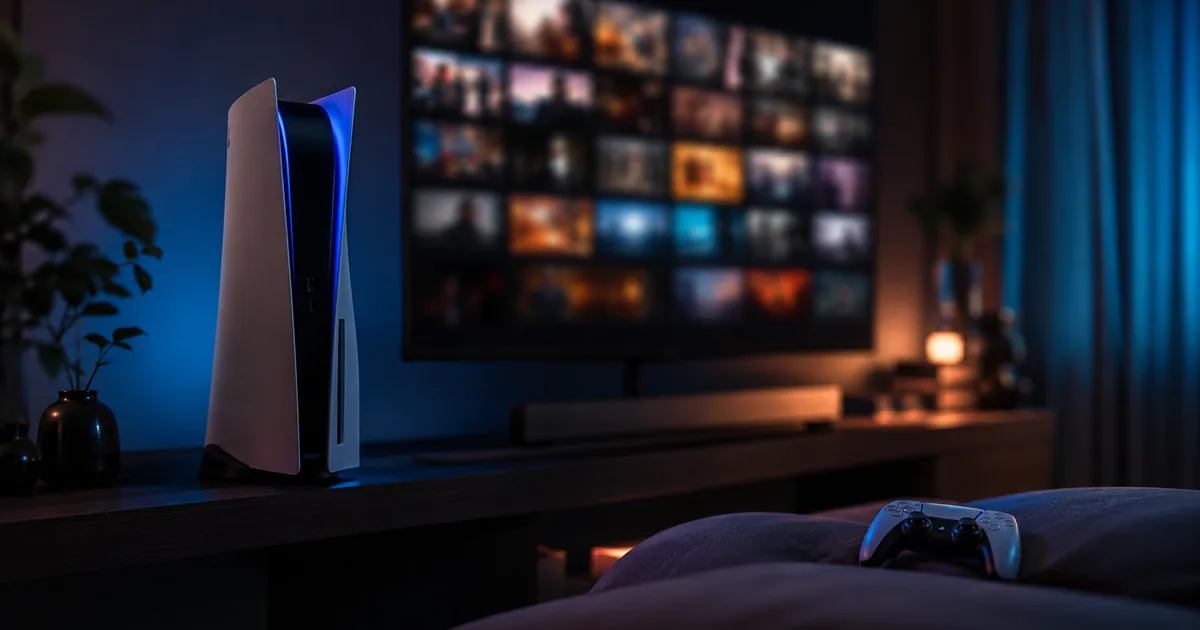
Sony switched on Live TV on PS5 on Monday, dropping more than a hundred free ad-supported channels into the Media row of every PlayStation 5 in the United States. The coverage has been busy counting the channels. Almost nobody has counted what Sony gets.
Here is the thing that separates this from Pluto, Tubi, Roku Channel and the rest of the free-TV pile, and it is missing from essentially every writeup: you cannot watch it without signing in. Sony’s own launch post says players “sign in with their PlayStation Account” to start. That account is not a throwaway email. It is attached to your purchase history, your friends list, your trophy record and your playtime down to the minute. No other free-TV operator in the American market has that. Roku knows a household. Sony knows a person.
What Sony Told Advertisers
The trade press got a much clearer version of this than the consumer press did.
Variety reported that the appeal to advertisers is access to a logged-in audience that skews younger and is hard to reach through broadcast or general streaming apps, and that the play for Sony is keeping the console in use between games so idle screen time converts into ad revenue. That is an honest description of the product. It is also not the description on the box.
The ad plumbing is already contracted out. Sony is working with Publica and PubMatic, two firms whose entire business is connected-TV ad delivery and measurement. The content partners are real and expensive: ABC News, ESPN, Fox, NBCUniversal, A+E, AMC, Lionsgate, Amazon MGM Studios, the NFL Channel, NASCAR, UFC and Crunchyroll, with a back catalogue running from “Community” and “The Shield” to “Forensic Files” and “Ice Road Truckers.” TheWrap noted the whole thing sits under Sony Pictures Television.
Nobody assembles that lineup, integrates two ad-tech vendors and ships it to tens of millions of consoles as a favour.
There is a second, quieter piece of business logic here that the launch coverage skipped. Sony Pictures Television owns a deep library that is worth very little sitting on a shelf and quite a lot running as a channel with ads in it. Routing that catalogue through hardware Sony already sold means the company collects the ad revenue without paying a distributor, a carriage fee or a platform tax to Roku, Amazon or Google. Forbes noted the scale of the channel rollout; the more interesting number is the one Sony now keeps in full.
The Setting Sony Did Not Mention
There is a toggle. It is not where a normal person would find it.
To stop Sony serving ads based on your console activity, you go to Settings, then Users and Accounts, then Privacy, then Data You Provide, and switch off Personalized Advertising. That is four levels deep, in a menu tree most PS5 owners open once to change a password, and it predates this launch by years. The sign-in screen for Live TV does not walk you there.
So the actual offer, stated plainly, is this:
- You already paid roughly $500 for the hardware.
- Sony is now selling the attention of the device you own.
- The targeting runs on an identity you were required to create to play games online.
- The opt-out exists, is real, and is buried.
Where LNC Stands
We do not think a free ad-supported channel bundle is a scandal. Ad-funded television is older than most of the people who will watch it, and 100 channels of free content on a console people already own is a genuinely decent deal for anyone happy to trade attention for entertainment. Tom’s Guide is right that as a Pluto competitor it is a solid product.
The problem is the disclosure, and it is Sony’s to fix. When you tap that icon and hit the sign-in prompt, the screen should say in one sentence that watching connects your viewing history to the PlayStation account holding your purchases and playtime, and it should put the Personalized Advertising switch right there rather than four menus away. That is not a heavy lift. Sony built a whole ad stack in a few months; a consent screen is an afternoon.
There is a wider point about who the PS5 belongs to now. A console is not a free ad-supported TV that someone gave you. It is a piece of hardware you bought outright, and Sony has spent the last several years steadily converting its home screen into leased advertising real estate, from store promos to the dedicated Live TV page it now maintains. Each individual step is small and defensible. The direction of travel is not.
Canada is next, and Sony has said it is looking at other regions. When it reaches the European Union, the consent question stops being a matter of Sony’s judgment and becomes a matter of law, because tying ad personalisation to a mandatory account is precisely the arrangement the GDPR was written to interrogate. It would be cheaper for Sony to build the honest version of that screen once, now, for everybody.