
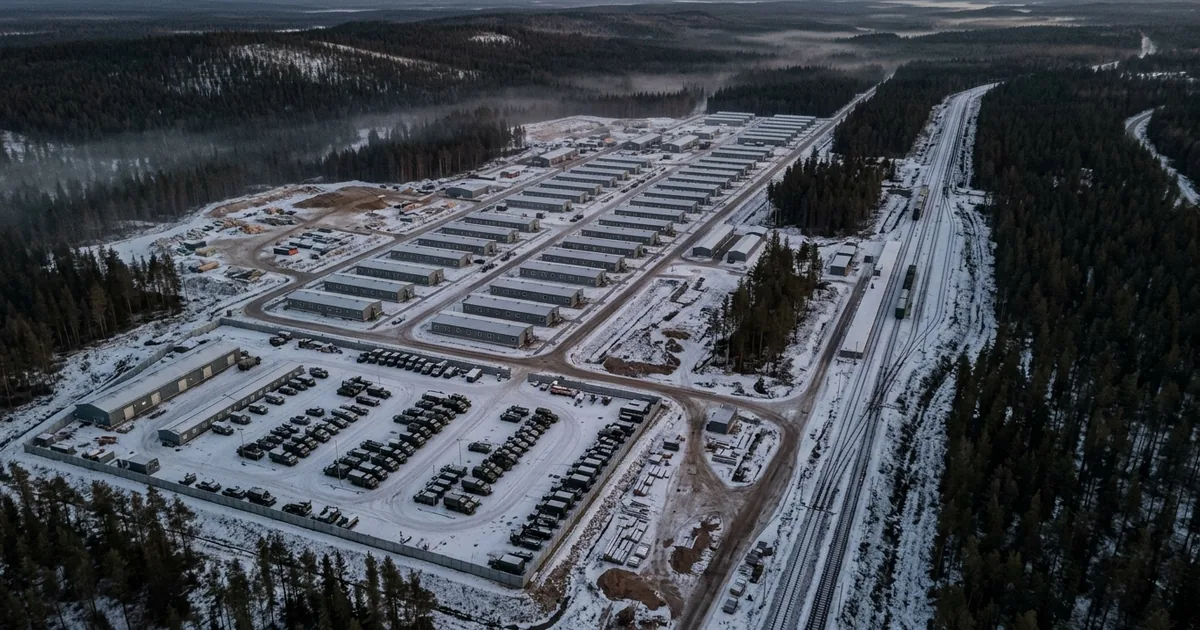
Satellite images released this week show rows of fresh barracks, motor pools, and rail sidings spreading along Russia’s western frontier, with enough capacity to house roughly 115,000 troops within reach of NATO’s border.
The concrete is real and the rail lines are new, but the soldiers are mostly somewhere else, and that gap is the most important thing to understand about the threat.
What the Satellites Actually Show
A joint investigation by four Nordic broadcasters, Norway’s NRK, Sweden’s SVT, Denmark’s DR, and Estonia’s Delfi, pieced the picture together from commercial satellite imagery and NASA nighttime-light data. At 16 of the 19 sites the reporters tracked, the lights have gotten brighter over the past year, the signature of construction crews, new housing, and bases coming back to life after the units that once filled them were shipped south to fight in Ukraine.
The standout is Finland. Lieutenant General Pasi Valimaki, commander of the Finnish Army, told the investigators that Russia is laying the groundwork to station as many as 80,000 troops along the Finnish border, up from about 20,000 before the invasion. In the Pechenga district near the Norwegian border, the complex now under construction could hold up to 17,000 personnel. Marko Eklund, a former Finnish intelligence officer, described it as two to three times what was there before.
What makes the reporting hard to wave away is the method. This is not a leaked intelligence assessment that Moscow can brush off as Western propaganda. It is commercial imagery anyone can buy and public NASA data anyone can check, read by reporters rather than spies. When four national broadcasters from four different countries independently land on the same map, the Kremlin’s usual move, calling it a fabrication, gets much harder to sell.
The Number That Matters Isn’t 115,000. It’s Zero.
Here is the part the alarming headlines tend to skip. Most of those new garrisons are empty. The men who would fill them are fighting and dying in Ukraine, and until that war winds down, Russia simply does not have the manpower to occupy what it is building. Brian Nissen, the NATO commander responsible for the Baltic states and Poland, put it plainly to the same investigation: the risk of direct conflict with the alliance stays low for as long as Russia is pinned down in Ukraine.
So the threat is real, but it is a threat of capacity, not deployment. Moscow is building the holster. The open question is when, and whether, it loads the weapon.
That distinction matters because it changes what the West should be watching. Counting troops at the border today understates the danger, because the danger is designed to arrive later. Dismissing empty barracks as a bluff overstates today’s safety, because the buildings are a statement of intent measured in years, not theater measured in weeks.
A Ceasefire Could Start the Clock
The uncomfortable twist is that the event most of the world wants, an end to the war in Ukraine, is the same event that would free Russia to fill these bases. Nearly every official quoted in the investigation circles the same hinge point: a ceasefire. The day the shooting in Ukraine stops, the clock on Russia’s northern rearmament starts running at full speed.
We have already watched how fragile those off-ramps are. When the three-day truce brokered earlier this spring buckled on its second day, it showed how little either side trusts a pause to hold. A durable settlement would be a relief for Ukraine and a real humanitarian gain. It would also hand Vladimir Putin back the divisions he has spent two years grinding down, and those divisions have to go somewhere. The barracks rising in Karelia and Murmansk are a fairly clear answer to where.
That is the strategic trap Europe is staring at. Pushing hard for peace in Ukraine is the right thing to do and may also speed up the next confrontation. Pretending those two facts cancel each other out is how you sleepwalk into being unready for both.
What NATO Is Building Back
The alliance is not standing still. On June 6, NATO formally stood up Forward Land Forces Finland, a new multinational presence in Lapland, with Sweden as the framework nation. The core is a Swedish battlegroup based in Boden, roughly 600 personnel that can scale to 1,200, backed by a multinational staff in Rovaniemi and answerable to NATO’s Supreme Allied Commander Europe. France, the United Kingdom, Norway, Denmark, Iceland, and Italy have signed on to help grow it toward brigade strength.
It is a meaningful signal and a modest force. Six hundred soldiers, even twelve hundred, are a tripwire, not a wall. The bet is the same one NATO has made along its whole eastern edge: a small allied presence that turns any Russian move into an attack on the entire alliance, not just one nervous neighbor. Farther south, Lithuanian intelligence has spent months warning that Russia is expanding brigades into divisions and standing up new units across the eastern flank, from Kaliningrad outward. Finland’s new barracks are the northern chapter of a buildup that runs the length of the border.
The Readiness Gap Is the Real Story
Strip away the satellite drama and what is left is a question about democracies under time pressure. Russia can order a garrison built and conscripts sent north by decree. NATO’s members have to pass budgets, win elections, hold coalitions together, and convince taxpayers that a threat measured in years deserves money spent now. That is democracy working as designed, and it is also slower than autocracy by design.
The complication sitting over all of it is Washington. With the United States signaling it wants to thin its troop presence in Europe and lean on allies to carry more of the load, the northern flank is being rebuilt at the exact moment the alliance’s anchor power is asking to step back. Europe is being told to spend more on defense by the same partner whose own commitment is starting to look conditional. Helsinki and Stockholm are reading that subtext clearly, which is part of why they are moving first.
The planners are blunt about the window. The next one to three years, they argue, are the dangerous stretch, the gap between Russia rebuilding faster than expected and Europe rearming slower than it promised. The barracks going up near the Finnish border are not a prediction that war is coming. They are a calendar, and the West is being shown, politely and in satellite resolution, how much time it has left to get ready.
Empty buildings are easy to ignore. That is exactly what makes them worth watching.