
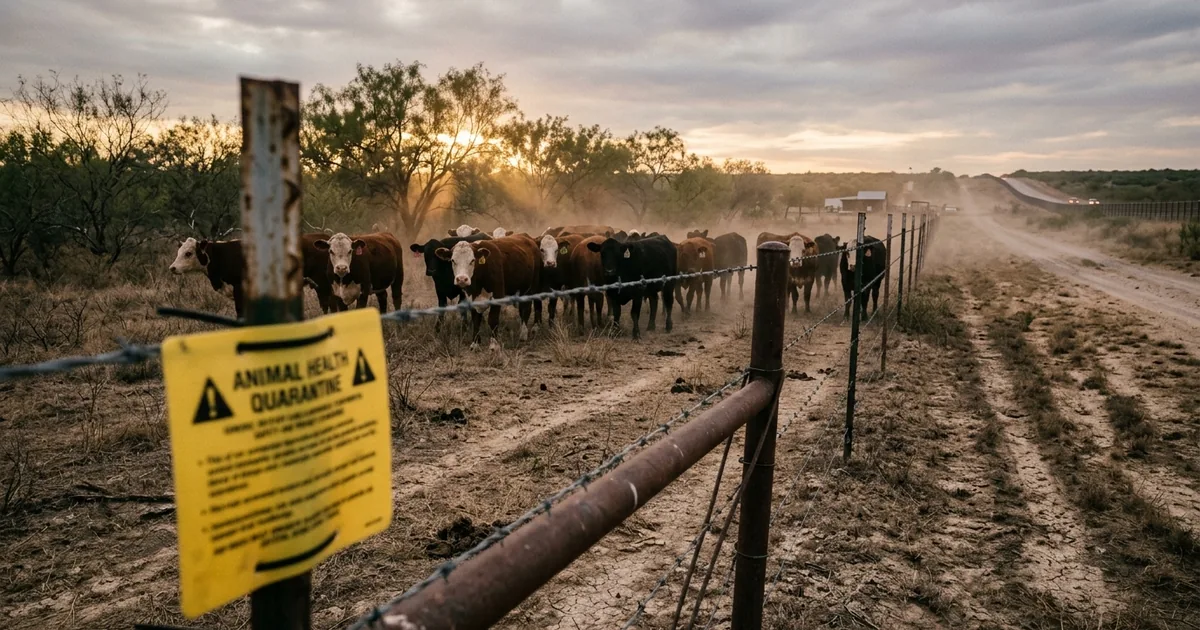
A flesh-eating parasite the United States spent decades and a fortune wiping out is back on American soil. The New World screwworm reached Texas in June, and it did not sneak across the border so much as walk through a door that Washington’s war on science left standing wide open.
On June 3, the U.S. Department of Agriculture confirmed the first domestic screwworm case in generations, a three-week-old calf in La Pryor, deep in South Texas. Within days the infestation surfaced in three more Texas counties and across the line in Lea County, New Mexico. This is not a metaphor. The female fly lays her eggs in an open wound, and the larvae burrow into living flesh, widening the wound so more flies can feed. America eradicated this thing in 1966 with one of the great public-health victories of the twentieth century. We are now watching it come back, in real time, because the people running the government decided the science that held it off was a line item they could delete.
What Is Actually in Texas Right Now
The screwworm is not new to the hemisphere. It has been marching north since 2023, chewing through Panama, up through Central America, into Mexico by 2024, and now over the Rio Grande. Texas Agriculture Commissioner Sid Miller noted the parasite has traveled more than 1,100 miles from southern Mexico to reach his state, and called the slow federal response “the most frustrating thing I’ve run up against in my 12 years as Ag Commissioner.”
The human stakes are no longer hypothetical. Federal health officials confirmed the country’s first human screwworm case last August, a Maryland resident who picked up the infection while traveling in El Salvador and later recovered. That case was imported, not locally acquired, and no person has yet caught it on American ground. But the math is simple: once the fly establishes itself in livestock, pets, and wildlife, the distance between a calf in Zavala County and a child in a border town shrinks fast. A livestock problem becomes a human-medicine problem, and human medicine is the federal portfolio of one Robert F. Kennedy Jr.
The Tripwire Washington Switched Off
Here is the part the administration would prefer you skip. In early 2025, Elon Musk’s Department of Government Efficiency took a chainsaw to the U.S. Agency for International Development, and among the programs that went into the shredder was the one monitoring and containing New World screwworm in Central America. The cut, first detailed by Agri-Pulse, was part of a broader purge of more than 100 U.S.-funded United Nations Food and Agriculture Organization programs worth roughly $382 million, money that had bankrolled 180-plus outbreak investigations across 22 countries and built out more than 160 testing labs.
The timing is the indictment. DOGE switched off the early-warning system in the same stretch of 2025 that the administration was reopening the southern border to Mexican cattle. Representative Shri Thanedar put it bluntly, saying the administration “GUTTED funding for screwworm detection and fired 25 percent of workers whose job it was to monitor the disease.” Over at USDA, the Animal and Plant Health Inspection Service shed roughly 1,300 employees last year. You do not rip out the smoke detectors and lay off a quarter of the fire department in the same season you prop the door open, unless you have decided that expertise itself is the enemy.
The Blame Game, and the Honest Accounting
Predictably, the people who cut the program are now pointing everywhere but at themselves. USDA Secretary Brooke Rollins has blamed the Biden administration for letting the parasite cross the Darién Gap, and Senator Roger Marshall floated the idea that migrants carried it north, a claim Newsweek noted has no evidence behind it. A USDA spokesperson insisted “there were no cuts to any staff used on the response to this issue.”
Give the honest version its due: the screwworm did begin its northward push in 2023, on Biden’s watch, and that is a fair thing to note. But the parasite was already moving when this administration took the early-warning network offline, and a containment program is most valuable precisely when a threat is on the move. The USDA denial is a dodge dressed as a rebuttal. The cut that mattered was not to some domestic “response” team that did not yet exist; it was to the Central American surveillance program that was supposed to spot the outbreak while it was still hundreds of miles away. You cannot defund the watchtower and then claim the guards are all still on the wall.
Why RFK Jr.’s Name Belongs on This
Kennedy did not personally sign the screwworm cut. DOGE did, and containment lives at USDA under Rollins, not at Health and Human Services. So why put the Health Secretary’s name on a flesh-eating fly?
Because RFK Jr. is the loudest, most visible avatar of the single governing theory that produced all of this: that scientific institutions are bloat, that expert consensus is a conspiracy, and that surveillance you cannot see the point of is waste. This is the same secretary who fired all 17 members of the CDC’s vaccine advisory committee in June 2025 and stocked the replacements with vaccine skeptics, a move the Infectious Diseases Society of America called “reckless, shortsighted and severely harmful.” It is the same secretary who presided over billions in NIH research cuts and the cancellation of half a billion dollars in mRNA vaccine contracts. He spent his first year tightening his grip on a CDC in freefall, the very agency that tracks human screwworm infection.
And now, with a parasite establishing itself and the first human case already on the books, the man whose job is to protect human health has reportedly gone missing. A New York Times investigation, summarized across multiple outlets, described Kennedy as “checked out,” rarely visiting headquarters, barely communicating with the agencies under him, and leaving staff doubting the department’s ability to respond in a crisis. Asked about a string of disease outbreaks, his answer was “Yeah, we’re working on it.” A hantavirus cluster, he assured the country, was “under control and we’re not worried about it.” This is the posture of a government that treats every emerging biological threat as someone else’s problem until it is eating a calf in Texas.
The Bill Comes Due at the Meat Counter and the Clinic
The screwworm’s return is already a household expense. American beef prices have climbed to levels not seen since the Korean War, up between 20 and 35 percent over the past year, with the national cattle herd sitting at a 75-year low. The last time the country fought this parasite back in 1976, the effort cost Texas producers the equivalent of $732 million and the broader economy $1.8 billion in today’s dollars. Every dollar of that is a preview of what eradication costs when you let the fly get a foothold instead of stopping it abroad.
The defense is now being rebuilt at a sprint. The USDA is racing to stand up sterile-fly production in Mexico and a dispersal facility in South Texas, betting on the same biological technique that won the war the first time. That technique is sound. It also takes years and hundreds of millions of dollars to scale, and it only works if the country trusts the scientists running it. You can rebuild a fly factory faster than you can rebuild a public’s faith in expertise after the people in charge have spent two years calling that expertise a hoax. The screwworm is a slow test of a simple question: how long can a country run on contempt for the people who keep it safe before the bill arrives in flesh and blood?