
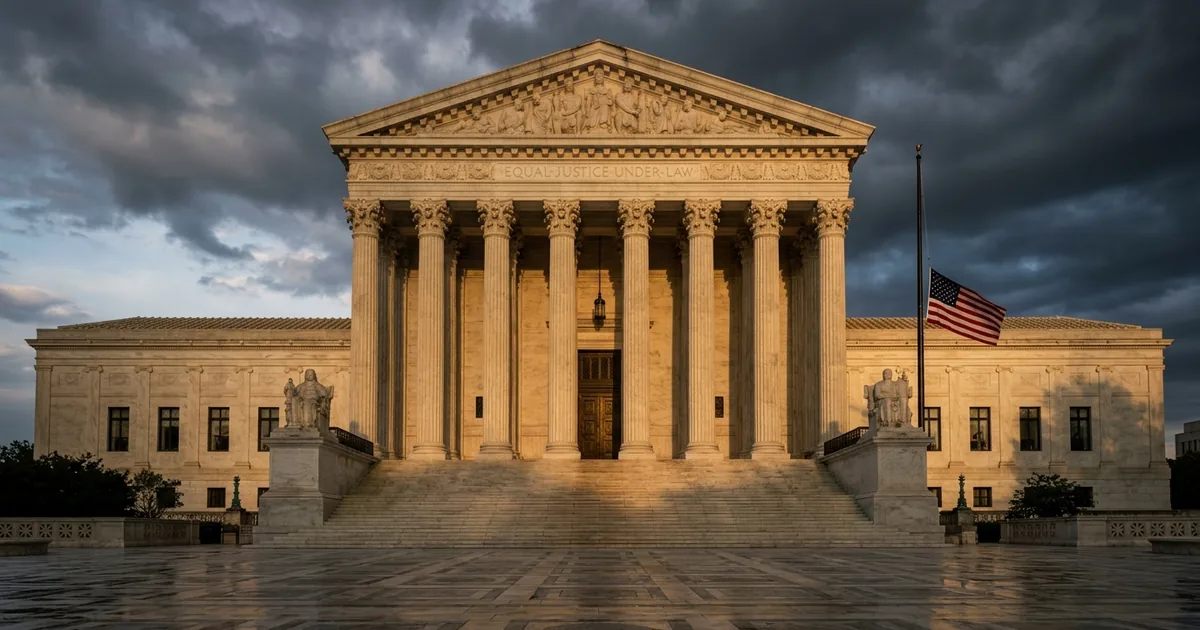
The Supreme Court ruled on Thursday that federal courts have no power to review how a president ends Temporary Protected Status, a decision that clears the Trump administration to strip legal status from roughly 350,000 Haitians and several thousand Syrians who have built lives in the United States over years and, in some cases, decades.
The holding is narrow in its facts and vast in its logic, because it lifts an entire category of executive action out of the courthouse and places it past the reach of any judge.
That second part is the part that lasts. Immigration is the subject of the case. Power is the actual stake.
What the Court Actually Held
Temporary Protected Status is a humanitarian program that lets nationals of countries hit by war or disaster live and work in the United States legally while conditions back home stay dangerous. In Mullin v. Doe, decided 6 to 3 along ideological lines, Justice Samuel Alito wrote that the statute creating that program “allows ‘no judicial review of any determination … with respect to the … termination’ of a TPS designation.” Alito announced the judgment and wrote for the Court on everything but one section, where Chief Justice John Roberts, Justice Clarence Thomas, and Justice Brett Kavanaugh joined a narrower plurality.
The majority read that review bar expansively. It does not only block courts from second-guessing the policy judgment behind a termination. As SCOTUSblog’s account of the ruling lays out, the bar also swallows procedural challenges and even constitutional equal-protection claims, the kinds of arguments courts almost always keep a hand in.
The practical result lifted orders from federal district courts in Washington and New York that had stopped the administration from ending the Haiti and Syria designations. Those designations were terminated by then-Secretary of Homeland Security Kristi Noem; the case now carries the name of the sitting secretary because the government keeps litigating as administrations turn over.
Justice Elena Kagan, joined by Justices Sonia Sotomayor and Ketanji Brown Jackson, built the dissent around how modest the plaintiffs’ request was. The beneficiaries, she wrote, “ask for only one thing: that they may stay in this country while they continue to litigate their claims.” The majority’s answer was that no court can grant even that, because no court is permitted to look.
A Second Ruling Narrows the Border on the Same Day
The TPS decision did not arrive alone. In Mullin v. Al Otro Lado, also 6 to 3 and also written by Alito, the Court held that a migrant standing on the Mexican side of a port of entry has not legally “arrived” in the United States and therefore cannot trigger the right to apply for asylum. “An alien ‘arrives in the United States’ only when he crosses the border,” the opinion states.
The ruling revives a practice known as metering, in which border agents tell asylum seekers to wait in Mexico for a processing slot that may never open. The tactic traces back to at least 2016 and predates the first Trump term. As NPR reported, the decision hands the administration a tool it had chased for years to thin the number of people officers must screen at the southern border. Read together, the two cases pull in one direction: more executive control over who enters and who stays, and fewer doors into a federal courtroom to contest it.
The Real Shift Is About Power, Not Just Immigration
Strip away the immigration specifics and the structural move comes into focus. The Court did not simply side with the administration on the merits. It said that on this question there are no merits for a court to reach, because Congress wrote the judiciary out, and the majority chose to take that instruction at full strength. When a branch of government accepts that framing, it narrows its own role on purpose.
That matters well past Haiti and Syria. Advocates warn the logic, read broadly, could reach protections for more than a million people across roughly 17 countries who hold status under similar discretionary programs. The reasoning also hands the executive a template. Any statute with a judicial-review bar now carries the Court’s signal that the bar means what the executive says it means, constitutional claims included. The same conservative majority that left the administration’s position standing after the birthright-citizenship arguments unraveled at the lectern has now drawn a harder line: across a widening set of immigration disputes, the executive acts and the courts stand down.
This is the structural point more than the partisan one. Institutions rarely collapse in a single ruling. They erode through a run of decisions, each defensible on its own terms, that together relocate authority from one branch to another. A judiciary that declines to review is not neutral. It is siding, in effect, with whichever party already holds the power to act.
What Happens to 350,000 People Now
For the families inside the numbers, the abstraction ends fast. Haitians make up the largest group, with estimates running from about 330,000 to 350,000 people who have held work authorization and built households, businesses, and years of tax records on the strength of a federal promise. Several thousand Syrians, many of whom fled a civil war, fall under the same ruling. With the lower-court orders gone, the administration can move to end work permits and begin removals, and the people affected no longer have a clear path to ask a judge to pause the process.
Resettlement organizations responded within hours. Groups including Global Refuge called the decision a green light for mass removal of people who entered and stayed through legal channels, a characterization the administration disputes by pointing to the temporary status the program’s name implies. Both readings can hold at once. The status was always provisional, and ending it this way still uproots a third of a million people who followed the rules as they understood them.
The Question the Ruling Leaves Open
The Court answered what the executive may do. It left a harder question for the rest of the system. If a president can end a status that touches hundreds of thousands of people, and no court may review whether that choice was lawful, then the only checks still standing are political: Congress, and the ballot. Whether either one moves is now the story to watch, because the courthouse, on this issue, has been told to close its doors.