
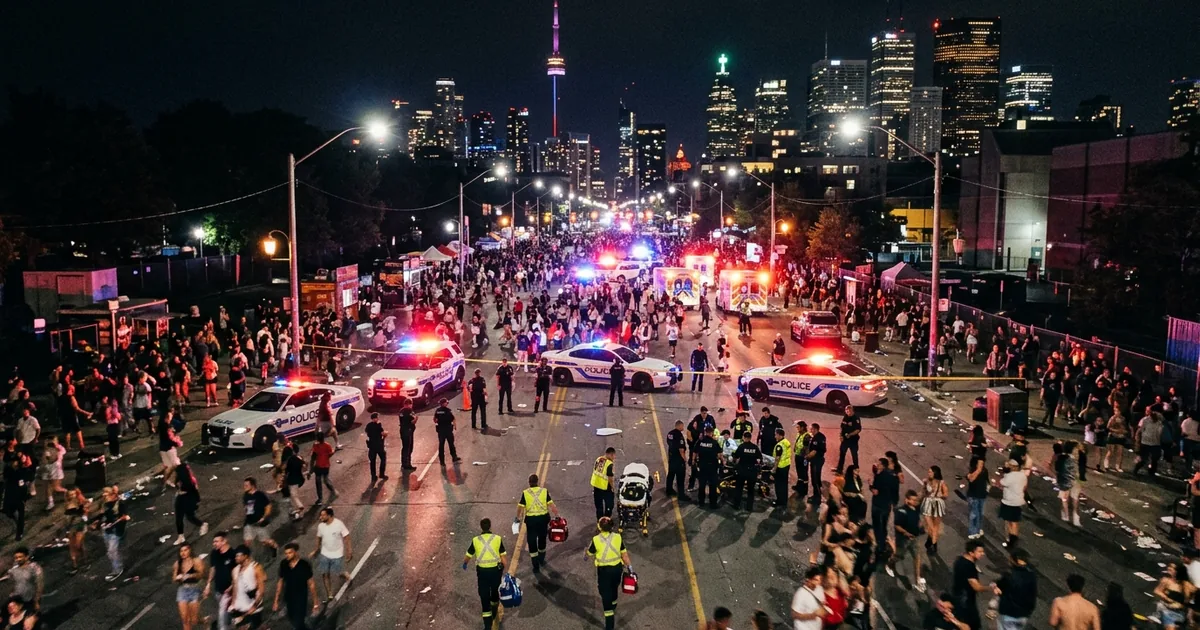
Toronto police responded to an active shooter situation Saturday evening at one of Canada’s largest street festivals, with two people killed and three others wounded in what has become the latest mass shooting to strike a major public gathering in the country.
The shooting erupted at approximately 8:12 p.m. local time during the Salsa on St. Clair festival, an annual celebration of Latin music and culture that draws tens of thousands of visitors to a stretch of St. Clair Avenue West in Midtown Toronto. Officers arriving at the scene near the intersection of St. Clair Avenue West and Arlington Avenue found five people suffering gunshot wounds, according to CBC News. Two of the victims were pronounced dead at the scene.
An Active Shooter at a Community Celebration
The Toronto Police Service initially classified the situation as an active shooter incident, a designation that triggered a massive emergency response and sent thousands of festivalgoers scrambling for safety. The festival, which typically fills a roughly one-kilometer stretch of St. Clair Avenue West with food vendors, dance stages, and live music, was packed with Saturday evening crowds when gunfire broke out.
CTV News reported that the three surviving victims were transported to hospital, though their conditions were not immediately disclosed. Police have not released details about the circumstances of the shooting or confirmed whether a suspect was taken into custody, leaving open questions about whether the gunman was among the casualties or remained at large in the immediate aftermath.
A Pattern Canada Cannot Ignore
The shooting at Salsa on St. Clair follows a disturbing pattern of gun violence at Canadian public events and gathering spaces. Toronto itself experienced a devastating mass shooting on Danforth Avenue in 2018 that killed two and injured 13, and earlier this year a gunman opened fire at a school in Tumbler Ridge, British Columbia, underscoring that gun violence at community spaces is no longer an American-only crisis.
What makes this incident particularly alarming is the target: a street festival with minimal physical barriers, open entry points, and the kind of dense crowd concentration that makes effective security nearly impossible without fundamentally changing the character of the event. Canadian municipalities have struggled with the same tension American cities face, namely how to secure open-air community gatherings without transforming free public celebrations into fortified perimeters.
The Festival’s History and Community Impact
Salsa on St. Clair has been a fixture of Toronto’s summer calendar for over two decades, typically held across a full weekend. CNN described it as Canada’s largest Latin street festival, a designation that speaks to both the event’s cultural significance and the scale of the crowd present when the shooting occurred.
The festival occupies a pedestrian-only zone on St. Clair Avenue West, with vehicle traffic diverted and the street turned over to stages, vendors, and open-air gathering. That design, while creating the vibrant community atmosphere that has made the event beloved for two decades, also means attendees have limited shelter and exit routes if a threat emerges.
What Remains Unknown
As of Saturday night, Toronto police had not provided critical details: the identity of the shooter, whether they acted alone, whether the attack was targeted or indiscriminate, and whether any suspect had been apprehended. The active shooter designation was notable in that Canadian police services use the term more conservatively than American counterparts, suggesting the situation was genuinely fluid in the minutes after the first shots.
The absence of a confirmed arrest or neutralization of the shooter in the immediate police statements is the most unsettling element for a city that will be processing this event over the coming days. Toronto’s gun violence crisis has been a recurring political flashpoint, with debates over handgun bans, border smuggling from the United States, and the adequacy of community violence intervention programs cycling through municipal and federal politics for years.
The two people who died Saturday evening went to a street party. That is the fact that will sit heaviest as Toronto wakes up Sunday morning, and it is the fact that no amount of policy debate will make less brutal.