
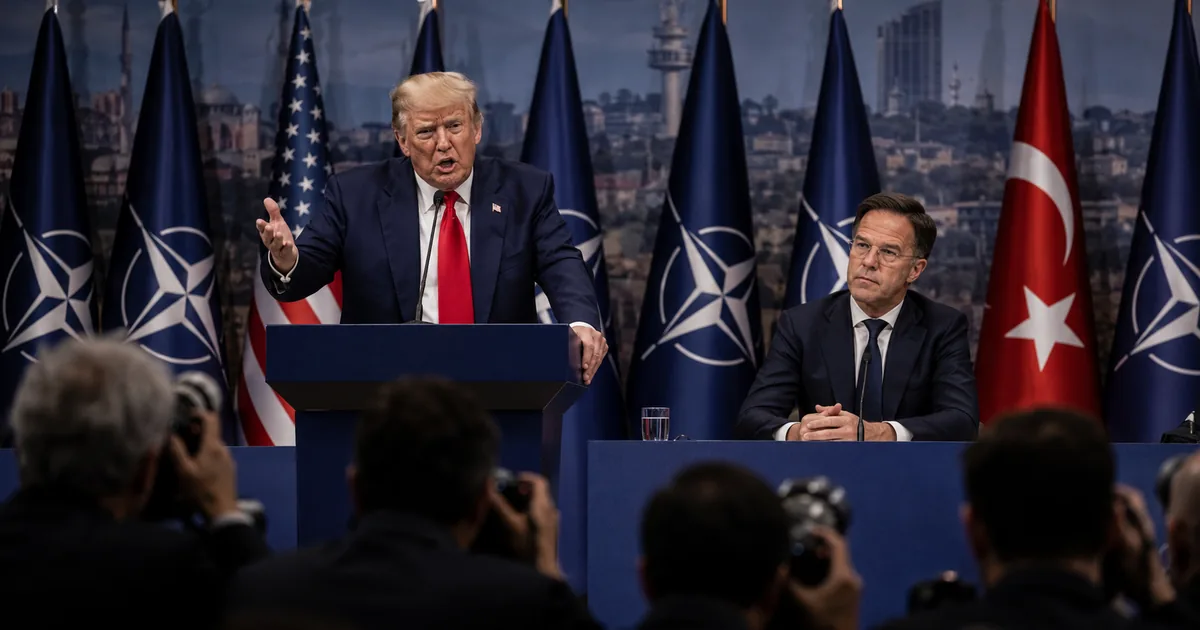
President Donald Trump used the closing day of the NATO summit in Ankara to order his Treasury secretary to cut off all trade with Spain, calling a founding ally “hopeless, bad people,” and to revive his demand that the United States take control of Greenland.
It was less a diplomatic stumble than a live demonstration of what Trump now believes the Atlantic alliance is for: not collective defense, but tribute.
“Cut It Off”: The Spain Blowup
Standing beside NATO Secretary General Mark Rutte at a news conference on Wednesday, Trump turned a question about alliance spending into a threat against a member state. He said Spain was “a terrible partner in NATO,” that he did not “want anything to do with Spain,” and instructed Treasury Secretary Scott Bessent to “cut it off,” according to CNBC’s account of the exchange. Al Jazeera reported that he paired the trade threat with the claim that Spain’s leaders were “hopeless” and had no business remaining in the alliance.
The trigger was money, and then some. Spain was the lone holdout among NATO’s 32 members refusing to commit to the summit’s headline target of spending 5% of GDP on defense. It had also, back in March, refused to let the United States use joint bases on Spanish soil for operations against Iran and closed its airspace to American military flights tied to that war. In Trump’s ledger, those are not policy disagreements between sovereign governments. They are unpaid bills.
Markets took the threat literally even if diplomats did not. Spanish government bonds sold off and the IBEX 35 fell more than 2.8% on the day, with the 10-year yield climbing as traders priced in the possibility that a sitting U.S. president might actually try to sever commercial ties with the eurozone’s fourth-largest economy. Rutte, seated inches away, tried to defuse it in real time, reminding Trump that Spain had raised its spending and “made a huge step” over the past year. The leaders of Britain, France, and Germany said nothing at all.
Greenland, on a Loop
In the same appearance, Trump returned to a demand that has shadowed his second term since January: that the United States acquire Greenland, the autonomous Danish territory whose government and population have repeatedly said is not for sale. Defense News described the summit as one that exposed cracks in the alliance precisely because the American president spent it threatening the territorial integrity of one ally and the economy of another.
There is a temptation to treat the Greenland talk as a bit, a recurring provocation that never materializes. That reading is getting harder to sustain. When the demand resurfaces at a NATO summit, alongside a live order to a cabinet secretary to punish Spain, it stops being rhetoric and starts being posture: the working assumption that alliance membership entitles Washington to land, bases, and deference, and that allies who decline can be treated as adversaries.
The Ceasefire He Declared Dead
The Spain and Greenland fireworks landed on top of an already combustible day. From the same stage, Trump declared the fragile Iran ceasefire “over,” a collapse that unfolded as U.S. Central Command struck more than 80 Iranian targets and Tehran’s Revolutionary Guard claimed retaliatory strikes on American installations in Bahrain and Kuwait. Live News Chat covered the ceasefire’s collapse and the return of open fighting in the Gulf as it broke.
Stringing those threads together is the point. In the span of a single news conference, the president threatened a trade war against one NATO member, floated annexing part of another, and buried a Middle East truce his own administration had brokered weeks earlier. A summit that Rutte built around three sober priorities, more defense investment, stronger industrial capacity, and support for Ukraine, became a referendum on whether the man leading its most powerful member still believes in the enterprise.
NATO as a Protection Racket
Here is the why underneath the spectacle. Trump is not managing the alliance; he is monetizing it. The 5% spending target, a number he himself pushed allies to accept, has become a loyalty test, and Spain failed it. The punishment is not a strongly worded communiqué but a threatened economic embargo announced from the host country’s presidential compound. That is the logic of a protection racket, not a mutual-defense pact: pay the premium and grant access, or the guarantor becomes the threat.
The cost of that logic is the one thing NATO exists to provide, which is credibility. Article 5’s promise that an attack on one is an attack on all only deters an adversary if allies believe Washington means it. That promise is a hard sell in Madrid on the same afternoon the president is trying to strangle its economy, or in Copenhagen while he eyes its territory. Rutte’s job on Wednesday was reduced to talking his most important member off a ledge in front of cameras, which tells you where the alliance’s center of gravity now sits.
What Happens Next
European leaders left Ankara with a choice they have been deferring for two years: treat Trump’s threats as weather to be waited out, or start building the continental defense architecture that assumes the United States is no longer a reliable partner. Spain’s markets already voted. The open question is whether its allies, the ones who stayed silent while a founding member got threatened with an embargo, decide that silence is still the safe play.