
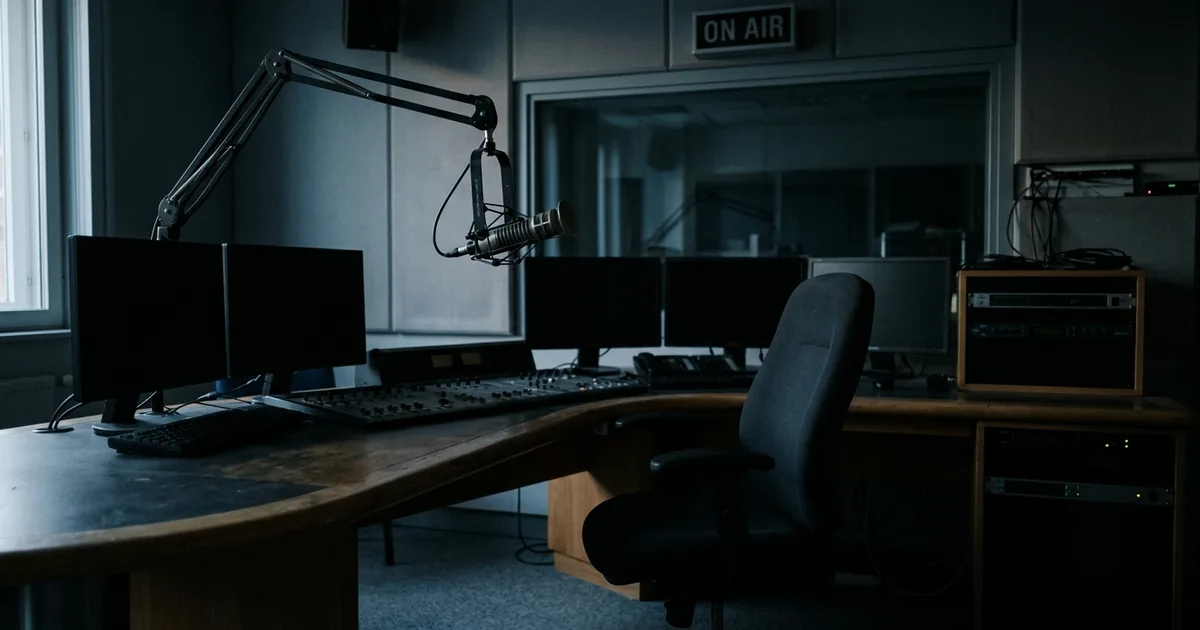
The infrastructure that tells Americans what is happening to them is coming apart in real time, one buyout offer and one shuttered newsroom at a time. In a single stretch this spring, NPR moved to cut staff after Washington pulled its money, CBS News Radio went silent after nearly a century on the air, and hundreds of local journalists were walked out of buildings their stations have occupied for generations.
This is not a run of bad quarters at a few companies. It is a structural contraction hitting public radio, legacy broadcast, and local television at the same moment, and the people who lose the most are the audiences who already had the least coverage to begin with.
NPR Trims Its Newsroom After Washington Pulls the Money
NPR has offered voluntary buyouts to roughly 300 employees and said it expects to accept up to 30, a move the network framed as a way to close an $8 million budget shortfall. In its own reporting on the cuts, NPR tied the gap directly to the loss of federal support, the clearest sign yet that the long political campaign against public media has stopped being rhetorical and started showing up on a balance sheet.
Strip away the corporate language and the stakes are simple. Public radio was built to reach places commercial broadcasters never found profitable, rural counties, tribal lands, small cities with one struggling paper. When the funding contracts, those are the signals that fade first. A buyout is voluntary on paper. The coverage gap it leaves is not.
CBS News Radio Signs Off After Nearly a Century
The bleaker symbol arrived when CBS News Radio shut down on May 22 after nearly 100 years feeding hourly newscasts to hundreds of affiliate stations. For most of the twentieth century, that network was how a huge share of the country heard the news first, in the car, at the kitchen table, on a factory floor. Its end is the kind of thing that would have been a national story a generation ago and now registers as one more line in a layoff tracker.
That muted reaction is its own warning. When the collapse of a century-old news institution barely breaks through, it means the audience has already been trained to expect the bleeding.
The Local News Wipeout Nobody Voted For
The damage runs deepest below the national tier. Over the past year, more than 650 journalists were cut across local ABC, CBS, Fox, and NBC affiliates, and another wave of cable channels is going dark this month. The result is a steady expansion of news deserts, communities where no full-time reporter shows up at the council meeting, the zoning board, or the county courthouse.
Researchers have spent a decade documenting what follows when local news disappears: voter turnout slips, split-ticket voting falls, municipal borrowing costs rise, and corruption gets cheaper to commit. This is the part of the story that should worry people who never watch cable news at all. A democracy without local reporting does not get quieter. It gets easier to manipulate. The turmoil playing out inside the big cable brands, captured in the recent on-air rupture at MSNBC, is loud and visible. The quiet erasure of a beat reporter in a mid-sized city is not, and it may matter more.
Big Media’s Answer Is to Change the Scoreboard
Faced with shrinking audiences, the largest media companies are not racing to rebuild trust. They are trying to rewrite how the audience gets counted. At this year’s upfronts, networks pushed advertisers toward new “outcome” measures that tie commercials to foot traffic and ticket sales rather than raw viewership, a shift Variety detailed in its coverage of the ratings revolt.
The logic is understandable and the optics are terrible. When you cannot grow the crowd, you redefine what counts as a crowd. It may keep the ad dollars flowing for another cycle. It does nothing for the laid-off producer or the town that lost its station.
Who Fills the Vacuum
The map is already being redrawn, and not by the public-interest mission that built public broadcasting. MS NOW, the rebranded network that split from NBC, has been staffing up. The California Post, a West Coast extension of the Murdoch-owned New York Post, is building a newsroom for a 2026 launch. The survivors will be the outlets with a billionaire backer or a clear ideological lane, which tells you a great deal about what the next decade of American news will sound like.
The open question is not whether the business can be saved in its old form. It cannot. The question is whether anything rebuilt in its place will still see its job as telling people the truth about their own communities, or whether that function quietly becomes a luxury good. The answer is being decided right now, in budget meetings most Americans will never hear about, on a radio network that is no longer broadcasting.