
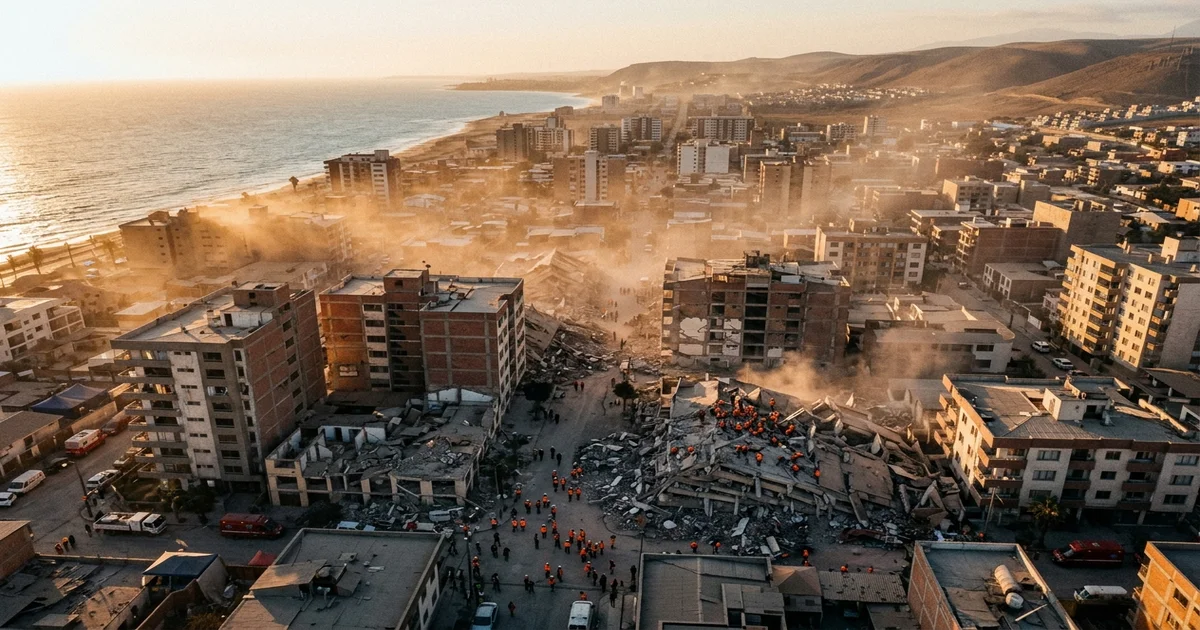
Two back-to-back earthquakes have turned La Guaira and parts of Caracas into a search grid where time is the one resource nobody has enough of.
Four days after a magnitude 7.2 foreshock and a 7.5 mainshock struck within 39 seconds of each other, the confirmed death toll has climbed past 1,400, more than 3,200 people are injured, and an estimated 68,900 remain unaccounted for.
The numbers alone are staggering, but the math underneath them is worse. Rescue teams from 24 countries are now on the ground, yet the critical 72-hour survival window effectively closed on Saturday. That does not mean crews have stopped digging. It means the odds of pulling someone alive from a pancaked apartment block in La Guaira have shifted from slim to almost nonexistent, and every hour that passes pushes the confirmed toll closer to what the U.S. Geological Survey’s PAGER system has been warning since Tuesday: a final count that could reach into the tens of thousands.
What Happened on June 24
The twin quakes hit at approximately 6:05 p.m. local time on June 24. The foreshock registered 7.2 on the moment magnitude scale; the mainshock, arriving just 39 seconds later, measured 7.5. Both were strike-slip events centered near the northern coast, and the combination delivered a one-two punch that older concrete structures in La Guaira and western Caracas simply could not absorb.
According to Al Jazeera’s live reporting, more than 1,400 buildings collapsed in La Guaira alone. Simon Bolivar International Airport, the country’s main gateway, sustained heavy damage. Roads fractured and power grids failed across multiple states, including Aragua and Carabobo, cutting off communities that were already difficult to reach before the ground started moving.
A Rescue Effort Running on Desperation
Venezuela’s acting president, Delcy Rodriguez, confirmed Saturday that 2,741 rescuers from two dozen countries are now working in the affected zones. The United States committed $150 million in aid, split between a $100 million contribution to a United Nations humanitarian fund and $50 million directed to organizations already operating in the country, as ABC News reported.
But international logistics can only move so fast, and the gap between organized rescue capacity and the scale of destruction has forced ordinary Venezuelans into the rubble. Residents in the hardest-hit neighborhoods are digging with their hands, prying at concrete slabs with whatever tools they can find. The scarcity of government rescue teams in outlying areas has been a persistent complaint from survivors, and it reflects a broader challenge: Venezuela’s infrastructure was already fragile before the quakes hit, weakened by years of economic crisis and underinvestment.
More than 14,000 officials are working in La Guaira specifically, and at least 30 international search teams are spread across the disaster zone. Those numbers sound large until you consider that CBS News reports over 3,100 families have lost their homes entirely, with more expected to be displaced as aftershock-damaged structures are assessed and condemned.
The Humanitarian Picture Is Getting Darker
The earthquake sequence is the deadliest to hit Venezuela since the 1900 San Narciso event, and the humanitarian fallout is deepening. Hospitals in La Guaira and Caracas were overwhelmed within hours of the mainshock, and medical supply chains that depend on the now-damaged airport and road network are strained. Clean water access has deteriorated in several municipalities, raising the specter of waterborne disease in a country whose public health system was already under severe pressure long before June 24.
Aid agencies are warning that the transition from rescue to recovery will be brutal. The 68,900 people still unaccounted for represent a data gap as much as a body count; many may have fled to family elsewhere in the country, but in a nation with limited telecommunications infrastructure, confirming who is alive and who is buried is an agonizingly slow process.
What Comes Next
The immediate priority remains clear: keep searching, even past the statistical window, because survivors have been found in earthquake rubble well beyond 72 hours in past disasters. But the medium-term challenge is arguably harder. Venezuela will need to house, feed, and provide medical care to tens of thousands of displaced people while simultaneously rebuilding critical infrastructure in a region where the geology just proved that the next big quake is a question of when, not if.
The international community has opened its checkbook. Whether the money translates into effective reconstruction in a country whose governance structures have been strained for over a decade is the question that will define the aftermath far more than any single rescue pulled from the rubble this weekend.