
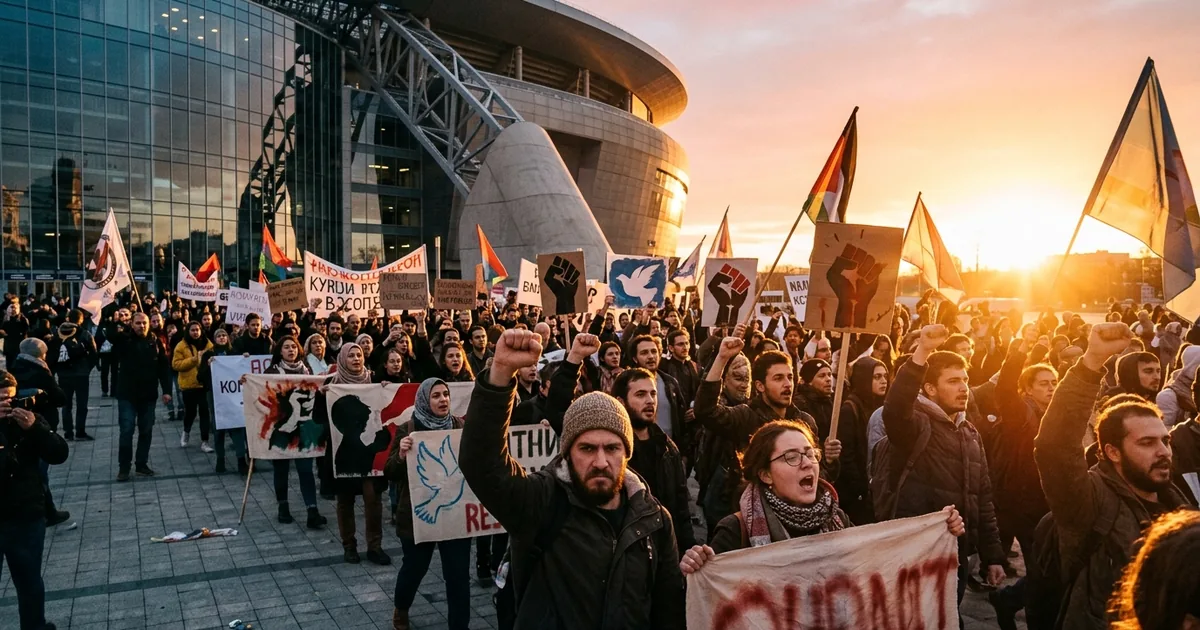
Iran opened its 2026 World Cup against New Zealand with a 2-2 draw at SoFi Stadium on June 15, and the louder story unfolded outside the gates, where more than 200 members of the Iranian diaspora gathered to demand the regime’s downfall. The first World Cup co-hosted by the United States was always going to be political. It took exactly one Iran fixture to prove it.
A Draw on the Field, a Reckoning in the Parking Lot
The match itself ended even, a 2-2 result that flattered neither side and will be forgotten by the group stage’s final whistle. What will not be forgotten is the scene in Inglewood, where protesters carried signs accusing Tehran of torturing and executing political prisoners and athletes, and where chants for regime change carried over a stadium built for spectacle rather than dissent.
This is the contradiction FIFA bought when it awarded matches to Los Angeles. A sporting body that markets itself as apolitical handed Iran a fixture in the city with the largest Iranian population on earth outside Iran, with estimates running from 375,000 to more than half a million people. The diaspora did not need an invitation to show up. It needed a date and a location, and FIFA provided both.
The Flag FIFA Won’t Let In
The sharpest fight was over a piece of cloth. Protesters carried the pre-revolutionary Lion and Sun flag, the banner many Iranian exiles treat as the symbol of the country they want back, and FIFA has barred that flag from inside its venues. By Wednesday the dispute had moved from the sidewalk to the courthouse. A lawsuit filed in Los Angeles Superior Court sought a temporary restraining order to stop FIFA from denying entry to spectators carrying the flag or confiscating it inside the stadium.
That legal filing is the detail worth sitting with. It reframes a flag policy as a First Amendment question on American soil, and it puts FIFA in the position of enforcing a foreign government’s symbolic preferences inside a United States stadium. CBS News documented the protests outside the Iran match, and the optics are not subtle: a global federation telling Iranian Americans which flag they may wave in Inglewood. FIFA wanted a tournament about football. It got a venue-by-venue argument about whose speech counts.
Why Los Angeles Was Always the Flashpoint
None of this is a surprise to anyone who has watched Southern California’s Iranian community organize over the past two years. This is a diaspora protesting a regime it accuses of systematic repression at home, the same government that ran an 88-day internet blackout to choke off dissent. For that community, an Iranian national team playing in their backyard is not a neutral sporting event. It is the regime’s flag and anthem broadcast into the heart of the exile capital, paid for by a tournament that insists none of this is its problem.
NBC Los Angeles captured the mixed reaction across the city, and mixed is the honest word. Some came to support the players as athletes who did not choose their government. Others came to make sure the cameras could not separate the team from the state it represents. Iran’s coach said his squad was sent straight back to its training base in Mexico after the match, a logistical footnote that also reads as a security decision.
The Tournament’s Real Test Is Just Starting
Iran plays Belgium at the same stadium on June 21, which means SoFi gets a second act, and the legal questions raised this week will not have resolved by then. The larger pattern is the one to track. A 48-team World Cup spread across three countries was sold as a celebration of North American unity. What the opening days are showing is that a tournament this size cannot wall itself off from the politics of the teams it hosts, especially when one of those teams represents a government a large share of the host city fled.
FIFA’s preferred posture is to call all of this a distraction from the football. The more accurate read is that the football is the distraction, and the real contest in Los Angeles is over who gets to speak, which flags are allowed, and whether a sporting federation can keep insisting it stands above politics while actively policing them. The group stage will produce winners and losers on the pitch. The fight outside the stadium does not have a final whistle.