
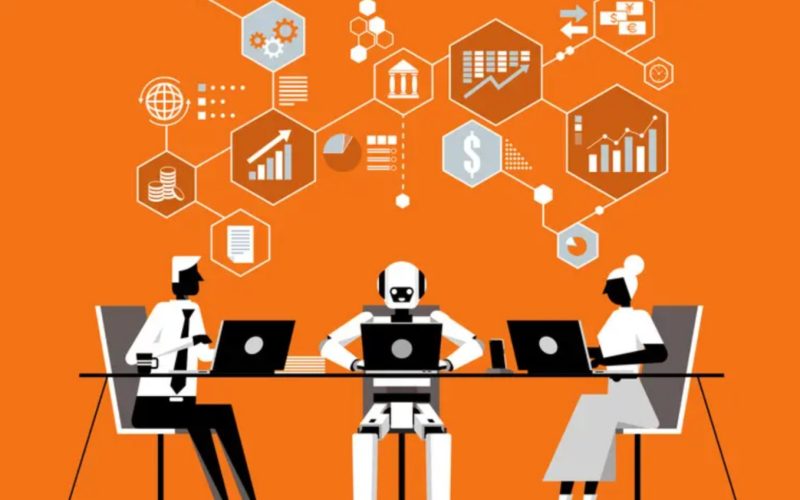
If 2024 was the year generative AI went mainstream, and 2025 was the year teams figured out where it actually works (and where it quietly breaks things) in production, then 2026 feels like the moment the industry finally grows up. More governance, more accountability, deeper integration into daily delivery, and real pressure to show measurable results. The work doesn’t get easier — it just changes shape.
The most useful mental model for 2026: software is no longer primarily hand-crafted. It’s increasingly co-produced with machines. Humans move up the stack: we define constraints, validate outcomes, manage risk, and design systems that remain reliable even as everything around them changes constantly. This shift won’t happen everywhere at once — some companies and regions are already living it, others are still in denial — but the direction is unmistakable.
AI stops being just a tool and starts acting like a real teammate
In many teams AI already writes code, generates tests, drafts docs, suggests refactors. The big change in 2026 is the expectation that it won’t merely “assist” — it will execute chained tasks across workflows like an agent. Stack Overflow’s 2025 developer survey showed 84% of respondents already using or planning to use AI tools, with 51% of professional developers doing so daily. That’s no longer experimental; it’s becoming the default way half the profession works.
But widespread usage doesn’t mean full trust. The same ecosystem is increasingly honest about the fact that AI can be confidently wrong, subtly insecure, or completely misaligned with product goals. A very common pattern: developers use AI to move faster, then spend almost as much time reviewing, fixing, and integrating. That review step stops being an annoying chore — it becomes a core engineering skill.
In practice, 2026 rewards people who can combine speed with healthy skepticism. The strongest engineers treat AI like a junior teammate with endless energy but inconsistent judgment: fantastic at producing drafts, dangerous without careful oversight.
Smaller teams ship more — but reliability becomes the real differentiator
One of AI’s most disruptive effects is that it dramatically compresses the team size needed to ship a feature. A three-person team can now prototype and deliver what used to take ten. Gartner has been pointing at this for a while: AI-native platforms let small, nimble teams move much faster.
Inside organizations this creates new pressure. If one small squad can deliver quickly, leadership starts asking why every team can’t. The danger is that companies start measuring only output while under-investing in quality. In 2026 the real competitive edge won’t be “who can generate the most code fastest,” but “who can generate code fast and keep production stable.”
Expect renewed focus on engineering fundamentals that briefly felt old-fashioned: architectures that contain blast radius, observability that catches regressions early, proper dependency hygiene, reproducible builds, secure defaults. AI accelerates velocity — it also accelerates how quickly small mistakes turn into major incidents.
Regulation moves from “legal will handle it” to day-to-day engineering reality
For anyone working with EU customers or data, 2026 is a hard milestone. The EU AI Act entered into force in August 2024 and becomes fully applicable on August 2, 2026, with some obligations already phased in earlier.
In practice this means AI governance starts looking a lot like security governance: not optional, not “later,” not siloed in compliance teams. Engineers will increasingly be asked concrete questions: Which model are we using? What was it trained on? What data flows through it? How do we monitor for drift? How do we provide transparency to users? How are risk controls documented?
You don’t need to become a lawyer. But product, backend, and ML engineers will need a shared vocabulary to answer “what is this system actually doing” and “how do we prove it stays within bounds.” If you can translate between technical reality and compliance needs, you become unusually valuable in 2026.
“Sovereign” and region-specific AI turns into a strategic reality
Another layer is where the AI actually runs and whose rules it follows. Gartner has forecast that by 2027 a significant number of organizations will adopt region-specific AI platforms due to compliance and digital sovereignty pressures. Even if the full wave lands in 2027, architectural decisions get made earlier — 2026 is when many enterprises start locking in direction.
For practitioners this isn’t abstract policy. It directly influences cloud strategy, vendor selection, data residency rules, and how you design systems that can swap models or operate across jurisdictions. A real career advantage in 2026 comes from building portability: model-agnostic abstractions, clean data boundaries, deployment patterns that allow switching providers without a full rewrite.
As Andrii Zhurylo, founder of Dijust Development, puts it:
“AI gives you speed you never had before — but speed without control is just expensive chaos. The winners in the next few years won’t be the teams that generate the most lines of code; they’ll be the ones that can move fast and still sleep at night knowing the system won’t blow up.”
Cybersecurity becomes faster, more adversarial, and more demanding
Security has been trending up for years, but AI changes the rhythm. Attackers can automate reconnaissance, phishing, exploit chaining. Defenders can automate detection, triage, response. The result isn’t “security solved” — it’s security at a higher tempo.
The World Economic Forum’s Future of Jobs Report keeps cybersecurity and AI/big data near the top of fastest-growing skills. That pressure doesn’t ease in 2026 — it intensifies as every organization exposes more AI-powered surfaces and integrations.
Practically, the average software engineer will be expected to think like a security-conscious engineer. More emphasis on secure-by-default patterns, least-privilege access, secrets hygiene, dependency scanning, runtime protection. If you’re in DevOps, SRE, or platform engineering, 2026 likely hands you even more responsibility: you’re now guarding both reliability and trust.
The job market shifts: fewer routine tasks, more judgment-heavy work
The biggest fear around AI is mass job loss. The more realistic near-term story is job redesign. Some tasks shrink or disappear; others expand. Boilerplate, first-pass docs, simple glue code — increasingly automated. But the need for humans to set requirements, validate correctness, manage risk, and align stakeholders grows.
Randstad’s leadership has said it plainly: even as AI reshapes knowledge work, “the human role remains indispensable” — especially around oversight and adaptability. That matches what many engineers see day-to-day: AI shortens time-to-first-draft, not time-to-done — unless the team has strong review discipline.
Impact is uneven. Roles heavy in repetitive operations face more pressure; high-agency technical roles stay resilient. The safest positioning in 2026 is work that’s hard to fully specify, requires deep context, and carries real outcome responsibility.
The 2026 skill stack: AI literacy + fundamentals + communication
By 2026 “AI literacy” is no longer optional — in the EU it’s even referenced in parts of the AI Act timeline. But literacy doesn’t mean you need to become an ML researcher. It means you can reason about model limitations, recognize common failure modes, and build guardrails.
At the same time, fundamentals matter more, not less. AI can write code, but it can’t guarantee your architecture survives load, your data stays private, or your dependency chain doesn’t become an attack vector. Engineers who deeply understand performance, concurrency, distributed trade-offs, and testing strategy will look “senior” very quickly in AI-heavy environments.
And then there’s the human side. WEF keeps highlighting creative thinking, resilience, flexibility, curiosity, lifelong learning. In 2026 that translates directly to career advantage: the people who learn fast, explain trade-offs clearly, and collaborate across roles get trusted with bigger scope.
Practical career advice for 2026 — no hype
Assume AI will be part of almost every workflow, but organizations will still be bottlenecked by delivery quality, security, and trust. Your goal is to be the person who can ship fast with AI while keeping the system sane.
- Software engineers: master AI-assisted development without letting it erode your standards. Strong testing, clean interfaces, rigorous reviews become even more important.
- ML/AI engineers: differentiate through deployment maturity — monitoring, eval, privacy, governance.
- DevOps/SRE/platform: you’re at the center of cost, reliability, incident response, and policy enforcement in a more complex stack.
- Early-career: 2026 can actually be great — AI acts as a 24/7 tutor and accelerator, but you still have to build real understanding, not just copy-paste.
- Mid-career: become the translator — turn business goals into technical constraints and supervise AI-enabled delivery.
- Senior: your leverage is judgment — designing systems that stay correct, safe, and maintainable when “writing code” is no longer the bottleneck.
Bottom line for 2026
The industry will talk less about how impressive AI is and more about whether it’s governable. That means audit trails, evaluation frameworks, documented constraints, transparent operations. “Soft” skills become hard: negotiating scope, documenting decisions, communicating risk, aligning people.
The IT professionals who thrive in 2026 won’t just be the fastest tool users. They’ll be the ones who combine AI velocity with human responsibility — who can deliver fast without sacrificing safety, compliance, or sanity — and who treat reliability and security as core product features, not afterthoughts.