
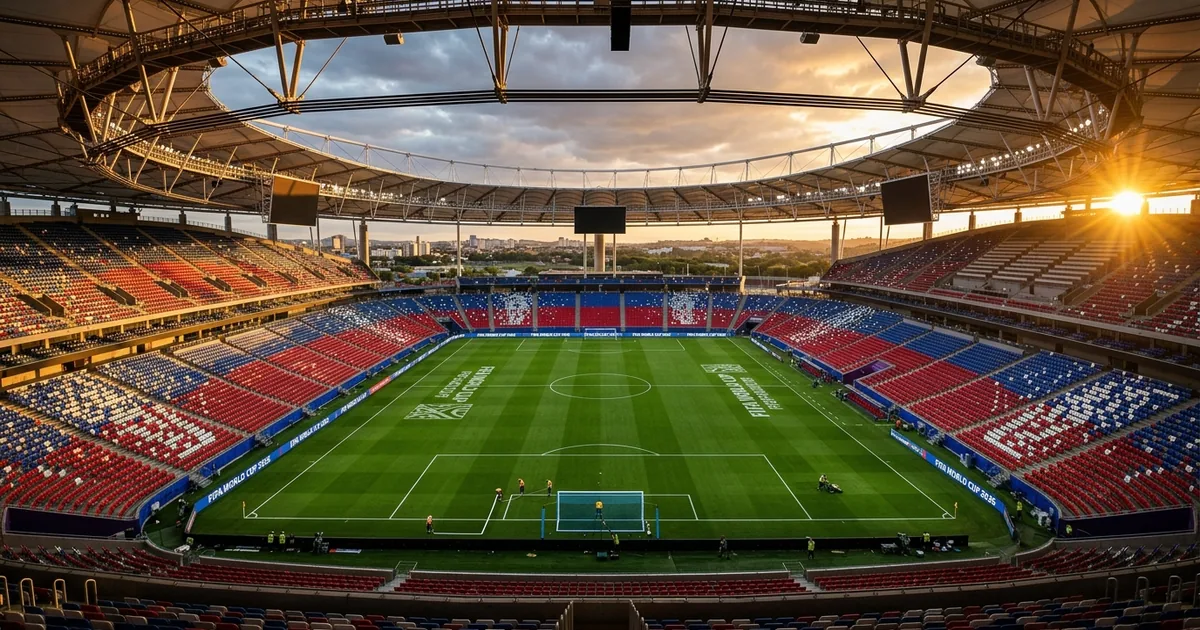
The biggest FIFA World Cup in history starts Wednesday when Mexico faces South Africa in the opening match, and for the first time in the tournament’s 96-year existence, nobody has a convincing answer to the most basic question: who is going to win this thing?
The Numbers That Define This Tournament
Forty-eight teams. Sixteen host cities across the United States, Mexico, and Canada. A group stage featuring 12 pools of four, with the top two from each group plus the eight best third-place finishers advancing to a new round of 32. The final is set for July 19 at MetLife Stadium in East Rutherford, New Jersey, which holds 82,500 fans and sits close enough to Manhattan that the global media infrastructure practically builds itself.
This is the first World Cup under the expanded format, up from 32 teams, and the scale shift introduces genuine tactical uncertainty. More games, more rest-day variability, more opponents that top-tier teams have rarely faced in competitive settings. ESPN’s prediction model gives no team better than a 16 percent chance of winning the whole thing.
The Favorites, Such as They Are
Spain and France are the co-favorites in most forecasting models, each sitting around 16 percent win probability. Spain enters as the reigning European champion, and their midfield depth from Barcelona and Real Madrid gives them the deepest talent pool in the tournament. France has Kylian Mbappe, who at 27 is entering what should be the peak years of his career, and a squad that has reached two of the last three finals.
Argentina, the defending World Cup champion, has Lionel Messi at 38. This is almost certainly his last tournament, and the sentimental pull is enormous, but Argentina’s squad has aged alongside their captain and the group stage draw did them no favors. England, perpetual underachievers on the biggest stage, enters with a golden generation and the weight of decades of near-misses. Brazil and Portugal round out the realistic contender pool, though both carry their own question marks.
The honest assessment, confirmed by Nate Silver’s model and Opta’s supercomputer simulations, is that the field is the most open it has been since at least 2002. There is no dominant team. There are six or seven good ones and a lot of unknowns.
What the Expanded Format Actually Changes
The jump to 48 teams is not just a numbers game. It reshapes competitive dynamics in ways FIFA’s marketing materials do not emphasize. More teams means more mismatches in the group stage, which sounds boring until you consider that the third-place qualification pathway creates bizarre incentive structures. A team can lose a match and still advance with a favorable goal difference, which could lead to the kind of strategic lethargy that killed excitement in certain group games at Euro 2024.
On the other hand, 48 teams means Saudi Arabia plays in its first World Cup on home-region time zones, means New Zealand and Indonesia get meaningful minutes against established programs, and means the tournament will genuinely represent global football rather than the European and South American duopoly that has dominated the trophy case for a century. Only eight non-European, non-South American teams have ever reached a World Cup semifinal. This format gives more nations a plausible path.
The American Host Factor
For the United States, the home tournament carries enormous stakes beyond the pitch. This is the first men’s World Cup on American soil since 1994, and the USMNT enters with a squad built specifically for this moment. Christian Pulisic, Weston McKennie, and a generation of players who grew up in European club academies represent the most technically proficient American squad ever assembled.
The host advantage is real. In the tournament’s history, host nations have reached at least the quarterfinals more than 60 percent of the time. Add the crowd energy, zero travel fatigue, and the pressure of a nation watching football with genuine interest for the first time in a generation, and the U.S. has the ingredients for a deep run even if the talent ceiling is lower than the European elite.
The Messi Question
No discussion of this World Cup is complete without addressing the elephant in the stadium. Messi turns 39 during the tournament. He won the whole thing in Qatar in 2022, delivered what many consider the greatest individual World Cup performance in history, and has spent the years since playing in MLS. The legs are not what they were. The vision is still there, but the explosive acceleration that made him the most dangerous player alive is gone.
Argentina’s coaching staff has built the team to protect Messi, surrounding him with runners and pressers who do the physical work while he operates in pockets. It worked in 2022 when he was 35. Whether it works at 38, across what could be seven games in 38 days in North American summer heat, is the question that gives this tournament its most compelling narrative.
The World Cup starts tomorrow. Nobody knows how it ends. That is exactly what makes it worth watching.