
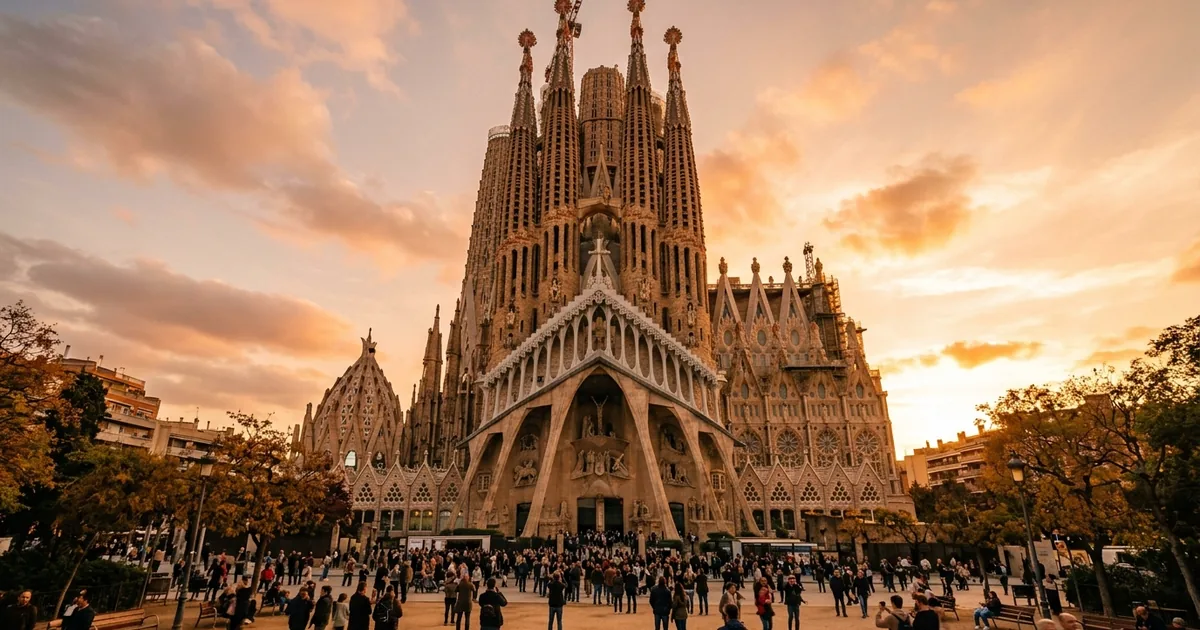
Pope Leo XIV presides over a historic evening Mass at Barcelona’s Sagrada Familia tonight, blessing the newly completed Tower of Jesus Christ and turning Antoni Gaudi’s unfinished masterpiece into the tallest church on the planet at 172.5 meters.
A Century in the Making
The timing is not coincidental. This Mass marks the centenary of Gaudi’s death, the Catalan architect who spent the final 43 years of his life consumed by the basilica’s construction before being struck by a tram in 1926. He was buried in the crypt of the still-unfinished building, and for a hundred years since, successive generations of architects, engineers, and donors have labored to realize his vision.
The Tower of Jesus Christ, which Pope Leo will formally bless during the 7:30 p.m. service, stands as the building’s central spire and its crowning achievement. At 172.5 meters, it surpasses the previous record holder, Ulm Minster in Germany, which held the title of world’s tallest church for over a century at 161.5 meters. NBC News reported that the basilica’s completion has been accelerated in recent years by advances in computer-aided stone cutting that Gaudi could never have imagined.
The First American Pope Returns to Europe
For Leo XIV, born Robert Prevost in Chicago, this Barcelona visit represents his second major European engagement since his election last year. The first American pope has drawn massive crowds throughout his three-day visit to Spain, which began Tuesday with his arrival at Barcelona’s El Prat airport and a midday prayer at the Cathedral of Barcelona.
Tuesday evening’s prayer vigil at the Lluis Companys Olympic Stadium drew an estimated 55,000 attendees, a signal of how deeply the new pope’s pastoral style resonates with European Catholics who spent years watching the Vatican from a distance. Leo’s approach, deeply informed by his decades of work in Latin America and his roots as the first American to lead the Catholic Church, has centered on accessibility and direct engagement in ways that recall the early energy of Francis’s papacy.
Why Barcelona, Why Now
The choice of Barcelona over Rome for this milestone speaks to a broader strategy. The Sagrada Familia is not just a church; it is one of the most visited monuments in Europe, drawing 4.7 million visitors annually. By making this the backdrop for a papal Mass, Leo is positioning the Catholic Church at the intersection of art, architecture, culture, and faith in a way that secular audiences can engage with even if they never set foot in a parish.
Barcelona itself is significant. Catalonia has one of the lowest rates of regular Mass attendance in Spain, hovering around 12 percent. Holding a major papal event here is less a victory lap and more an evangelistic statement: go where the church is weakest, not where it is strongest.
The Sagrada Familia’s story also mirrors themes Leo has returned to repeatedly in his first year: patience, long-term vision, and the idea that the most meaningful projects span generations. Gaudi knew he would never see the basilica finished. He reportedly told skeptics, “My client is not in a hurry,” referring to God.
The Security and Scale Challenge
The logistics alone are staggering. Organizing a papal Mass inside an active construction site that doubles as a UNESCO World Heritage landmark required unprecedented coordination between Vatican security, Spanish national police, Barcelona’s municipal government, and the Sagrada Familia’s own administration. Road closures across the Eixample district began hours before the event, and local transit authority TMB rerouted more than a dozen bus lines to accommodate the security perimeter. The Washington Post detailed how access is being managed through a tiered credential system, with only about 4,500 people inside the basilica for the Mass itself and thousands more watching on screens in surrounding streets.
The visit concludes Wednesday with a trip to the Montserrat monastery in the mountains outside Barcelona, a site sacred to Catalan identity and home to the Black Madonna, one of the most venerated images in Catholicism.
What It Means for the Church
A year into his papacy, Leo XIV is doing something none of his predecessors attempted at this scale: using architecture and cultural heritage as a bridge between the institutional church and a public that increasingly identifies as spiritual but not religious. The Sagrada Familia, a building that took a hundred years to complete and attracts millions who will never attend a Sunday service, is the perfect stage for that message.
Whether that translates into anything more durable than a spectacular photo opportunity is the question that will follow Leo back to Rome.