
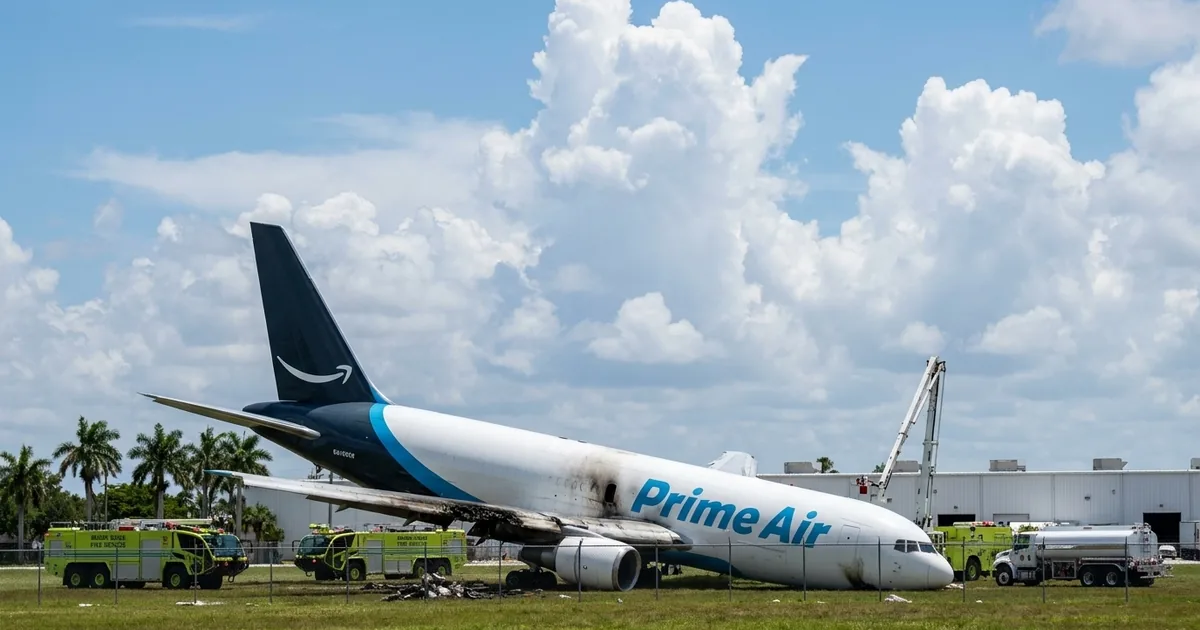
Since Wednesday the Miami crash has been reported as a cockpit story: one pilot said the plane was too fast, the other did not answer, and a Boeing 767 ran out of runway. That is accurate, and it is the smaller half of what the record actually shows.
The larger half is a date. A former 21 Air captain took his safety complaints about this carrier to the federal government, OSHA rejected them, and his appeal has been sitting at a Department of Labor tribunal since 2023. It is still sitting there. Five men who cleaned airplanes for a living were killed on September 6 by a jet that carrier was operating, and no one has yet ruled on whether the pilot who complained about it was right. Every outlet has covered the complaints and the cockpit tape. None of them has put the two on the same timeline.
What the Recorders Actually Captured
The facts of the landing are not in dispute and they are bad. 21 Air Flight 7598, a Boeing 767 freighter inbound from San Juan on an Amazon Air run, touched down close to 5,000 feet down a 9,360-foot runway at roughly 180 miles per hour. It then travelled about 1,300 feet past the end of the pavement, across a public road, and into a van.
The National Transportation Safety Board’s investigative update, released September 9, describes a cockpit in which one pilot repeatedly flagged the aircraft’s speed on final approach and after touchdown, and never got what investigators called a consistent verbal response from the other. The recorders also caught the automated warnings stacking up behind them, repeated sink rate alerts and a too low terrain callout, as the jet came down. CNBC reported that the crew briefly tried to go around before the overrun.
Both pilots survived. The captain, 55, had 7,145 flight hours and received his 767 type rating in May of this year. The first officer, 37, had 2,665 hours and was typed on the 767 in 2025. The NTSB has not issued a preliminary report yet and has not determined a cause. That is expected in late September or October.
The Complaint That Has Been Pending Since 2023
Two days before the cockpit summary landed, CBS News reported that former employees of 21 Air had raised safety concerns about the company long before this flight. The central figure is Karl Seuring, a pilot with more than thirty years of experience who became head of the carrier’s pilots union and was later fired. In his account, he raised safety concerns with a 21 Air manager and was told, plainly, that it was not going to change.
Seuring and other former pilots alleged that managers suppressed safety reports, pushed crews to fly without adequate rest, put crew on the line who could not communicate safely in English, and flew aircraft they considered unairworthy. Seuring’s own federal case alleged insufficient rest between flights, takeoff procedure violations, and retaliation for speaking up.
OSHA rejected his retaliation complaint. He appealed. The appeal went to a Department of Labor tribunal in 2023 and has not been decided.
“We anticipated and we feared it. And we knew the day would come, and there wasn’t anything we could do.”
That is Seuring, speaking to NPR after the crash, describing the accident as something he and his colleagues had been expecting. 21 Air disputes all of it. The company says Seuring was fired because he misrepresented his employment history, and it denies the safety allegations. Those allegations are unproven, which is precisely the point: three years on, nobody with authority has established whether they are true or false.
The Dead Were Not on the Airplane
The five people killed were not crew and not passengers. They were in a van on the far side of the airport perimeter, and they worked for Professional Ocean Service Corp, a contractor that cleans aircraft for airlines. Rolando Aleman Leon was 55. Yoel Rodriguez Naranjo was 53. Carlos Acosta Fajardo was 53. Javierkys Reyes Quevedo was 47. Julio C. Pineda was 75 years old and still working.
They had no relationship with 21 Air, no say in its rostering, and no way to know any of this was being argued about in a federal tribunal. We have already written about the missing arrestor bed at the end of Runway 30, which is the infrastructure version of the same question. This is the paperwork version.
Three Years Is Not an Adjudication, It Is a Filing Cabinet
Here is where we come down. Whatever the NTSB concludes about the flight deck, the institutional failure in this story is already established and does not require a final report: a Part 121 cargo pilot filed formal safety allegations against his employer, the enforcement system took three years and still has not answered him, and in the meantime the carrier kept flying and five contract workers died beside a runway.
A whistleblower process that outlasts the aircraft type rating of the captain in the accident is not functioning as a safety mechanism. It is functioning as a place to put things. The value of a pilot complaint is entirely in its timeliness, because the only reason to take one seriously is to act before the thing the pilot is describing actually happens. Resolved in 2024, Seuring’s appeal would have been a live input into whether 21 Air’s certificate deserved a closer look. Resolved in 2027, it is a footnote to a fatal accident.
Responsibility here is not mysterious. The Department of Labor owns the delay. The FAA owns the certificate and should not need a labor tribunal’s permission to audit a carrier whose own union leadership was publicly alleging rest violations and suppressed safety reports. And Amazon, which does not fly these aircraft but does choose who flies them and has built a delivery promise on that arrangement, has said essentially nothing about the men its freight killed.
The NTSB will spend the next year establishing what happened in the last ninety seconds of Flight 7598. Someone should spend considerably less time than that establishing what happened to a complaint filed in 2023.