
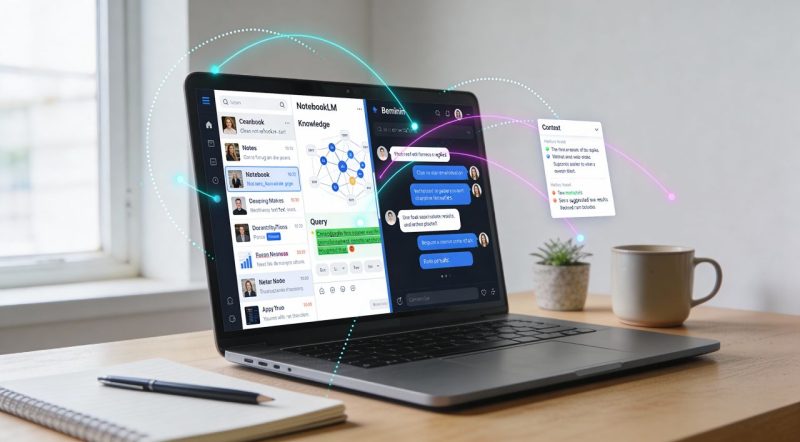
Google just made one of its quietest yet most strategically significant AI moves of 2025, and it happened without a formal announcement. The company is rolling out direct integration between NotebookLM, its source-grounded research assistant, and Gemini, its flagship AI chatbot.
Early users discovered the feature appearing silently in their Gemini interface last week, signaling a fundamental shift in how Google thinks about AI-powered knowledge work.
This isn’t just feature creep. It’s Google finally connecting the dots between two powerful but previously siloed tools, creating something that could redefine how researchers, students, and knowledge workers interact with their own information. More importantly, it’s a direct shot across the bow at Microsoft’s tightly integrated Copilot ecosystem and OpenAI’s file-handling capabilities in ChatGPT.
What Actually Changed
The integration works exactly as you’d hope: users can now attach entire NotebookLM notebooks directly to Gemini conversations through a new attachment option in the chat interface. Instead of the traditional secure file upload process, there’s now a “NotebookLM” button sitting alongside options for Drive, Gmail, and other Google services.
Select a notebook you’ve already created in NotebookLM (perhaps one containing research papers, meeting notes, or business documents) and Gemini immediately gains context from all those sources. Ask it to summarize findings across multiple documents, generate a comparative analysis, or draft content grounded in your specific materials, and it responds using your curated information rather than just its training data.
The execution is seamless enough that some users initially thought it was a bug. One early adopter on X uploaded a NotebookLM notebook containing Cambridge IGCSE Biology past exam papers, then asked Gemini: “What are the most frequently asked questions from chapter 1 based on the past papers provided?” Gemini responded with chapter-specific analysis pulled directly from the notebook’s contents, complete with citations.
Why This Integration Matters for Google’s Competitive Position
The timing reveals strategic calculation. Google released this integration the same week OpenAI launched GPT-5.2 and just weeks after Microsoft expanded Copilot’s integration across its entire productivity suite. The AI race has compressed to the point where companies are shipping major features within days of each other (what some analysts are calling “singularity-speed competition”).
NotebookLM has emerged as one of Google’s most surprisingly successful AI products. Originally launched as Project Tailwind, it differentiated itself through source-grounded responses (meaning it only answers questions based on documents you explicitly provide, dramatically reducing hallucinations). Features like Audio Overviews, which transform research materials into podcast-style conversations, and the recently added Deep Research capability have made it indispensable for students and professionals dealing with complex information.
But NotebookLM had one glaring weakness: it existed in isolation. While Gemini integrated tightly with Gmail, Calendar, Drive, and other Google services, NotebookLM required manual copying and pasting to connect with anything else. That friction made it powerful for focused research but clunky for everything that came after.
The integration solves that fundamental problem. Now, the source-grounded research capabilities of NotebookLM flow directly into Gemini’s broader conversational reasoning and task execution. You can research a topic in NotebookLM, then immediately leverage that research in Gemini to draft emails, create presentations, or run strategic analyses (all while maintaining traceability back to your original sources).
The Competitive Landscape Just Shifted
Microsoft’s advantage in the enterprise AI market has rested partly on the tight integration between Copilot and the entire Microsoft 365 ecosystem. OpenAI’s ChatGPT gained ground by allowing multi-file uploads and creating persistent “Projects” that maintain context across conversations. Anthropic’s Claude offers similar project-based organization.
Google’s response combines both approaches while adding something neither competitor can match: NotebookLM’s source-grounded methodology. When you attach a NotebookLM notebook to Gemini, you’re not just uploading files (you’re bringing in a pre-analyzed, structured knowledge base complete with existing summaries, generated study guides, mind maps, and audio overviews).
The feature also addresses a key criticism of AI assistants: they’re too willing to fabricate information. By routing complex research queries through NotebookLM’s architecture first, Google can maintain the citation-heavy, source-verified approach that made NotebookLM trustworthy while leveraging Gemini’s superior conversational abilities and broader integration points.
Geoffrey Hinton, often called the godfather of AI, recently suggested Google may now be surpassing OpenAI in certain capabilities. The NotebookLM integration exemplifies why: it’s not just about model performance but about creating coherent workflows that solve real problems knowledge workers actually face.
What Users Can Actually Do
The integration enables several powerful workflows that weren’t previously possible without manual data transfer:
Multi-notebook synthesis: NotebookLM doesn’t allow merging notebooks (each remains isolated). But through Gemini, users can now query multiple notebooks simultaneously, effectively using Gemini as a bridge between separate research projects. A consultant could maintain distinct notebooks for different clients, then ask Gemini to identify common themes or strategic insights across all of them.
Web research plus personal knowledge: Gemini can pull insights from the open web while simultaneously referencing your NotebookLM sources. This combination of external information with internally curated materials creates a more comprehensive research environment than either tool provided alone.
Advanced reasoning on curated sources: Gemini’s latest models, particularly the Gemini 3 Pro that powers enterprise features, excel at complex reasoning tasks. Connecting that reasoning capability to NotebookLM’s verified source material means you can run sophisticated analyses (competitive assessments, trend predictions, scenario modeling) grounded in documents you trust rather than the model’s potentially outdated training data.
Seamless artifact generation: Need to turn your research into a presentation, briefing document, or report? Previously, you’d have to export from NotebookLM, switch to Gemini or another tool, and reconstruct context. Now you can generate these artifacts directly in Gemini while maintaining full access to NotebookLM’s source citations.
The implementation even includes a “Sources” button in Gemini that opens the full NotebookLM interface, allowing users to verify citations or explore source materials in greater depth without leaving their workflow.
The Rollout Strategy and Current Limitations
Google is deploying the integration gradually, consistent with its typical approach to major feature launches. The feature appears to be web-only initially, with mobile support presumably following once Google validates the experience. Not all users have access yet, even among Gemini Advanced subscribers, suggesting a phased rollout based on region, account type, or other factors.
This staggered approach makes strategic sense given the complexity of connecting two sophisticated systems. NotebookLM handles sensitive user data (research papers, proprietary business documents, personal notes) and integrating that with Gemini’s broader capabilities requires careful attention to data handling, permissions, and privacy controls.
The gradual rollout also lets Google identify edge cases and performance issues before committing to full availability. Early reports suggest the integration performs well with standard use cases but hasn’t been stress-tested at scale. Questions remain about how it handles extremely large notebooks, complex multi-notebook queries, or edge cases like conflicting information across different sources.
Enterprise Implications and Business Model Questions
The integration has particularly significant implications for enterprise customers. Google Workspace has been pushing hard into AI-powered productivity with features like Duet AI (now branded under Gemini) across Gmail, Docs, Sheets, and Meet. NotebookLM Enterprise, available to business customers, includes enhanced security, administration controls, and collaboration features.
Connecting NotebookLM Enterprise to Gemini Enterprise creates a comprehensive knowledge management and analysis platform that could compete directly with Microsoft’s enterprise AI offerings. A business could maintain company-wide NotebookLM repositories (product documentation, market research, competitive analysis) then give employees access to that curated knowledge through natural language queries in Gemini.
This positions Google Cloud more competitively against Microsoft Azure and OpenAI’s enterprise services. Google Cloud has seen consistent revenue growth (exceeding 22% year-over-year), and AI services represent a key driver. The NotebookLM-Gemini integration gives Google a differentiated enterprise offering: not just another chatbot, but a complete knowledge work platform with verification and traceability built in.
The pricing structure raises interesting questions. NotebookLM offers a generous free tier with a paid NotebookLM Plus option that increases usage limits and adds features. Gemini similarly has free and paid tiers (Gemini Advanced). The integration appears available to free users, at least during this rollout phase, suggesting Google wants broad adoption rather than using it primarily as a premium feature.
Looking Forward: The Agentic AI Endgame
This integration represents an intermediate step toward something more ambitious: fully agentic AI systems that can autonomously complete complex, multi-step tasks while maintaining grounding in verified information.
Google has been experimenting with agentic capabilities through projects like Astra and Mariner, which aim to have AI assistants that don’t just answer questions but take actions (booking travel, updating calendars, coordinating across multiple services). The challenge with agentic systems is trust: how do you ensure an AI making autonomous decisions on your behalf isn’t hallucinating facts or making incorrect assumptions?
The NotebookLM integration provides a potential solution. By grounding agentic behaviors in source-verified information, Google could create AI agents that operate with both autonomy and reliability. Imagine an AI assistant that can conduct deep research using NotebookLM’s methodology, synthesize findings, generate strategic recommendations, draft implementation plans, and coordinate execution (all while maintaining clear traceability to source materials that humans can verify).
The competitive pressure to ship these capabilities is intense. Microsoft recently integrated Claude Opus 4.5 into GitHub Copilot and other developer tools within days of release. OpenAI is rumored to be working on GPT-5.3 enhancements. The pace of AI development has compressed to the point where weeks matter strategically.
Google’s approach (connecting specialized, high-reliability tools like NotebookLM to general-purpose reasoning engines like Gemini) might prove more durable than simply scaling model size. It acknowledges that different tasks require different balances of creativity, accuracy, and reliability.
The Bottom Line
Google’s NotebookLM-Gemini integration won’t generate the headlines that new model releases attract, but it might matter more in the long run. The real value of AI assistants isn’t just their ability to generate text or answer questions (it’s their ability to amplify human expertise by making information accessible and actionable).
By connecting NotebookLM’s source-grounded research capabilities with Gemini’s conversational reasoning and ecosystem integrations, Google created something genuinely useful: a knowledge work platform that combines reliability with flexibility. You get the verification and traceability of NotebookLM with the broader capabilities and integrations of Gemini.
The integration also signals Google’s evolving AI strategy. Rather than trying to build one monolithic AI that does everything, the company is creating specialized tools optimized for specific tasks and connecting them through coherent interfaces. NotebookLM handles research and source verification. Gemini handles conversation and reasoning. Drive provides storage. Gmail handles communication. Each component does what it does best, and the integrations let them work together seamlessly.
Whether this proves more effective than Microsoft’s integrated approach or OpenAI’s single-model strategy remains to be seen. But as the AI market compresses and competitors ship major features within days of each other, Google’s bet on connected specialist tools rather than generalist models might be the differentiation that matters.
For now, if you’re a Gemini user, check your attachment menu. You might find a NotebookLM option waiting there (quietly changing how you interact with your own knowledge).