
YouTube has officially become television. That’s not hyperbole or marketing spin. It’s what the data shows, month after month, as Google’s video platform has pulled away from every competitor in the most important metric that matters: actual time spent watching.
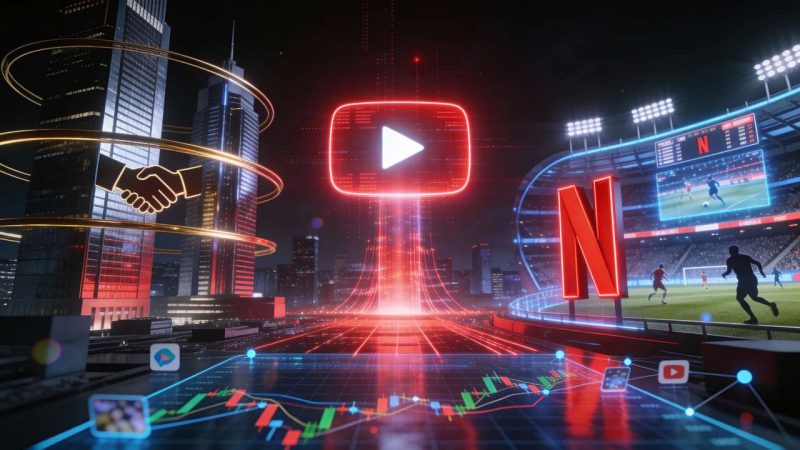
And while Netflix scrambles to reinvent itself through live sports and Warner Bros. Discovery, the streaming landscape is consolidating faster than anyone predicted, with billion-dollar acquisition deals reshaping who will survive the next decade.
According to Nielsen’s November 2025 Gauge report, YouTube now commands nearly 14% of all television viewing time in the United States. That’s more than any single streaming service, cable network, or broadcast channel. For context, streaming as a whole captured 47.3% of all TV time in July 2025, officially surpassing cable and broadcast combined for the first time. YouTube alone represents nearly a third of that streaming dominance.
The Numbers Tell the Story
YouTube’s rise has been methodical and relentless. The platform hit a record 11.6% share of TV viewing in February 2025, then 12.4% in April, then 12.5% in May, then 13.4% in July. By November, it had stabilized at 13.9%. This isn’t a spike driven by a single viral moment. It’s sustained growth that has widened the gap between YouTube and every competitor to historic proportions.
Nielsen’s Media Distributor Gauge shows YouTube leading Disney (which includes Hulu, Disney+, and ESPN+) by 4 full share points in July, the largest margin since tracking began in November 2023. Netflix, despite its massive subscriber base of over 301 million globally, sits at 8.8% of TV viewing time, roughly two-thirds of YouTube’s share.
Here’s what makes YouTube’s dominance particularly striking: Nielsen only measures television screens. YouTube reaches far more viewers on mobile devices and computers, meaning its true share of video consumption is significantly higher than these numbers suggest. CEO Neal Mohan has noted that for the first time, more Americans now watch YouTube on their televisions than on mobile devices, with users streaming over 1 billion hours of content daily on TV screens alone.
Netflix’s Live Gambit: Wrestling, Football, and a $5 Billion Bet
Netflix isn’t standing still. The company that once dismissed live programming as unnecessary has pivoted aggressively into live sports and events, making strategic bets that could reshape its business model entirely.
The centerpiece is WWE. Netflix signed a 10-year, $5 billion deal to become the exclusive streaming home for WWE Monday Night Raw in the U.S., Canada, UK, and Latin America. Since January 2025, the partnership has exceeded expectations, with Raw’s debut pulling in twice its average U.S. audience and viewership growing to 3 million per episode by August 2025. The platform also streams premium WWE events like WrestleMania and SummerSlam.
Then there’s football. Netflix aired two NFL Christmas Day games in 2024, drawing 26.5 million U.S. viewers and reaching 65 million American households. The company paid a reported $150 million for those rights and has extended the Christmas Day partnership through 2026. Industry observers note that Netflix is positioning itself for a much bigger prize: when Thursday Night Football and NFL Sunday Ticket rights (currently held by Amazon and YouTube) come up for renewal in 2030.
Netflix has also secured exclusive U.S. rights to the 2027 and 2031 FIFA Women’s World Cups, adding 128 matches across two tournaments to its live sports portfolio. The strategy is clear: build live streaming infrastructure now, prove reliability at scale, and be ready when the biggest sports rights hit the market later this decade.
The Consolidation Wave: Big Three Dominance Takes Shape
The streaming wars are evolving into something that looks increasingly like the airline industry or mobile carriers: a handful of giants controlling most of the market while smaller players either merge, get acquired, or slowly fade away.
Netflix’s $82.7 billion agreement to acquire Warner Bros. Discovery’s major assets (including Warner Bros. Pictures, DC Studios, and HBO Max) would create a streaming behemoth that combines Netflix’s 301 million subscribers with HBO Max’s content library and production infrastructure. The deal, announced in December 2025, immediately drew a competing $108.4 billion hostile bid from Paramount, setting up a bidding war that could define the industry’s structure for a generation.
This follows a pattern. Disney acquired 21st Century Fox for $71.3 billion in 2019. Amazon bought MGM for $8.5 billion in 2022. Skydance acquired Paramount Global. The survivors are getting bigger while the middle tier gets squeezed.
Warner Bros. Discovery CEO David Zaslav has been explicit about where this is heading: “2025 could offer a pace of change and an opportunity for consolidation that would provide a real positive and accelerated impact on this industry.” Translation: expect more deals, more mergers, and fewer independent platforms.
The Current Landscape: Who’s Where
Based on Nielsen data and subscriber counts, here’s how the major players stack up in late 2025:
YouTube: 13.9% of TV viewing time, dominant position in streaming viewership, estimated $550 billion valuation (higher than Netflix’s $520 billion). Over 8 million YouTube TV subscribers for its live TV service.
Netflix: 301.6 million global subscribers, 8.3% of TV viewing time, $31.6 billion in revenue (2023). Aggressively expanding into live sports and pursuing major acquisitions.
Amazon Prime Video: 200 million subscribers globally, roughly 21% market share by viewing hours, benefiting from Prime membership bundling. Owns Thursday Night Football rights.
Disney+ (including Hulu and ESPN+): 127.8 million Disney+ subscribers, combined 9.4% of TV viewing. Strong franchise content (Marvel, Star Wars, Pixar) but facing subscriber fatigue concerns.
Max (HBO Max): 127.2 million subscribers, potentially being acquired by Netflix or Paramount.
Peacock: Gaining ground through sports (NFL, Olympics), but still sub-scale at under 2% of TV viewing.
Paramount+: 79 million subscribers, pursuing aggressive M&A strategy after Skydance acquisition.
Free ad-supported (Tubi, Roku Channel): Growing rapidly as subscription fatigue drives viewers toward no-cost alternatives. Tubi particularly strong with younger and multicultural audiences.
What This Means for Consumers
The average American household now subscribes to 4.1 streaming services, down slightly from 4.2 in 2024. That number appears to have plateaued as consumers resist adding more monthly payments. The response from streamers has been predictable: ad-supported tiers, bundling deals, and password-sharing crackdowns.
Netflix’s ad tier now includes live sports with commercials across all subscription levels, even premium ad-free plans. Amazon Prime Video inserted ads for its 130 million U.S. viewers. Disney+ and Hulu are merging into a single app with combined content. The era of cheap, ad-free streaming is ending.
Consolidation could bring some benefits: fewer apps to manage, potentially lower prices through bundles, and larger content libraries in one place. But it also means less competition, which historically doesn’t favor consumers on pricing.
The Road Ahead
The streaming industry is entering what analysts call a “Big Three” phase, similar to how airlines, telecoms, and automakers have consolidated. Netflix, Amazon, and Disney are positioned to dominate, with YouTube (as part of Google/Alphabet) operating in a category of its own that blends creator content, live TV, and traditional streaming.
For Netflix, the acquisition of Warner Bros. Discovery would add HBO’s prestige content, DC’s superhero franchises, and Warner’s film library to a platform already flush with original programming. Combined with live sports rights, Netflix would become a true entertainment conglomerate rather than just a streaming service.
But YouTube’s structural advantages may be impossible to overcome. It doesn’t need to outbid competitors for sports rights or spend billions on scripted content. It has something no other platform can replicate: a creator ecosystem that produces millions of hours of content at essentially zero acquisition cost, algorithm-driven discovery that keeps viewers engaged, and a business model that works whether users pay or not.
As Mohan put it: “YouTube is the new television.” Based on the numbers, he’s right. The question is whether anyone can catch up, or if the rest of the industry is now fighting for second place.
Sources
- Nielsen – The Gauge and Media Distributor Gauge Reports (2025)
- Fortune – Netflix-Warner Deal Analysis
- The Wrap – Streaming Market Share Data
- Variety – YouTube Streaming Dominance Coverage
- Front Office Sports – Netflix Sports Rights Expansion
- EMARKETER – Netflix WWE Partnership Analysis
- Parrot Analytics – Streaming Consolidation Report
- Business of Apps – Video Streaming Statistics 2025
Editorial Image Prompt: A dramatic photorealistic editorial image showing multiple streaming service logos (YouTube, Netflix, Disney+, Amazon Prime) on a large smart TV screen in a modern living room, with a remote control in the foreground. Cinematic lighting with the TV as the primary light source, emphasizing the battle for the living room screen. Documentary style, 16:9 aspect ratio, professional news photography aesthetic similar to Bloomberg or The Verge coverage.