
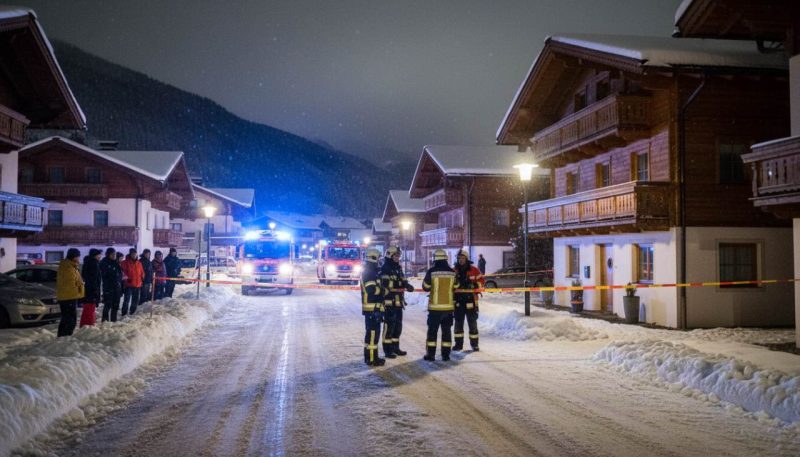
The party was supposed to be the safe, glossy version of risk, the kind you buy with a plane ticket, a lift pass and an overpriced glass of champagne. Instead, just after 1:30 a.m. on New Year’s Day in the Swiss resort town of Crans-Montana, a blaze inside a packed bar turned into one of the deadliest peacetime disasters in modern Swiss history.
By mid-morning, authorities in the canton of Valais were working with a grim estimate: around 40 people killed and roughly 115 injured after fire ripped through Le Constellation, a popular bar crowded with New Year’s revelers. The venue, tucked into a luxury ski resort best known for manicured pistes and second homes, suddenly became a trap.
Officials say the fire spread with shocking speed. Witnesses described a typical Alpine party scene with music, drinks, and sparklers, followed in seconds by a wave of flame and choking smoke. Investigators believe an open flame, possibly a candle or sparkler held too close to flammable décor or a wooden ceiling, ignited the interior. What followed appears to have been a classic flashover, where heat and gases accumulating until the room effectively exploded into fire.
Authorities have been quick to stress what this was not. There is no indication of terrorism or intentional arson, prosecutors say. This was an accident. But it was an accident enabled by architecture, design, regulation and enforcement, human choices nested inside a system that promised safety and delivered catastrophe instead.
A Tourist Town Turns Into A Mass Casualty Site
Crans-Montana is built to handle visitors. Over the holidays, its population swells with tourists from across Europe and beyond. Le Constellation was one of the places they went to feel part of the scene. On New Year’s Eve, the crowd inside reportedly numbered in the hundreds, with some estimates suggesting 300 to 400 people.
When the fire broke out, there was almost no margin for error. Confined space, combustible materials, and a crowd already pressed close together meant the first seconds mattered most. Many people did not get them.
Outside, the town pivoted instantly into something more like a war zone than a ski postcard. Dozens of ambulances, 10 to 13 helicopters, and around 150 first responders were deployed into the narrow streets. Hospitals in Sion, Lausanne, Geneva and Zurich were activated to receive the injured, many with severe burns and inhalation injuries. A no-fly zone was declared over the area and a helpline was set up for families desperate for news.
By daylight, the bar and surrounding area were sealed off behind cordons and police tape. The snow that draws tourists to the resort became a silent witness, showing tracks of emergency vehicles, boot prints, and melted slush stained by the lights of fire engines.
A Young, International Crowd Among The Dead
The victims are young and international, the sort of people who fill budget airlines and night trains to the Alps each winter. Among the dead and missing are Swiss, Italian, French and other European nationals. Italian authorities have reported that more than a dozen of their citizens were initially unaccounted for. The identification process is slow, in some cases agonizingly so, because severe burns have made bodies difficult to recognize.
Families across Europe spent New Year’s Day trying to get through to phones that would never ring again.
Switzerland’s president, Guy Parmelin, called the blaze “one of the worst tragedies our country has ever experienced.” He is right in a narrow sense, as large-scale civilian disasters are rare in Switzerland. But that rarity is part of what makes this fire so destabilizing. When a country trades on its reputation for order, for trains that run on time and codes that are enforced, failure lands harder.
When Safety Is A Brand, Failure Is Political
On the surface, this is a local story about a bar in a ski town. Look a bit deeper, and it’s a test of something bigger: what it means for a liberal democracy to make safety a central promise and then fall short.
The mechanics of the fire echo a depressingly familiar set of disasters: the Station nightclub fire in Rhode Island, the Kiss nightclub fire in Brazil, and the Colectiv club blaze in Bucharest. Different countries, similar pattern: an indoor venue packed beyond comfort, flammable soundproofing or décor, pyrotechnics or open flames used as atmosphere, insufficient or blocked exits, and a regulatory apparatus that looked solid on paper and porous in practice.
Crans-Montana adds another element: wealth. This wasn’t a neglected warehouse or a marginal club in a disinvested neighborhood. This was prime Alpine real estate, with regulators who know perfectly well how to enforce strict standards when it comes to property lines or building heights. If a bar in that context still turns into a deathtrap, that tells you the problem isn’t just resources, it’s priorities.
The Regulatory Gaps Hiding In Plain Sight
Investigators will eventually produce a timeline: the ignition point, the speed of spread, and the moment when escape routes were overwhelmed. But the crucial questions are already visible:
- Were there clear and sufficient emergency exits, well-marked and unobstructed, for a venue that could hold hundreds?
- Were occupancy limits realistic for the floor plan, and were they enforced on a night when everyone expected to be shoulder to shoulder?
- What rules governed the use of open flames or sparkler-style effects inside the venue and how seriously were they taken?
- When did the bar last undergo a fire safety inspection, and what did inspectors actually see?
Those aren’t technicalities. They are the difference between a frightening incident and a mass-casualty event. When they fail in a democracy, it is rarely because no one knew better. More often, it’s a softer, more insidious failure: inspectors overworked or under-empowered, local officials reluctant to crack down on profitable tourist businesses, and a culture that treats “festive atmosphere” as a reason to look away from risk.
That is governance. And governance is political.
Democratic Accountability In A Global Resort Economy
Because Crans-Montana’s clientele is international, the disaster doesn’t stop at Switzerland’s borders. Families in Italy, France and elsewhere will be watching how Swiss authorities handle what comes next, whether they choose full transparency or defensive opacity, and real accountability or ritual scapegoating.
In a liberal democracy, accountability after tragedy is as important as prevention before it. A credible response will require:
- A public, detailed report on the fire’s causes and the failures that allowed it to become so deadly.
- Legal consequences, both civil and criminal, if negligence is found, not just for bar owners and managers, but potentially for officials who failed to enforce rules they were entrusted with.
- Concrete, time-bound reforms to nightlife and resort safety, including stricter occupancy rules, tougher limits on indoor flames and pyrotechnics, and more invasive inspections, especially in venues heavily marketed to tourists.
There is a broader, quieter cost if those steps don’t happen. Open societies depend on a shared, almost invisible trust: that you can fly to another country to ski, dance, drink, and return home in one piece. When that trust is broken and shrugged off as “bad luck,” it corrodes not just tourism, but the sense that public institutions are capable of protecting ordinary people rather than wealth and image.
The Party, The Trap, And The Reckoning
By next week, the snow in Crans-Montana will be fresh again. The lifts will run. New visitors will arrive. Resorts are good at returning to normal, as it is their business model.
But for dozens of families, there is no normal to return to. Their new year began with a phone call, if they were lucky, or a news alert if they were not. For them, the question is painfully specific: How could this happen in a place that promised it would not?
The honest answer will not be found in talk of freak accidents or fate. It will come from whether Swiss institutions, so often held up as models of competence, are willing to treat this fire as a systemic failure, not a tragic outlier. If they do, the legacy of the dead could be something more than numbers in a headline: a line in the code book, a new standard, or a life saved at some future party, in some other crowded room, when the lights go down and the music comes up.