
At the stroke of midnight, New York City quietly welcomed a new mayor. By midafternoon, it was clear that Zohran Mamdani intends to be more than a caretaker of the status quo.
Mamdani, 34, a Democratic Socialist and the city’s first Muslim and first South Asian mayor, was officially sworn in just after midnight on New Year’s Day in the shuttered Old City Hall subway station. Attorney General Letitia James administered the oath as Mamdani placed his hand on two Qurans, one from his grandfather and another from the New York Public Library’s collection once owned by Arturo Schomburg. The ceremony was small and legally precise. It transferred power. It also told a story about who this city is for.
Most mayors mark the formal moment of succession at City Hall or Gracie Mansion. Mamdani chose a decommissioned station that riders now glimpse only as a blur through train windows. The decision turned the subway itself into a kind of inaugural text. It framed public transit as a civic treasure and suggested that too much of New York’s beauty and history has been closed off from the people who paid for it. The setting matched the mayor’s campaign promise to treat buses and trains not as afterthoughts but as central guarantees of urban citizenship.
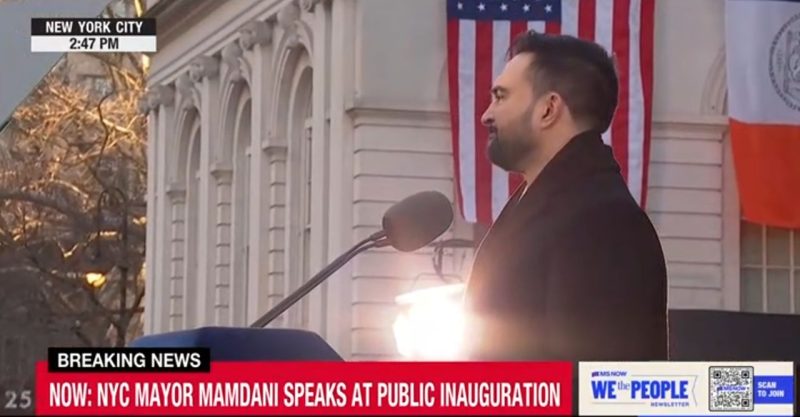
By early afternoon the mood had shifted from quiet ritual to public celebration. On the steps of City Hall, Mamdani raised his right hand again for a ceremonial oath in front of thousands of supporters gathered in the cold. The plaza had the feel of both a political rally and a street festival. Volunteers handed out signs. Chants of his first name rolled down the steps. Drums and brass mixed with the sound of subway lines rumbling beneath Lower Manhattan.
Senator Bernie Sanders delivered the symbolic oath. The crowd answered with the familiar chant of his name, a reminder that New York’s new mayor comes from a political lineage that once seemed far outside city hall culture. Representative Alexandria Ocasio Cortez opened the program with a speech that cast the election as a test of courage for a city she described as tired of being managed around the edges. Performers including Lucy Dacus and Mandy Patinkin took the stage, contributing to a program that felt less like a procession of dignitaries and more like a curated portrait of the coalition that brought Mamdani to power.
The guest list mattered. Sharing the platform with the public advocate, the comptroller and neighborhood organizers allowed Mamdani to frame his rise not as a solitary achievement but as the latest chapter in a decade of progressive organizing. For years, that movement has pushed for rent protections, police accountability and transit investment. Now it controls the city’s most powerful office and will be judged not on its rhetoric but on its results.
In his speech Mamdani leaned into that responsibility. He sketched a program built around a citywide rent freeze, a more aggressive posture toward landlords who leave apartments vacant, free buses, expanded transit service and universal childcare. To pay for it, he promised new taxes on the wealthiest residents and on corporations that treat New York as a Playground rather than a home. He described these not as wishful slogans but as necessary corrections for a city where too many residents feel that prosperity passes over their heads.
The challenges are obvious. Albany holds key powers over taxation, rent regulation and the transit system. Bond markets and real estate interests are watching closely. Past mayors who promised to shake the city’s economic order discovered how quickly structural limits can narrow the imagination. Mamdani’s success will depend on whether he can convert his electoral mandate and his movement’s organizing muscle into leverage in those less visible arenas.
For now, his team is trying to reshape expectations about what a mayor is supposed to do. The midnight oath underground and the mass ceremony in the winter light above ground worked together as a visual argument. Government, he suggested, should be felt in the everyday experience of riding a bus, signing a lease or walking through a neighborhood that still feels like home. The measure of city hall will not only be crime rates or bond ratings but the degree of freedom and security that ordinary New Yorkers feel in their lives.
Outside New York the inauguration is being read as part of a broader story. Around the world, large cities have become laboratories for ambitious housing and climate policy. With Mamdani, New York joins that roster more explicitly. A left wing mayor who campaigned on rent freezes and free transit now governs the country’s largest city and one of the world’s financial capitals. Political strategists from Boston to Barcelona are watching to see whether his program can survive contact with budget season.
The risks are real. The same energy that filled Broadway with supporters could flare into frustration if rents continue to rise or if transit improvements stall. Opponents are already prepared to interpret any crime statistic or fiscal shortfall as proof that ambitious social policy is incompatible with competent governance.
Yet the first day of the Mamdani administration suggested that the new mayor understands how much of politics is narrative. He took the oath in a closed station built for a different era of public ambition and then addressed the city from the steps that have hosted generations of power. Between those two images he placed a promise: that New York’s next chapter will be written not only for capital and tourists but for the people who ride the trains, wait at the bus stop and wonder each year whether they can still afford to stay.