
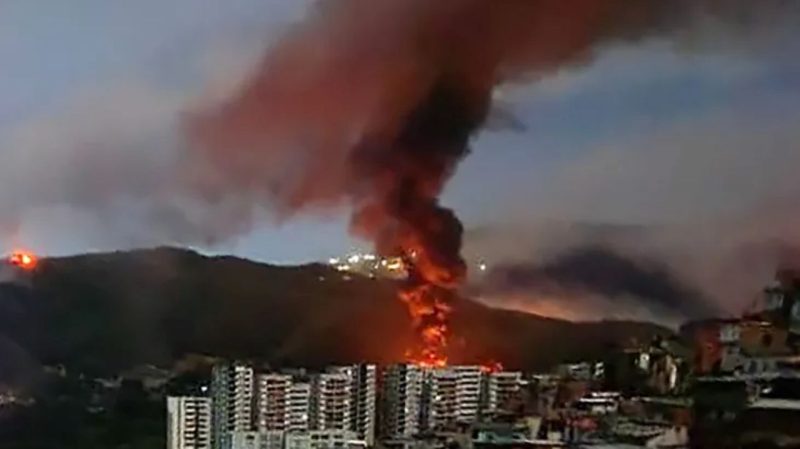
If you wanted a single night to capture the contradictions of American power, this was it: explosions over Caracas, power cut to neighborhoods around key military bases, and then an early‑morning social‑media post from President Donald Trump declaring that Venezuelan leader Nicolás Maduro and his wife, Cilia Flores, had been captured and flown out of the country.
For Venezuelans, it could be the end of an era. For the rest of the world, it is a deeply unsettling experiment: can the United States use criminal indictments as a runway for invading another country’s capital and snatching its head of state?
The answer will define not just Venezuela’s transition, but the future of democratic norms in the hemisphere.
What Happened In Caracas, And What We Actually Know
Across multiple credible outlets, the spine of the story is consistent. Late Friday and into early Saturday, residents of Caracas reported loud explosions and flashes near strategic military sites, including La Carlota Airbase and the vast Fuerte Tiuna complex. Parts of the city went dark as power failed in southern districts, with witnesses describing what looked like strikes on air‑defense systems and communications hubs.
Hours later, Trump took to social media to claim a “large scale strike” on Venezuela and to announce that Maduro and Flores had been “captured and flown out of the Country,” calling it a joint operation with U.S. law‑enforcement agencies. That claim has since been echoed by U.S. officials, including Senator Mike Lee, who cited Secretary of State Marco Rubio as confirming that Maduro was in U.S. custody to face longstanding narco‑terrorism charges stemming from a 2020 indictment that once carried a multi‑million‑dollar reward.
From inside Venezuela, the picture is murkier. Vice President Delcy Rodríguez says she does not know where Maduro or Flores are and has publicly demanded proof of life, while Defense Minister Vladimir Padrino López has promised resistance and cast the strikes as an illegal foreign invasion.
What we do not have yet is independent visual confirmation of the couple in custody or clarity on where they have been taken. This is, in the strictest sense, a breaking story. But we have enough to understand the stakes.
When Indictments Ride In On Airstrikes
On the surface, the U.S. case against Maduro is familiar. The Justice Department has for years accused his government of turning the Venezuelan state into a narco‑trafficking enterprise, charging him and aides with conspiring to ship tons of cocaine to the United States. His wife, Cilia Flores, is not a political novice but a central player in chavismo: a former National Assembly president and attorney general whose nephews were convicted in New York for attempting to smuggle cocaine, a case that helped frame Washington’s narrative of a “narco‑regime.”
The leap is not the indictment; it is the method of enforcement. Instead of extradition talk, we have cruise missiles and special operators. Rather than a request filed with a foreign ministry, there is a pre‑dawn raid in another country’s capital and a presidential victory lap on social media.
Legally, Washington will argue two things:
- Domestic authority: that the president can use force to protect U.S. national security and execute criminal warrants tied to terrorism and drug trafficking, drawing on old Authorizations for the Use of Military Force and counter‑narcotics statutes.
- International justification: that Maduro was no longer a legitimate head of state but a criminal usurper, and that his capture was necessary to end a criminal enterprise victimizing both Venezuelans and Americans.
If you believe in the rule of law as something more than clever lawyering, that is a dangerously elastic reading. Head‑of‑state immunity and national sovereignty are not progressive talking points; they are the guardrails that keep might from becoming its own justification. When the United States claims the right to cross those lines unilaterally, it hands every other major power the same rhetorical license.
Imagine Russia announcing that a foreign leader is corrupt and dangerous, issuing its own indictment, and then bombing that leader’s capital to “serve the warrant.” If you are comfortable with Washington’s logic tonight, you have to be prepared to live with Moscow’s or Beijing’s version tomorrow.
Venezuelans Between Justice And Yet Another Foreign Script
None of this absolves Maduro. His government wrecked a country that was once wealthy and proudly democratic: packing courts, neutering an opposition‑controlled legislature, greenlighting security forces that killed and tortured opponents, and mismanaging the oil economy into free fall. Millions have left; those who remain endure hyperinflation, shortages, and a collapsing health‑care system.
So yes, many Venezuelans, especially in the diaspora, will feel a fierce, almost guilty relief. The man who broke their country might finally face real accountability, and not from a pliant Venezuelan court.
The danger is that justice arrives wrapped in the old imperial script. Latin America has a long list of U.S. interventions carried out “for democracy” that ended in blood and backlash: Guatemala’s coup in 1954, Chile’s in 1973, Panama in 1989. Today’s operation will be read through that history, not outside it.
That creates three hard problems for any democratic transition:
- Legitimacy: whoever follows Maduro will be tainted if they look like they were installed by U.S. force. Even Venezuelans who despised Maduro may bristle at the sense that Washington is picking winners and losers.
- Security fragmentation: if some units of the armed forces fight on and others cut deals, the country could slip into a hybrid of low‑grade civil conflict and warlordism. That is a terrible environment in which to rebuild courts and electoral institutions.
- Polarization with neighbors: regional governments, including democracies, will be reluctant to bless a precedent that says Washington can abduct a sitting president while citing criminal charges. Expect hedged statements and lots of talk about sovereignty, even from leaders who privately despise Maduro.
Real democratic reconstruction in Venezuela would mean independent courts, credible elections, and some kind of negotiated accommodation with at least parts of the chavista base. That work cannot be done from a C‑17 cargo hold.
Trump’s Strongman Moment And The Hypocrisy Problem
It is impossible to ignore the domestic politics. Trump has run for years on a muscular, grievance‑soaked vision of American power: railing against “witch hunts” at home while praising hard‑line leaders abroad. Now he is the president boasting that he captured a foreign strongman on the strength of U.S. indictments.
The irony is glaring. A president under multiple criminal cases is leaning on the moral authority of U.S. prosecutors and judges to justify a risky foreign operation. A movement that has attacked independent institutions as part of a “deep state” suddenly venerates those same institutions when they function as a legal veneer for regime change.
This is where the progressive worry kicks in: if you normalize military solutions to messy foreign problems, you not only short‑circuit diplomacy, you also teach your own public that violence is a legitimate extension of domestic legal disputes. The fantasy that “we can just go in and take him out” abroad will have a domestic echo every time a segment of the electorate decides that courts have become obstacles rather than referees.
What This Means For Global Democracy
Democracy advocates often talk about a rules‑based international order. The phrase is clunky, but the idea is simple: even powerful countries should submit to norms that limit what they can do.
The Maduro raid, as reported so far, cuts both ways.
On one hand, it says dictators and kleptocrats cannot count on impunity. If you flood another country with cocaine and crush your own civil society, you may one day find yourself in a U.S. courtroom explaining it to a jury.
On the other, it reinforces the fear that “democracy promotion” is just a marketing arm for American hard power, that principles are cited when convenient and ignored when they get in the way.
The best‑case scenario from a democratic‑norms perspective looks like this: Maduro and Flores surface alive, are given due‑process protections that are visible and real, and face open trials that lay out their alleged crimes in a way Venezuelans can see. Washington then backs a genuinely inclusive transition in Venezuela, not only the genteel opposition but labor groups, chavista voters, and human‑rights advocates, and resists the temptation to turn the country into a Cold War trophy.
The more likely outcomes are messier: prolonged instability in Caracas, a contested successor government, and yet another argument for every future autocrat that the United States talks about law but practices might.
In that sense, what happened overnight is not just a question of whether Maduro finally meets justice. It is a question of whether the democratic world can hold two truths at once: that some leaders are criminals, and that even criminals deserve institutions stronger than the people who occupy them.
If rule of law is going to mean anything beyond “what Washington says it means this year,” those institutions, courts, Congress, international forums, need to start asserting themselves now. Otherwise, the next president with a grudge and a drone fleet will have a simple playbook: indict, invade, announce.