
Minneapolis is once again the place where America runs its arguments about policing, state power, and who gets protected by the system. This time, the flashpoint is the killing of Renee Nicole Good, a 37 year old US citizen who was shot by an ICE agent during a federal operation in south Minneapolis. The protests that erupted in the aftermath did not stay local. They spread, because the underlying fear is not local either: a federal enforcement surge, an on the ground confrontation caught in multiple videos, and an investigation structure that many Minnesotans do not trust.
What is happening is bigger than one city block. It is a test of how immigration enforcement is being conducted inside American communities, what accountability looks like when the federal government investigates itself, and whether democratic norms can hold when officials choose escalation over transparency.
What Happened In Minneapolis
The basic facts are not in dispute. Renee Nicole Good was shot and killed during an ICE operation near East 34th Street and Portland Avenue in south Minneapolis. The dispute is over what led to the shooting and whether lethal force was justified.
Federal officials, including Department of Homeland Security leadership, have argued that Good used her vehicle as a weapon and that the agent acted in self defense. Local leaders have strongly rejected that framing. Minneapolis Mayor Jacob Frey publicly told ICE to leave the city and said the federal narrative was false. The anger is amplified by video that, according to multiple news reports, appears inconsistent with the claim that an officer was run over.
In a city that still lives with the memory of George Floyd’s murder and the institutional failures that followed, the perception that the government is rewriting visible reality is not just provocative. It is destabilizing.
The Federal Surge And The Atmosphere Of Occupation
This killing landed in the middle of a broader Trump administration push that has brought a major increase in federal immigration enforcement activity in the Twin Cities. Residents and immigrant rights advocates described a climate of fear, constant sightings of federal vehicles, and a sense that ordinary daily life is being reorganized around avoiding the state.
When you flood a city with federal agents, you change the rules of public space. The street stops feeling like a street. It starts feeling like a checkpoint. That is why protests formed quickly at the shooting site and at federal buildings. People were not only reacting to the death. They were reacting to the idea that this surge is the new baseline.
Protests Spread And Tensions Rise
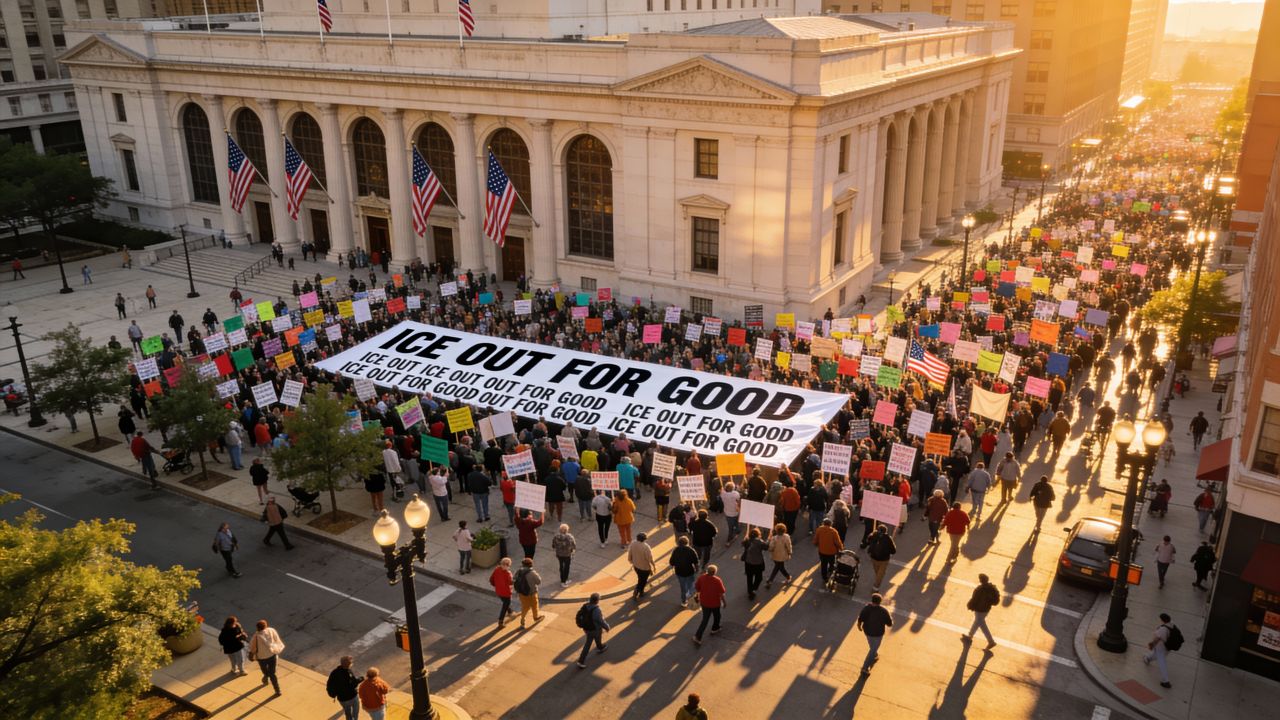
In Minneapolis, demonstrators erected barricades near the shooting location and declared a “no ICE zone.” Crowds confronted federal vehicles. Police and federal agents used crowd control measures during clashes near federal facilities.
Vigils and protests also appeared in other cities, reflecting how quickly local trauma becomes national symbolism in an era where video circulates faster than official statements.
This is not simply activism by association. It is pattern recognition. People see a set of institutions that can use force, control the narrative, and control the investigation. They respond by trying to build public pressure, because that is the only leverage they believe they have.
The Investigation Problem Is The Democracy Problem
If you want to know why this story is exploding, look at the investigation structure.
Minnesota’s Bureau of Criminal Apprehension said it was initially participating in a joint investigation, then was blocked from access to key materials. That matters because credibility is not a public relations problem. It is the core product of a justice system. When state and local officials say they cannot independently review evidence, interviews, and scene materials, people assume the outcome is pre selected.
This is how legitimacy collapses. Not with one scandal, but with the accumulation of processes that look designed to prevent accountability.
The Portland Echo And The Broader Political Stakes
At roughly the same time, a separate shooting by a Border Patrol agent in Portland added gasoline to the national mood. Even without proving equivalence between incidents, the public reads them together as evidence of a broader posture: heavily armed federal immigration enforcement operating inside cities, with escalating confrontations and unclear guardrails.
Politically, the administration appears to be leaning into a message that equates interference with enforcement to criminality or even terrorism, while Democratic leaders are framing this as reckless overreach and a threat to civil liberties. The fight is not just about one shooting. It is about whether immigration enforcement is becoming a domestic security project with looser accountability norms than traditional policing.
A progressive lens sees an obvious danger here: when the state expands coercive power in the name of immigration control, those powers rarely stay neatly confined. They migrate. They become tools for other fights, other targets, other justifications.
What Comes Next
Three things will determine whether this becomes a turning point or just another grim entry in the national ledger.
First, transparency. Not performative transparency, but real access to evidence, independent oversight, and clear standards for use of force.
Second, accountability pathways. If state authorities remain sidelined and federal investigators clear federal agents behind closed doors, the backlash will not dissipate. It will metastasize.
Third, policy choices. If the federal surge continues at the same intensity, the operational tempo will produce more confrontations. That is not ideology. It is physics.
This story is about a life lost. It is also about what kind of country we are choosing to be when federal power shows up in a neighborhood, pulls the trigger, and then tries to own the entire process of explaining why.