
Despite Intel finally losing its position as one of the top three semiconductor companies by revenue last year, the technology race remains its key battleground and, at the same time, the primary source of skepticism among market participants.
The focus is shifting not so much to current financial performance as to Intel’s ability to become a full-fledged contract manufacturer capable of competing with TSMC and Samsung in advanced process technologies.
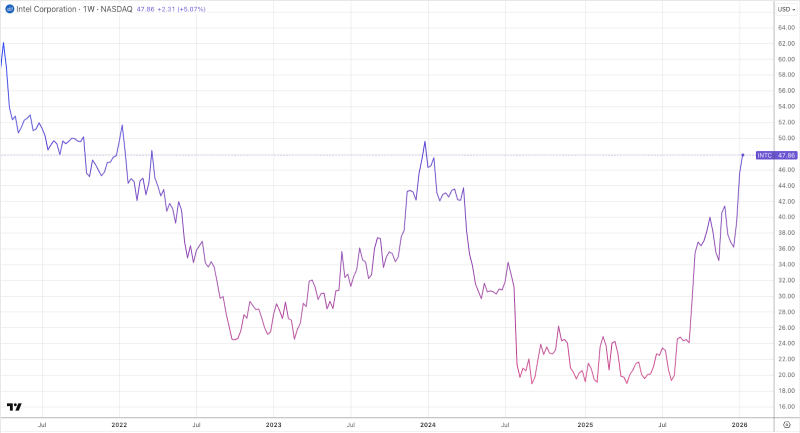
It is becoming clear that Intel’s 18A process technology is already demonstrating a yield rate of over 60%, which is markedly better than Samsung’s and only moderately inferior to the early stages of TSMC’s 2nm production. This result is crucial in itself, but more importantly, the 18A has actually become a transitional stage, because it is primarily focused on Intel’s internal products and serves as the technological foundation for the next step — the 14A process technology. In this context, expectations around the 18A process and Intel’s next steps are already reflected in the dynamics of the Nasdaq index futures. They exhibit increased volatility during periods of news releases about semiconductor companies’ production prospects. At the same time, Intel’s weight in the S&P 500 makes such volatility relevant for broader equity benchmarks, not just technology-heavy indices.
It is 14A that Intel management considers critically essential for the company’s future. At CES 2026, CEO Lip-Bu Tan publicly emphasized that development of the 14A is proceeding according to plan, and that the first PDKs for customers will be available in the near future. This process should consolidate Intel’s transition to second-generation RibbonFET transistors and the PowerDirect power supply circuit, while also offering elements such as Turbo Cells that can increase frequencies without significantly increasing power consumption and chip area. In fact, this is an attempt not just to catch up with competitors, but to offer its own technological narrative.
However, Intel’s key problem is not so much technology as economics. Unlike TSMC and Samsung, Intel has historically introduced capacity based on its own demand, rather than guaranteed orders from external customers. When switching to 14A, this becomes especially risky, since the process technology requires both low-NA and high-NA EUV tools, and capital costs increase to levels where downtime is unacceptable. Any large external order, such as those from major players like Apple, Nvidia, AMD, or Qualcomm, automatically requires investing long before revenue is generated, pushing back the break-even point for the contract business.
There is interest from potential customers and investors, but it remains cautious. Nvidia, for instance, considered using Intel’s 18A process technology but ultimately decided not to. This does not appear to be an outright rejection, and for large chip developers, testing alternatives to TSMC is a common practice. Instead, this episode highlights the 18A as an interim solution, while the real bets are on the 14A, which should become a long-lived Intel product for the external market.
At the same time, the interaction between Intel and Nvidia is gradually deepening in other formats. The companies have already signed an agreement worth about $5 billion to integrate Nvidia RTX chiplets into Intel processors for PCs and data centers. Intel has experience working with GPU tiles, and in the future, this will open the way to hybrid processors, where customers will be able to choose between Arc graphics and Nvidia solutions. It is significant that, according to Jensen Huang, work on this collaboration began last year under strict confidentiality.
Against the backdrop of these technological developments, more mundane market factors are also evident. In the server segment, Intel and AMD have already sold out a significant portion of their production programs for the current year, which creates the prerequisites for a 10-15% price increase for server CPUs. At the same time, AMD can increase the supply of server processors by more than 50%, and in the AI accelerator segment, expects to generate revenue of up to $15 billion, driven by the Instinct line and Helios rack solutions. All this increases the pressure on Intel, as the lag in the AI segment must be compensated for by placing greater emphasis on chip production and packaging.
As a result, Intel’s strategy is increasingly looking like an all-in bet. The success of 14A can transform the company into a full-fledged player in the contract market, thereby changing the industry’s balance of power. Failure threatens to leave Intel with expensive capacities, loaded mainly with its own orders, and with a prolonged break-even point. For investors, this is not a story about quarterly reports, but about the belief that this time a technological turnaround will actually occur.