
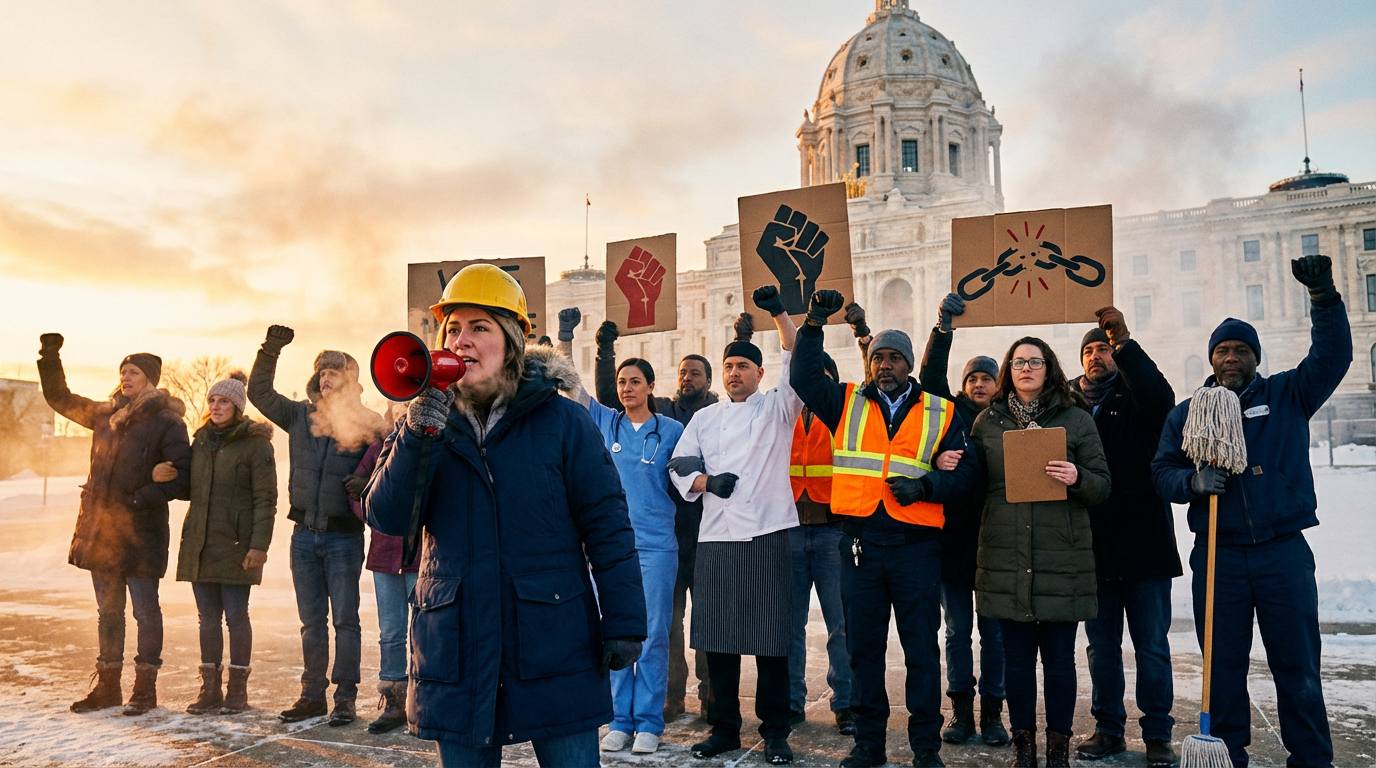
Minnesota is attempting something America hasn’t seen in nearly a century: a general strike. On Friday, January 23, unions, businesses, schools, and faith groups are calling for a complete economic shutdown under the banner “ICE Out of Minnesota: Day of Truth and Freedom.”
The call is simple: no work, no school, no shopping.
The trigger? The January 7 killing of Renee Good, a 37-year-old American citizen, poet, and mother of three, by ICE agent Jonathan Ross. Good had just dropped her six-year-old son off at school when she encountered federal agents swarming her south Minneapolis neighborhood. Within minutes, she was dead, shot multiple times as she sat in her SUV.
The Killing That Ignited a Movement
The circumstances of Good’s death remain bitterly disputed. Federal officials, including President Trump and Homeland Security Secretary Kristi Noem, claim she “weaponized her vehicle” and tried to run over the agent. Minneapolis Mayor Jacob Frey saw the video and responded with unusual bluntness: “Having seen the video myself, I want to tell everybody directly that is bullshit.” He followed with a message to ICE: “Get the fuck out of Minneapolis.”
Good’s killing was not an isolated incident. It marked the ninth time since September 2025 that ICE agents had opened fire on people across five states and Washington, D.C. Just one day earlier, DHS had announced what it called the largest immigration enforcement operation ever carried out, deploying 2,000 agents to the Minneapolis-St. Paul metropolitan area. A week after Good’s death, another federal agent shot a Venezuelan immigrant in the leg. Agents have sprayed chemical irritants directly into protesters’ faces.
Governor Tim Walz proclaimed January 9 as “Renee Good Day.” He later described the situation in stark terms, saying developments in the state “defy belief” and that “news reports simply don’t do justice to the level of chaos and disruption and trauma the federal government is raining down upon our communities.”
Labor Unions Unite Behind the Shutdown
What makes Friday’s action remarkable is the breadth of labor support. The Minneapolis Regional Labor Federation, AFL-CIO, along with the Saint Paul Regional Labor Federation, West Area Labor Council, North East Area Labor Council, and East Central Labor Council have all endorsed the shutdown.
Individual unions backing the call include Service Employees Local 26, UNITE HERE Local 17, Communications Workers Local 7250, the St. Paul Federation of Educators, the Minneapolis Federation of Educators, IATSE Local 13, the Amalgamated Transit Union Local 1005, the Committee of Interns and Residents, and the United Electrical Workers Local 1105 at the University of Minnesota.
“The Minnesota labor movement is united against the violent ICE occupation of our beloved cities that has directly impacted union members, our workplaces and our families,” the unions said in a joint statement.
Chelsie Glaubitz Gabiou, president of the Minneapolis Regional Labor Federation, framed the action as necessary to break corporate silence. “Parents are being forced to stay home, students held out of school, fearing for their lives, all while the employer class remains silent,” she said. “It’s time for every single Minnesotan who loves this state and the notion of truth and freedom to raise their voices.”
Businesses Join the Shutdown
The strike extends well beyond organized labor. Over 100 businesses, restaurants, and co-ops across the Twin Cities have announced they will close their doors Friday. Grocery stores, coffee shops, and retail establishments are participating. Dozens more businesses that remain open have pledged to donate a portion of Friday’s sales to organizations like the Immigrant Law Center of Minnesota and the Immigrant Rapid Response Fund.
Some businesses are doing more than simply closing. Pillar Forum Cafe and Commodities, a coffee shop and music venue in northeast Minneapolis, has become a hub for organizing. “From the beginning of when this issue began in Minneapolis, all of us here know how we feel about the matter and have been very vocal that we are against ICE,” said Valentine Lowry-Ortega, who works at the cafe. “We are against them being in our spaces and we are against sanctioned violence.”
The Demands
The coalition has three core demands: ICE must leave Minnesota immediately, the agent who killed Renee Good must face legal accountability, and Congress must reject any additional federal funding for ICE in the upcoming budget.
Organizers are calling for a march and rally in downtown Minneapolis beginning at 2 p.m. Friday. Keiran Knutson, president of Communications Workers of America Local 7250, told reporters that organizers hope to see “tens of thousands of workers in the street in the Twin Cities.”
National Solidarity and Historical Context
Minnesota is not acting alone. Payday Report has documented solidarity strikes planned in 120 cities across the United States. The week leading up to Friday has included targeted actions against companies accused of enabling ICE operations: Target, Home Depot, Enterprise, Hilton, and Delta.
General strikes are extraordinarily rare in American history. Minneapolis itself was the site of a landmark general strike nearly 100 years ago, organized by truck drivers with Teamsters Local 574 in 1934. That action helped establish the modern labor movement and demonstrated how collective economic power could force political change.
Whether Friday’s action can approach that scale remains to be seen. As labor organizers acknowledge, no union has formally voted to strike. Workers who walk off the job could face consequences, though the Minnesota AFL-CIO has established a legal fund targeting $150,000 to support any worker who faces illegal detention, regardless of union membership.
The Stakes for Minnesota
The situation in Minneapolis has escalated dramatically. Schools have offered virtual learning options through February as ICE vehicles have been spotted circling school grounds. Roosevelt High School has become a particularly tense flashpoint, with reports of agents gassing students and teachers.
Trump has responded to the resistance by announcing the National Guard could deploy to the Twin Cities. He has alerted 1,500 soldiers of the 11th Airborne Division that they may be sent to Minnesota. A U.S. Border Patrol official blamed “anarchists” along with Governor Walz and Mayor Frey for the violence.
For organizers, the confrontation is precisely the point. “This is not a request. This is a rupture. This is a protest and a promise,” read a statement from the Women’s March, which coordinated a one-minute national walkout on January 20. “A free America begins the moment we refuse to cooperate.”
Friday will test whether that promise has teeth, or whether it becomes another moment of protest that fades into the news cycle. If tens of thousands of Minnesotans actually stay home, the economic message will be hard to ignore. If the turnout disappoints, it could deflate momentum that has been building since Good’s death.
Either way, the question Minnesota is asking isn’t just about immigration enforcement. It’s about what ordinary people can do when they believe their government has crossed a line, and whether collective economic action can still shift the balance of power in 21st-century America.