
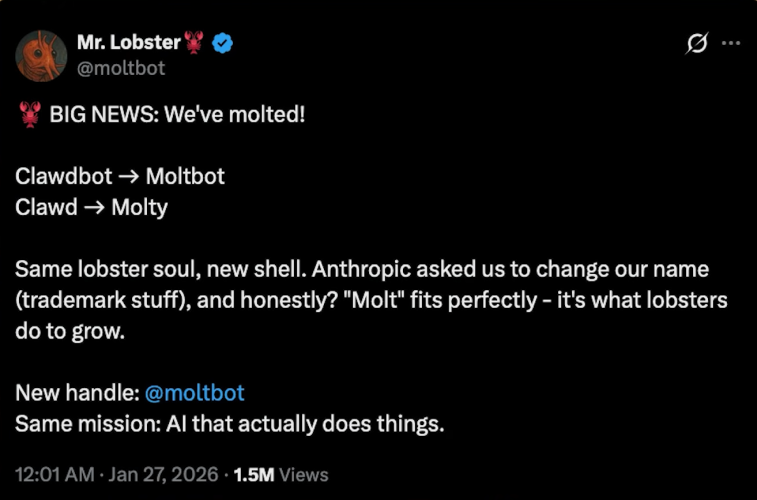
Clawdbot renamed MOLTBOT – We are guessing Anthropic had an issue with the name!
For over a decade, tech companies promised us AI assistants that would transform our lives. Siri arrived in 2011. Google Assistant followed in 2016. Alexa colonized millions of kitchens. And yet, in 2026, most of us are still frustrated, still repeating ourselves, still wondering why our “smart” assistants can’t remember a conversation from five minutes ago.
Then came Clawdbot. And suddenly, that future we were promised doesn’t seem so far away.
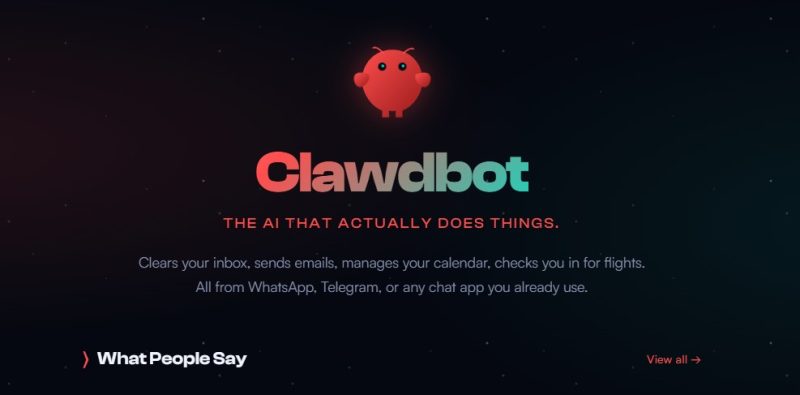
Created by Peter Steinberger, the Austrian developer who founded PSPDFKit and sold it to Insight Partners in 2021, Clawdbot is an open source AI assistant that runs on your own hardware and connects to messaging apps you already use: WhatsApp, Telegram, Discord, Slack, Signal, even iMessage. But here’s what makes it different from every other AI assistant you’ve tried: it actually does things.
Why Everyone Is Suddenly Obsessed With A Lobster
Clawdbot has exploded across the tech world in January 2026, racking up over 44,000 GitHub stars and spawning a Discord community of nearly 9,000 members who are actively building, tinkering, and sharing what their personal AI can do. The project’s mascot is a lobster (the name is a playful nod to Anthropic’s Claude), and the tagline says everything you need to know: “The AI that actually does things.”
Steinberger came out of retirement specifically to build this. After 13 years shipping native iOS apps, he dove headfirst into what he calls “vibe coding mode,” leveraging AI tools to build developer utilities at breakneck speed. Clawdbot isn’t just another project in his portfolio. It’s the culmination of years of thinking about what a personal AI assistant should actually be.
“2026 is already the year of personal agents,” one user wrote on X. Another put it more bluntly: “@clawdbot is Jarvis. It already exists.”
What Clawdbot Actually Does
Unlike ChatGPT or Claude’s web interface, Clawdbot doesn’t live in a browser tab waiting for you to visit. It runs 24/7 on your own machine (a Mac Mini, a Raspberry Pi, a cheap VPS, whatever you have), maintains persistent memory across conversations, and can proactively reach out to you when something needs your attention.
The use cases people are sharing online read like science fiction that somehow became real overnight. Users report having Clawdbot automatically process thousands of emails, unsubscribing from newsletters and drafting replies. Others have it monitoring cryptocurrency prices and executing trades (with approval prompts for safety). Some are using it to debug code from their phones while watching Netflix in bed.
One developer described telling his Clawdbot, named “Ema,” via Telegram to shut down his PC. It executed the command perfectly, effectively turning itself off in the process. Another rebuilt his entire website through Telegram messages while lounging on the couch.
The system works by running a local “gateway” that connects to your messaging platforms and routes commands to the underlying AI model, typically Anthropic’s Claude Opus 4.5, though you can use local models through Ollama if you want maximum privacy. It has full system access by default: it can read and write files, execute shell commands, control your browser, fill out forms, and even write its own plugins when you ask it to learn new skills.
The Privacy Proposition That Big Tech Can’t Match
Here’s the part that should make Apple, Google, and Amazon executives nervous: Clawdbot runs entirely on your hardware. Your data never touches anyone else’s servers (aside from the API calls to whatever language model you’re using). Your conversation history, your preferences, your automations, all of it stays local.
This is the opposite of how Big Tech’s assistants work. Siri sends your voice to Apple’s servers. Alexa processes everything through Amazon’s cloud. Google Assistant feeds your queries into the world’s largest advertising machine. Clawdbot, by contrast, is what Steinberger calls “decentralized, transparent, and under complete user control.”
The tradeoff, of course, is complexity. Getting Clawdbot running takes anywhere from 30 minutes for a basic setup to several hours for a fully configured installation. You need to be comfortable with terminal commands, API keys, and some light troubleshooting. This isn’t a tool for your technophobe aunt.
The Security Questions Nobody Wants To Ask
Let’s be clear about something: Clawdbot is powerful precisely because it has extensive system access. It can execute arbitrary commands on your computer. It can control your browser and autofill forms. For many users, particularly developers who understand the risks, this is exactly what they want. But it’s worth pausing to consider what you’re enabling.
The documentation recommends running Clawdbot in a sandboxed Docker container for group chats and external channels. For direct messages from unknown senders, there’s a pairing mechanism that requires manual approval before someone can communicate with your bot. These aren’t optional nice-to-haves; they’re essential guardrails.
Steinberger has clearly thought about these issues, and the project includes a “clawdbot doctor” command to surface risky or misconfigured settings. But as with any powerful tool, the ultimate responsibility for security rests with the user.
Why This Matters Beyond The Hype
The buzz around Clawdbot is so intense that it’s already moving markets. Cloudflare stock jumped recently on speculation that AI agent infrastructure like Clawdbot will drive demand for edge computing services. That’s how quickly the financial world is reacting to a single open source project from a developer who was technically retired.
But the real significance isn’t about stock prices. It’s about what happens when someone actually delivers on the promise of a personal AI assistant. For years, we’ve been told that AI would handle our tedious tasks so we could focus on what matters. Clawdbot is the first tool that makes that feel real for a growing number of users.
The question now is whether this remains a tool for tinkerers and developers or becomes something more mainstream. Steinberger’s background suggests he knows how to build products that scale. PSPDFKit wasn’t a hobby project; it was enterprise software used by companies worldwide. If he applies that same rigor to Clawdbot, the major tech companies might finally have real competition in a market they’ve dominated for over a decade.
For now, Clawdbot represents something increasingly rare in tech: a product that delivers more than it promises. In an industry drowning in AI hype, that’s worth paying attention to.
Installation is free via the project’s GitHub repository, though you’ll need an Anthropic or OpenAI subscription for the language model (or you can run local models for free). The official site at clawd.bot has documentation and setup guides.
Just be prepared: once you see what a real AI assistant can do, going back to “Hey Siri” is going to feel like downgrading from a smartphone to a rotary phone.