
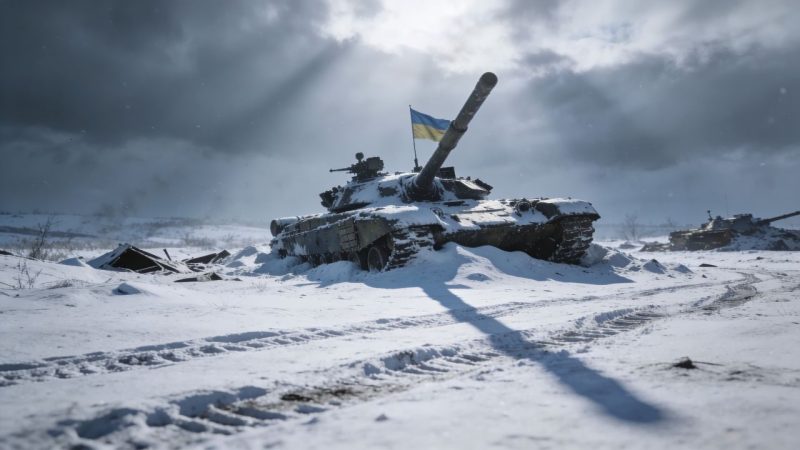
Ukraine just had its best week on the battlefield in over two years, recapturing 201 square kilometers of territory from Russian forces in a rapid five-day advance that reversed weeks of Moscow’s grinding gains. The timing was not accidental. Neither was the reason it happened.
Between February 11 and 15, Ukrainian forces pushed Russian troops back across a stretch of frontline roughly 80 kilometers east of Zaporizhzhia, according to an AFP analysis of Institute for the Study of War (ISW) data. The recaptured area nearly matched Russia’s total territorial gains for the entire month of December. It was Kyiv’s most significant advance since its counteroffensive in June 2023.
And it all happened because Elon Musk flipped a switch.
The Starlink Factor Changed Everything
The catalyst behind Ukraine’s surge was the disruption of Russian forces’ unauthorized access to Starlink, SpaceX’s satellite internet network. In early February, Musk announced “measures” to block Russian military use of the terminals, and both SpaceX and Ukraine’s defense ministry moved to shut down illegitimate connections along the frontline.
The impact was immediate and devastating for Russian operations. Without Starlink, Russian troops lost critical communications infrastructure, drone guidance capabilities, and command coordination that had become essential to their battlefield effectiveness. Russian military bloggers openly complained about the disruption, and the data tells the story clearly: during the five-day window, Russian forces managed to advance on only one day, February 9. Ukraine gained ground on all the others.
Ukraine’s cyber forces added an especially creative twist. They set up a phishing operation disguised as a “reactivation service,” tricking Russian soldiers into submitting identifying information and terminal coordinates. Ukrainian forces collected over 2,400 data packets on Russian-used terminals and transferred them to defense agencies for permanent deactivation. They also reportedly received €5,000 from Russian soldiers trying to restore connectivity, money that was promptly donated to Ukrainian drone fundraising efforts.
It was, by any measure, an extraordinary week.
The Bigger Battlefield Picture
The gains need context. Russia still controls approximately 19.5 percent of Ukrainian territory, either fully or partially, compared to 18.6 percent a year ago. The war has been grinding through its attritional phase for over a year, with advances measured in meters rather than kilometers. Both sides are fighting across a roughly 750-mile frontline, and the human toll continues to climb with each passing week.
Ukrainian forces made their primary advances in the Zaporizhzhia sector, an area where Russian troops had been steadily expanding their foothold since the summer of 2025. Additional ground was recovered in northeastern and eastern Ukraine, including the Kharkiv, Kostiantynivka, Pokrovsk, and Novopavlivka fronts.
The strategic significance goes beyond the square kilometers recaptured. Ukrainian officials have indicated that Russia’s military command was preparing for a summer 2026 offensive targeting either the Slovyansk-Kramatorsk or Orikhiv-Zaporizhzhia corridors, or possibly both. The Starlink disruption and Ukraine’s counter-advances have thrown a wrench into those plans, with Russian forces now struggling to secure the starting positions needed to launch on their intended timeline.
Geneva Talks: Two Days, No Breakthrough, More Questions
Ukraine’s battlefield momentum provided a sharp backdrop to the third round of U.S.-brokered peace talks in Geneva, which ran February 17-18 at the Intercontinental Hotel. The two-day negotiations brought together Ukrainian, Russian, and American delegations, with European officials from the U.K., France, and Germany hovering on the sidelines.
The first day lasted six hours across multiple bilateral and trilateral formats. The second day wrapped in roughly two hours. Neither produced a breakthrough.
Russia’s chief negotiator Vladimir Medinsky, a nationalist historian and Putin adviser who has pushed maximalist positions throughout the war, called the talks “difficult, but businesslike.” Ukraine’s lead negotiator Rustem Umerov said discussions focused on “practical issues and the mechanics of possible solutions,” and described them as substantive with some progress. Both sides agreed to continue consultations, with another round expected “in the near future.”
The key sticking points remain exactly where they have been for months: territory. Russia continues to demand control of large portions of southern and eastern Ukraine. Kyiv maintains that ceding sovereign territory is both legally impermissible and politically impossible. The Zaporizhzhia nuclear power plant, seized by Russian forces in March 2022, also featured prominently on the agenda, along with ceasefire monitoring mechanisms and prisoner exchanges.
Trump Pressure and the Clock Ticking
President Donald Trump, who described the Geneva meeting as “big talks,” added his characteristic pressure on Kyiv. “Ukraine better come to the table fast,” he told reporters on Monday, a comment that landed poorly in a country enduring its fourth year of full-scale invasion.
The White House has reportedly set a June deadline for a settlement, and U.S. envoys Steve Witkoff and Jared Kushner represented the Trump administration at the table. In a remarkable display of diplomatic multitasking, the pair attended morning sessions of indirect negotiations with Iranian officials in Geneva before crossing town to mediate the Ukraine-Russia talks.
Zelensky has pushed back on what he describes as disproportionate pressure on Ukraine compared to Russia. “We are ready to move quickly toward a worthy agreement to end the war,” he said in his nightly address. “The question for the Russians is: Just what do they want?”
It is a fair question. Hours before the talks opened, Russia launched a massive strike across 12 Ukrainian regions, firing nearly 400 drones and 29 missiles, including hard-to-intercept ballistic weapons, at energy infrastructure. Three power plant workers were killed in the frontline town of Sloviansk. Tens of thousands of residents in Odesa were left without heating and running water in the middle of a brutal winter.
What Comes Next
The Geneva round followed two earlier sessions in Abu Dhabi in January and early February, both of which ended without major progress. Military chiefs from all three countries used the Geneva sessions to discuss ceasefire monitoring logistics, including how a demilitarized zone might function and how military communication channels would operate after any deal.
Zelensky said after the talks concluded that Ukrainian forces are “ready to monitor a ceasefire” if the political will exists, and that monitoring would involve the United States. He noted that European security advisers from the U.K. and France also attended parallel sessions, a sign that Kyiv’s allies are working to ensure their interests are represented even if they are formally sidelined from the trilateral format.
The fourth anniversary of Russia’s full-scale invasion falls on February 24, just days away. Ukraine enters that grim milestone with its strongest battlefield position in months, a diplomatic process that is active but far from producing results, and a civilian population enduring rolling blackouts, missile strikes, and a winter that has been especially punishing. The war continues, the talks continue, and the distance between the two sides remains, for now, very wide.