
Nvidia’s record quarterly revenue, exceeding market expectations, and an optimistic forecast for the current quarter failed to prevent the stock from declining. The stocks lost about 7% in a week and 4.2% since the beginning of the year.
Investors are increasingly wondering if the peak in AI infrastructure capital expenditures is approaching. If the cycle slows down, revenue growth rates, which may reach 65% in the current fiscal year, will inevitably decrease in subsequent years, first to 30% and then to 13-14%. For a company whose valuation is based on the premise of continued exponential growth, such dynamics begin to affect valuation metrics.
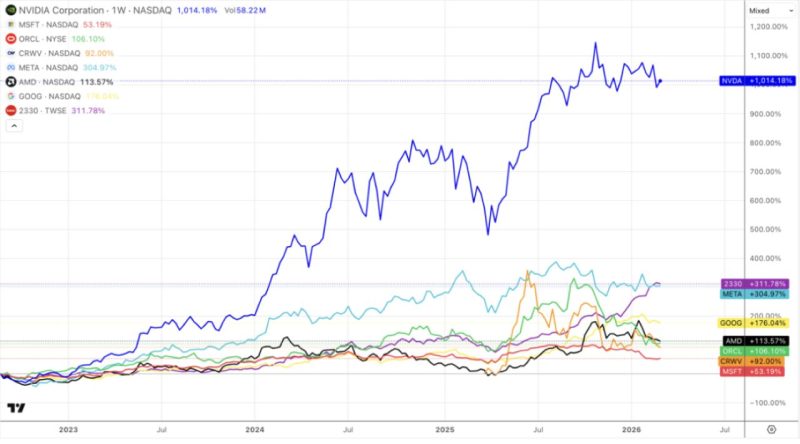
At the same time, customer diversification is increasing. OpenAI leases Trainium-based capacities from Amazon Web Services, actively uses Microsoft, Oracle, and CoreWeave infrastructure, while also cooperating with Cerebras. Although Nvidia’s solutions still dominate, the emergence of alternatives shifts the balance of bargaining power and limits the long-term potential of the exceptionally high margins. Even large clients like Meta Platforms are testing AMD and Google components, reducing dependence on a single vendor.
The market’s response to Nvidia’s report highlights a shift in sentiment. Immediately after the release, Dow Jones futures and other U.S. index futures showed muted movements, signaling heightened investor caution toward the technology sector. Despite strong revenue, the market focused on future risks, peak infrastructure costs, and slowing growth. This suggests that Nvidia’s stock is being driven less by current results than by the broader trajectory of the AI cycle and its implications for corporate investment in the years ahead.
At the same time, the foundation of the company is increasingly intertwined with the financial stability of its partners. By the end of the year, Nvidia officially became TSMC’s largest customer, providing 22% of the revenue of the Taiwanese contract manufacturer against 17% for Apple. In absolute terms, this is $23.2 billion, more than doubling over the past year. The change of leader in TSMC’s customer structure symbolizes the redistribution of global technological capital from consumer electronics to AI infrastructure.
However, this dominance hides an increasing risk. Nvidia’s procurement obligations increased from $16 billion to $95 billion year over year, and total contractual obligations reached $117 billion, comparable to the company’s operating cash flow. Investor Michael Burry points out that this structure resembles the dot-com era, when excessive optimism about demand led to an increase in financial liabilities. If demand for accelerators weakens, Nvidia will be forced to pay for capacity and components regardless of the actual utilization, which could pressure cash flow and margins.
In fact, a paradox emerges: the stronger the current demand and the higher the prices for accelerators, the more future obligations the company locks in, strengthening its operational leverage. As the AI market grows, this model maximizes profits. But when the cycle phase changes, the financial effect may be mirrored. This explains the nervousness of investors, because the market is starting to discount not the current records, but the likelihood of a slowdown.
A broader sector reassessment and concerns about the cycle could lead to further volatility and losses and may ultimately delay the anticipated OpenAI and Anthropic IPO — companies in which Nvidia is also an investor.
Thus, Nvidia remains the beneficiary of the largest investment cycle in modern technological history but at the same time becomes a point of systemic risk. The concentration of revenue from a single contract manufacturer, large-scale prepayments, and the gradual emergence of alternative architectures make the company’s valuation increasingly sensitive to any signals of demand saturation. For investors, this means moving from euphoria to a more selective analysis of cash flows, liabilities, and margin stability in the face of a possible AI market correction.