
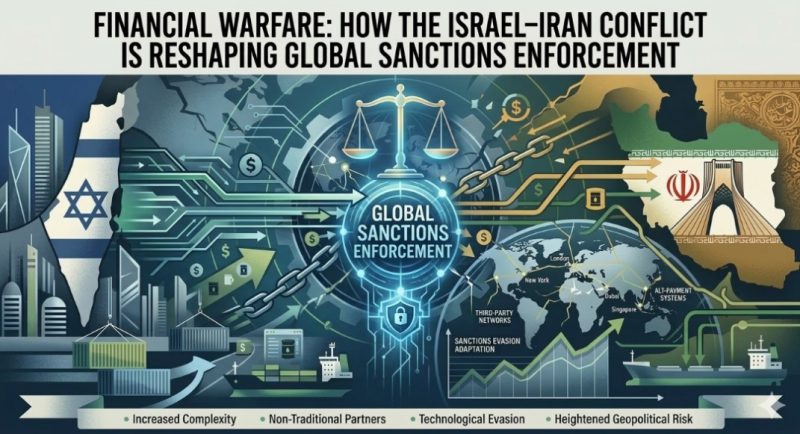
The current problems between the Israel and Iran have gone well beyond the ordinary military conflict. Geopolitical unrest and conflicts in the current digital and interdependent financial ecosystem are characterized by the application of financial warfare in which sanctions and compliance rules, as well as hacks, are becoming military instruments. The case of Israel and Iran conflict has turned out to be a formidable case study of how global sanctions enforcement, sanctions screening and AML screening systems are currently changing in response to the need to counter financial crime, funding of terrorism and evasion of sanctions.
The Geopolitical Wave of Financial Warfare
The traditional weapon of geopolitics has been economic pressure. Financial sanctions are often applied as a means to limit exposure to international financial systems and harm the economic capacity of opponents imposed by governments and international regulators.
Sanctions have led to the limitation of global banking systems and international trade to a large extent of Iran in the case of Iran. Complex shadow banking networks are also found by financial officials to circumvent sanctions and to conduct international transactions despite restrictions.
These developments depict the situation on the front lines of geopolitical conflict that is increasingly played out by financial institutions. To find suspicious transactions associated with sanctioned entities, banks, fintech companies, and payment service providers currently have to roll out sophisticated compliance tools.
The Israel Iran Conflict: Sanctions Enforcement
The last geopolitical processes have enhanced the application of specific financial sanctions. The governments have placed financial institutions, companies, and individuals suspected to be funding militant groups or being in support of sanctioned regimes.
As an example, governments have placed penalties on people and groups associated with Iranian funded organizations that are active in the Middle East, which are networks that finance terrorist activities and unlawful investment portfolios.
These actions show that enforcement of sanctions becomes more and more specific, i.e. instead of wide economic prohibitions, the financial monitoring is carried out with great precision and the financial institutions are to introduce effective sanctions screening frameworks.
Sanctions screening helps organizations to confirm that their customers, partners or counterparties of transactions are not listed on world sanctions lists created by regulators including the Office of Foreign Assets Control, the United Nations and the European Union. The screening of customer identities and transaction data will allow financial institutions to detect regulated relations promptly and avoid violations of regulations.
Why Sanctions Screening has become important to financial institutions
The growing sophistication of the sanctions regimes imply that the old-fashioned compliance procedures are irrelevant. Companies should adopt real-time sanctions screening systems that constantly screen the customer information, flow of transactions and corporation and ownership constitution.
The major reasons why sanctions screening has turned out to be critical include:
- Fast-evolving sanctions lists that are associated with geopolitical conflicts.
- Multi-jurisdictional financial transactions.
- Strong ownerships to cover up authorized organizations.
- Money laundering schemes through the trade.
With the escalation of a conflict, regulators often include new individuals, companies and vessels to the list of sanctions. Organizations also take a risk of not knowing that they are dealing with sanctioned parties because they lack automated sanctions screening tools.
The Value of AML Screening in the Illicit Financial Flows Prevention
In addition to imposing sanctions, the financial institutions should also enhance AML screening to establish suspicious transactions and possible money laundering processes.
The Israel-Iran war points at the growing dangers of illegal financial operations to the financing of proxy groups, cyber activities, or military financially. Compliance experts believe that due to conflicts, there is a risk of further abuse of informal payment systems, cryptocurrency transactions, and trade-based money laundering networks.
The AML screening assists the institutions to identify these risks through the behavior of customers, the patterns of transactions, and bad media indicators. Best AML screening systems usually comprise:
- Customer risk profiling
- Transaction monitoring
- Adverse media screening
- Check on politically exposed persons (PEP)
- Watchlist monitoring and sanctions
When integrated with the AML screening, the sanctions screening allows organizations to identify potential suspicious activities in advance and before they turn into compliance violations or criminal financial activities.
Financial Infrastructure and Cyber Warfare
Cyberattacks against financial institutions and online assets are another aspect of financial warfare. Geopolitical cyber groups have been taking greater interest in financial infrastructures including banks and cryptocurrency exchange platforms.
In a famous instance, a group of hackers attacked Iranian financial resources and wiped millions of dollars of cryptocurrency moneys linked to alleged activities of sanction evasion.
Through such occurrences an indication is shown that even financial systems are becoming strategic targets in geopolitical confrontations. This fact supports the necessity of developed compliance frameworks, that is, the combination of cybersecurity, AML screening, and sanctions screening.
The Future of Compliance in World of Conflict
With the geopolitical volatility in the world financial arena still unfolding, the compliance standards will only get tougher. Financial institutions should no longer operate within the conventional framework of compliance and transition to AI-based sanctions screening and AML screening technologies that are capable of identifying emerging dangers on the fly.
The organizations have compliance priorities such as:
- Introducing sanctions screening automated solutions
- Improving AML screening by using behavioral analytics
- Continuous customer due diligence
- Increasing the focus on cross-border transactions.
- Combining compliance technology with cybersecurity models
The regulators around the globe will also rely on heightening the questioning of the financial institutions that have been utilizing in the high-risk jurisdictions or the dealings of cross-border transactions related to the sanctioned territories.
Conclusion
The Israel-Iran Postwar reveals the way in which the modern warfare continues to take the economic and financial aspects. Geopolitical strategy is now involved in sanctions, cyber operations, and financial intelligence.
This changing environment highlights the need of effective compliance models by financial institutions and fintech enterprises based on state-of-the-art sanctions screening and AML screening systems. Enhancing these systems, companies will be able not only to comply with the requirements of the regulators but also help to secure the safety and stability of the global financial system.