
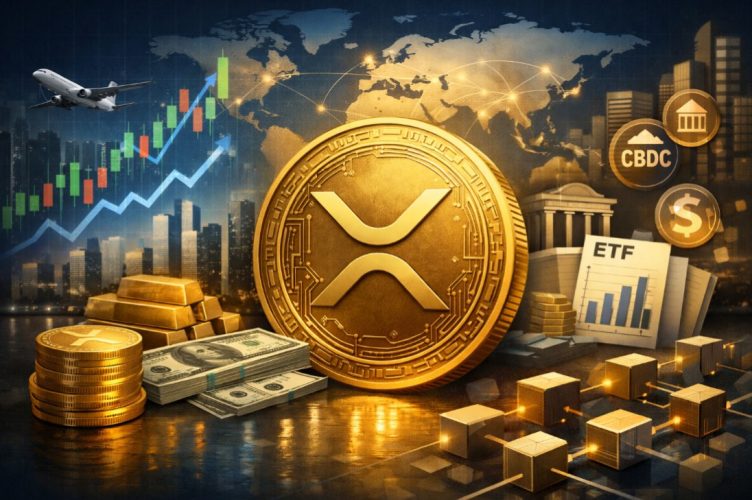
Most price targets in crypto are wishful thinking dressed up in charts.
Many investors are asking whether can XRP reach 100 is a realistic target — and the answer is more nuanced than most headlines suggest.
Let’s cut through the noise and look at what would actually need to happen.
First, Let’s Talk About Why XRP Is Different From Most Tokens
Ripple Labs built XRP with a specific job in mind: fixing how banks move money across borders.
Right now, an international wire transfer can take two to five business days and come with fees that eat into the total.
XRP settles that same transaction in under five seconds, for less than a fraction of a cent.
That’s not marketing — it’s an operational advantage that’s already being used by more than 300 banks and payment companies in over 70 countries.
XRP also has a fixed supply of 100 billion tokens, with somewhere between 53 and 58 billion currently active in the market.
That supply ceiling matters a lot when you start doing price math.
The Trillion-Dollar Question Behind a $100 Price Tag
Here’s the part most social media posts skip entirely.
If you’re tracking the live XRP Price today, you’ll notice it’s nowhere near triple digits — and there’s a structural reason for that.
Multiply $100 by the roughly 58 billion tokens in circulation, and you get a market capitalization of around $5.8 trillion.
To put that number in perspective: Bitcoin’s highest-ever market cap landed near $1.3 trillion, and the combined value of every cryptocurrency on Earth is currently around $2.2 trillion.
So XRP reaching $100 would mean this single token is worth more than two and a half times the entire crypto industry today.
That’s not a reason to dismiss the idea — but it is a reason to understand the scale of what you’re hoping for.
What Would Actually Have to Go Right
Believers in a $100 XRP scenario aren’t just daydreaming — they’re pointing to a set of concrete developments that are already in motion.
- The legal overhang is mostly cleared. A 2023 federal court ruling determined that XRP sold on public exchanges doesn’t qualify as a security, which was the main regulatory sword hanging over Ripple for years.
- ETF filings are piling up. At least nine asset management firms have submitted applications to the SEC for XRP-based exchange-traded funds — the same type of product that accelerated Bitcoin’s institutional adoption in 2024.
- Corporations are treating XRP like a treasury asset. Some companies are now holding XRP on their balance sheets the same way others hold gold or Bitcoin, signaling long-term confidence rather than speculative trading.
- The use case keeps widening. Beyond cross-border payments, XRP is now embedded in decentralized finance applications, Ripple’s stablecoin called RLUSD, and early-stage central bank digital currency projects.
- Quarterly volume is climbing. Ripple’s On-Demand Liquidity product processed $2.5 billion in a single quarter of 2024 — real transaction volume, not just price speculation.
Each of these is a legitimate demand driver, and together they paint a more credible picture than most altcoin bull cases.
The Headwinds That Could Keep $100 Years Away
There’s an honest case against $100 XRP too, and it starts with the math problem described above.
Getting from current prices to $100 means attracting somewhere in the neighborhood of $5 to $6 trillion in new capital — into a single token.
That’s never happened in financial markets, not for any asset class at this speed.
Competition is another real issue.
Dollar-backed stablecoins like USDT and USDC already handle cross-border value transfers at scale, offering institutions a familiar, low-volatility alternative to XRP.
Governments are also moving forward with their own digital currencies, which could directly undercut XRP’s pitch to central banks.
And Ripple itself releases a portion of XRP from escrow every month, adding steady sell-side pressure that caps how quickly prices can rise without overwhelming demand.
What Realistic Timelines Look Like
Analysts who follow XRP closely tend to anchor their forecasts well below $100 for the near term.
A range of $5 to $10 by the end of 2025 comes up frequently in models tied to ETF approvals and continued banking adoption.
Short-term price movements, however, are often driven less by long-term fundamentals and more by trading activity and global liquidity cycles. For retail traders, timing entries around peak market activity can make a noticeable difference — for example, understanding the best time to trade crypto in India typically involves watching periods when Asian and European market hours overlap, as volatility and volume tend to increase during these windows.
Looking further out, the $15 to $25 range surfaces in 2028 projections under moderately optimistic assumptions.
The $50 to $100 level appears in longer-horizon models — but almost always paired with conditions like mass bank migration to blockchain-based settlement and a crypto market that’s grown to $10 trillion or more.
The honest answer is that $100 is a 2030-at-the-earliest story, and more likely a 2035-plus scenario if it happens at all.
So, Should You Care About XRP?
XRP isn’t a lottery ticket — it’s a bet on whether blockchain technology eventually becomes the backbone of global banking.
If that transition happens, the demand for XRP could grow in ways that justify prices far above where it sits today.
If it doesn’t, or if competing technologies win that race, the $100 target stays theoretical.
The most useful thing any investor can do is track adoption metrics — transaction volumes, new institutional partnerships, ETF progress — rather than fixating on a price number.
$100 may or may not come, but the fundamentals are worth watching closely either way.