
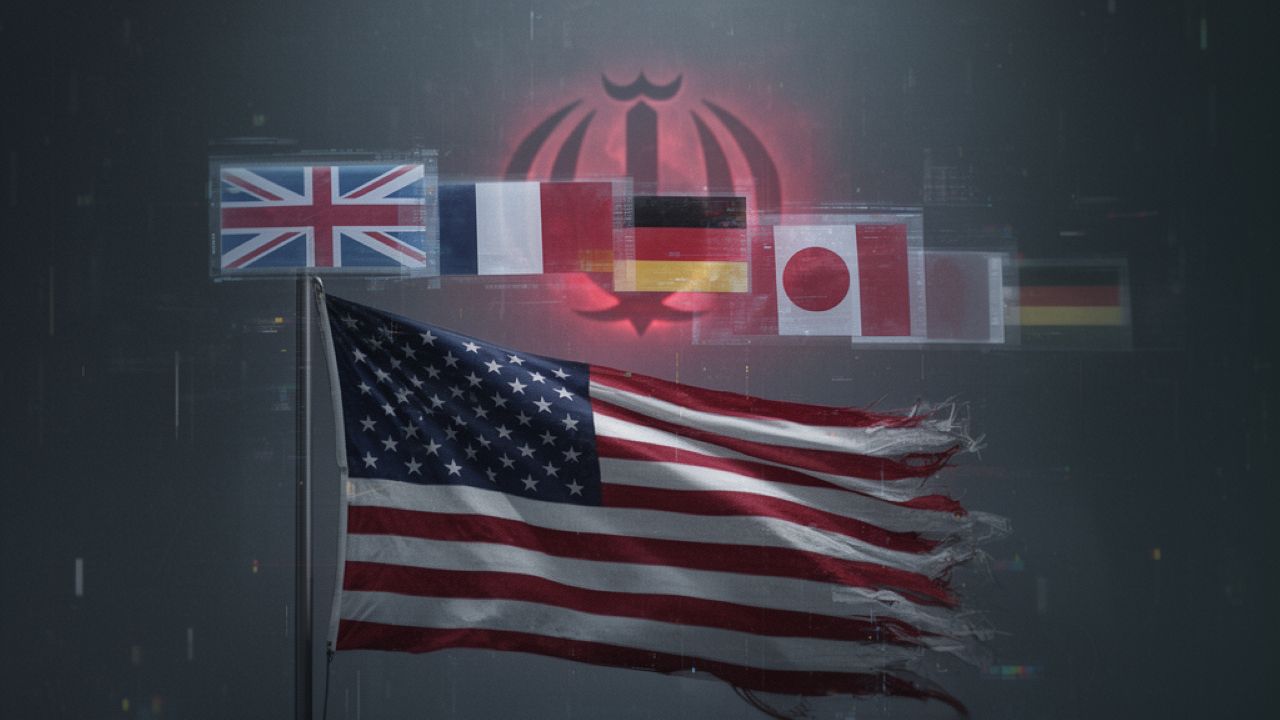
Here is the timeline you need to understand about Donald Trump and his allies in the Iran war, because it tells you everything about how this administration operates.
On March 3, after Spain refused to let the U.S. use its air bases for the Iran campaign, Trump said he didn’t need Spain’s help. On March 9, he called it “my honor” to secure the Strait of Hormuz alone. On Friday, he told Fox News he didn’t need help with drone defense. On Saturday, he told NBC News flatly: “We don’t need help.”
Then on Sunday, he began begging.
Trump called on China, France, Japan, South Korea, and the United Kingdom to send warships to the Strait of Hormuz, the narrow waterway Iran has effectively shut down in retaliation for the U.S.-Israeli strikes launched on February 28. He warned NATO would face a “very bad future” if members didn’t comply. He told the Financial Times he was “demanding” countries step up. “Whether we get support or not,” Trump said aboard Air Force One, “we will remember.”
They remembered too. They remembered every insult, every tariff threat, every NATO tongue-lashing, every time Trump called their contributions worthless. And one by one, they said no.
A Coalition of the Unwilling
The rejections rolled in like a diplomatic highlight reel. Germany’s Defense Minister Boris Pistorius was blunt: “This is not our war, we have not started it.” He then asked the question no one in Washington seems willing to answer: “What does Trump expect from a handful of European frigates that the powerful U.S. Navy cannot do?”
Australia said it had no plans to send ships. Japan, which gets roughly 70% of its oil through the Strait of Hormuz and has more at stake than almost anyone, also declined. Poland’s foreign minister told the administration to go through proper NATO channels. Spain said it would never accept “stopgap measures” and demanded the war end entirely. Greece said no. Italy said no. Sweden said no. Even Italy’s Giorgia Meloni, who has positioned herself as Trump’s closest European ally, couldn’t bring her government to help.
The UK offered the most diplomatic version of a rejection. Prime Minister Keir Starmer said Britain was “working with allies” on the situation but would not be “drawn into the wider war.” The possibility of deploying mine-hunting drones already in the region was floated, but London made clear it was unlikely to dispatch a warship. This from the country Trump once called America’s “oldest ally,” a relationship he promptly insulted by criticizing Starmer for insufficient support.
The European Union then made it official on Tuesday, deciding against expanding its naval operations around the Strait despite Trump’s public pressure campaign. Former Estonian President Toomas Hendrik Ilves captured the mood perfectly, telling NBC News it was “a bit rich” for Trump to be asking countries he had previously insulted for help.
Then Came the Reversal of the Reversal
After two days of very public rejection, Trump did what Trump always does when reality contradicts his narrative: he rewrote it. On Tuesday, he posted on social media that “most of our NATO ‘allies'” don’t want to join the effort, then declared: “Because of the fact that we have had such Military Success, we no longer ‘need,’ or desire, the NATO Countries’ assistance, WE NEVER DID!”
He extended this to the countries he had personally named just 48 hours earlier: “Likewise, Japan, Australia, or South Korea…. WE DO NOT NEED THE HELP OF ANYONE!”
So to be clear: Trump didn’t need help. Then he desperately needed help. Then after nobody offered help, he never needed help in the first place. This is not a foreign policy. This is a man flailing.
The Consequences Are Not Hypothetical
While Trump cycles through contradictory statements, the real-world damage is stacking up in ways that should terrify every American voter.
Oil prices have surged more than 40% since the war began on February 28. Brent crude topped $126 per barrel at its peak and remains above $100, marking the highest sustained prices since 2022. The International Energy Agency has called it the largest disruption to global energy supplies in history, surpassing even the 1970s oil crisis. Over 30 countries have agreed to release 400 million barrels from strategic reserves (the largest such release ever), and it’s barely making a dent.
Shipping through the Strait has collapsed. The waterway normally sees about 138 daily transits. Since the war began, that number has dropped to fewer than five on most days, with Iran attacking at least 21 merchant ships. About 150 vessels sit anchored outside the strait, waiting. Roughly 20% of the world’s daily oil supply and one-fifth of global liquefied natural gas passes through this chokepoint. It is, for all practical purposes, closed.
Goldman Sachs has raised its odds of a U.S. recession to 25%. If oil prices sustain at $140 per barrel (a scenario Oxford Economics has modeled), the eurozone, the UK, and Japan would all be pushed into economic contraction. The U.S. wouldn’t escape either. Fertilizer prices have already spiked from $475 to $680 per metric ton, threatening the spring planting season. Gas prices are climbing. Airline fuel costs are surging. The ripple effects are hitting every sector of the economy.
And the human cost: 200 U.S. troops have been wounded or injured across seven countries since the war began, according to Central Command. Ten have been seriously wounded with burns, traumatic brain injuries, and shrapnel wounds.
His Own People Are Walking Out
Perhaps the most damning development arrived Tuesday morning when Joe Kent, Trump’s own hand-picked director of the National Counterterrorism Center, resigned in protest. Kent, a retired Green Beret who completed 11 combat deployments and whose wife Shannon was killed in a 2019 ISIS bombing in Syria, became the first senior administration official to quit over the war.
His resignation letter was a grenade lobbed directly at the Oval Office. Kent wrote that Iran “posed no imminent threat to our nation” and that the war was started “due to pressure from Israel and its powerful American lobby.” He accused Israeli officials and American media figures of deploying a “misinformation campaign” to push Trump into the conflict, calling it “the same tactic the Israelis used to draw us into the disastrous Iraq war.”
Kent worked directly under Director of National Intelligence Tulsi Gabbard, herself a vocal opponent of Middle East interventionism who has reportedly been “almost completely shut out” of sensitive war discussions. The White House response was swift and predictable: a Trump adviser called Kent a “crazed egomaniac,” officials claimed he was a suspected “leaker,” and Press Secretary Karoline Leavitt called his characterization “insulting and laughable.” Trump himself dismissed Kent as “a nice guy” but “weak on security.”
But here’s what matters: Kent was a Trump true believer. He echoed Trump’s election fraud claims. He called January 6 rioters “political prisoners.” He was confirmed along party lines specifically because he was a loyalist. When your own loyalists are walking out and calling the war a manufactured crisis driven by foreign influence, that’s not a personnel problem. That’s a credibility collapse.
The Pattern Is the Point
What voters need to understand is that this is not an isolated diplomatic failure. It is the predictable result of a foreign policy built entirely on personal grievance and transactional bullying.
Trump spent years threatening NATO allies with abandonment, slapping tariffs on European goods, pulling out of international agreements, and publicly humiliating leaders who are now being asked to risk their soldiers’ lives. He launched this war without consulting any of them, without going through NATO channels, without building any kind of coalition beforehand. And now, three weeks in, with oil prices cratering the global economy, Iran firing missiles at Gulf state airports, a fire aboard the USS Gerald R. Ford burning for over 30 hours, and drones hitting fuel infrastructure from Abu Dhabi to Dubai, he’s shocked that nobody wants to clean up the mess.
Iran’s IRGC has said it will not allow “a litre of oil” through the Strait for U.S. allies, while selectively permitting Indian, Chinese, and Turkish ships to pass. Diplomacy is stalled because Trump has refused to negotiate, telling officials he’s “not ready” for talks even as Iranian officials have reportedly reached out through multiple channels.
Vice President JD Vance, once a vocal critic of Middle East interventionism, has offered nothing of substance, deflecting questions about his past positions by saying he “trusts the president to get the job done.” The same president who can’t decide from hour to hour whether he needs help or doesn’t.
What Happens Next
Trump says the war “won’t be long” and will be “wrapped up soon.” Israel says it has at least three more weeks of operations planned. Iran’s new supreme leader has pledged to keep the Strait closed indefinitely. Oil analysts at Eurasia Group say $100 oil is now the “baseline, not the risk case.” Trump has delayed his planned trip to China, telling reporters he needs to stay in Washington because “we’ve got a war going on.”
Meanwhile, American consumers are paying more at the pump, American troops are getting wounded, American diplomats don’t know who’s even leading the coalition-building effort (one U.S. diplomat told CNN the answer to that question was simply “DJT?”), and the world’s most important energy chokepoint remains shut.
Trump wanted a war without consequences. He got consequences without allies. And the American people are the ones picking up the tab.