
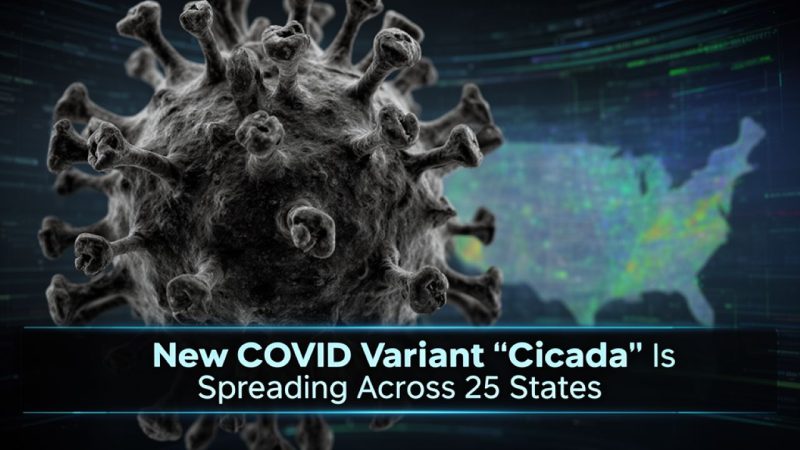
A COVID variant that spent more than a year lurking beneath the surface is finally making its presence known, and public health officials are paying close attention. The CDC confirmed in a March 19 report that BA.3.2, a heavily mutated strain nicknamed “Cicada,” has now been detected in at least 25 U.S. states and more than 23 countries worldwide. While case counts remain low domestically, the variant’s genetic profile has virologists sounding measured but unmistakable alarms.
The timing matters. COVID cases nationally are at seasonal lows, and most Americans have moved on from pandemic-era vigilance. But Cicada is not behaving like a routine mutation. With 70 to 75 changes in its spike protein alone, it represents the most genetically distinct variant to emerge since BA.2.86 (“Pirola”) surfaced two years ago. And in parts of Northern Europe, it is already responsible for roughly 30% of sequenced infections.
Why It Is Called Cicada
The nickname comes from T. Ryan Gregory, a professor of evolutionary biology at the University of Guelph who has previously coined variant names like “Pirola” and “Stratus.” Gregory drew the comparison to cicada insects, which spend years underground before suddenly reemerging in large numbers. BA.3.2 followed an eerily similar pattern.
The variant was first identified in South Africa in November 2024. It is a descendant of BA.3, an Omicron subvariant that briefly circulated alongside BA.1 and BA.2 back in early 2022 before fading into obscurity. BA.3 never disappeared entirely. It continued mutating quietly until BA.3.2 emerged with a staggering number of genetic changes, effectively making it a new evolutionary branch of the virus.
The first U.S. detection came in June 2025, when a traveler returning from the Netherlands tested positive at San Francisco International Airport. For months after that, detections remained sporadic. Then, last fall, Cicada started picking up momentum globally. The first confirmed case in a U.S. patient who had not traveled internationally was diagnosed in January 2026.
Where Cicada Is Spreading
As of the CDC’s most recent data from February 11, BA.3.2 has been found in wastewater samples from 132 collection sites across at least 25 states. It has also appeared in voluntary nasal swabs collected from international travelers. According to WastewaterSCAN, a Stanford University-led disease surveillance program, Cicada was detected in 3.7% of national sewage samples as of mid-March.
That number is still small compared to the dominant XFG lineage, which accounts for about 53% of samples, followed by LF.7 at roughly 10%. But wastewater tracking often reveals the presence of a variant well before clinical case counts catch up, which is exactly what makes the trend worth watching.
Internationally, the picture is more advanced. BA.3.2 is driving approximately 30% of sequenced cases in Denmark, Germany, and the Netherlands. The World Health Organization classified it as a “variant under monitoring” in December 2025, and additional detections have been reported in Japan, Kenya, the United Kingdom, and several other nations.
What Makes This Variant Different
The sheer volume of mutations is what separates Cicada from the steady drip of subvariants that have circulated over the past two years. Andrew Pekosz, a virologist at the Johns Hopkins Bloomberg School of Public Health, noted that BA.3.2 carries 70 to 75 mutations in its spike protein, the part of the virus that latches onto human cells and the primary target of COVID vaccines.
According to the CDC, BA.3.2 represents a lineage that is “genetically distinct” from the JN.1 family of variants that has dominated infections in recent years. In laboratory studies, the variant effectively escaped COVID antibodies generated by both vaccination and prior infection.
There is an interesting wrinkle, though. Dana Mazo, an infectious diseases physician at NYU Langone Health, pointed out that some of Cicada’s mutations may actually reduce how efficiently the virus binds to human cells. In other words, while your immune system may struggle to recognize this variant, the variant itself may also have a harder time gaining entry. That tension between immune evasion and reduced binding could explain why Cicada has been slow to dominate despite its alarming mutation count.
Symptoms To Watch For
The symptoms of BA.3.2 infection are largely consistent with what Americans have come to expect from COVID in 2026. The CDC’s current symptom list includes fever or chills, cough, shortness of breath, fatigue, muscle and body aches, headache, new loss of taste or smell, sore throat, congestion or runny nose, nausea or vomiting, and diarrhea.
One symptom that doctors are flagging more frequently with current variants, including Cicada: severe sore throat. Robert Hopkins Jr., medical director of the National Foundation for Infectious Diseases, said that an intense sore throat is being reported as a common complaint alongside the usual respiratory symptoms. Some later Omicron variants have been associated with what patients describe as a “razorblade throat,” and early reports suggest Cicada follows that pattern.
The good news, at least for now, is that Cicada does not appear to cause more severe illness than other circulating variants. Adolfo García-Sastre, director of the Global Health and Emerging Pathogens Institute at Mt. Sinai, said there is no evidence of increased hospitalizations in countries where the variant is more widespread. Pekosz offered a similar assessment, noting that while BA.3.2 may look alarming on paper, it has not translated into a measurable spike in severe disease.
Do Current Vaccines Still Work?
This is the question that matters most to public health planners, and the answer is complicated. The 2025-2026 COVID vaccines were formulated to target the JN.1 lineage. Because BA.3.2 is so genetically distant from JN.1, lab studies have shown reduced vaccine effectiveness against infection.
However, experts stress a critical distinction: the vaccines are still expected to protect against severe disease, hospitalization, and death. The WHO has echoed this assessment. García-Sastre noted that while it is not entirely clear how effective the current vaccine will be at preventing infection, some level of protection likely remains. And crucially, existing antiviral drugs like Paxlovid remain effective against BA.3.2.
The deeper immune defenses that vaccines activate, particularly T-cell responses, continue to provide a safety net even when antibody protection wanes. Monica Gandhi, an infectious disease specialist, has emphasized that the body’s layered immune system offers protection beyond what antibody levels alone would suggest.
Vaccine manufacturers are already evaluating whether reformulation will be needed for the fall. The annual update process gives manufacturers the ability to adjust their targeting, and if Cicada continues gaining ground, it could factor into the next vaccine composition decision.
Could Cicada Drive A Summer Surge?
That is the scenario some experts are beginning to game out. Hopkins said he has heard concern about the possibility of Cicada fueling a U.S. summer surge, though he stressed that outcome is far from certain. The variant would need to demonstrate a sustained growth advantage over XFG and other circulating strains to become dominant, and that has not happened yet domestically.
What is clear is that the conditions for spread exist. Vaccination rates remain low, public health infrastructure for COVID monitoring has been scaled back significantly, and most Americans are no longer taking precautions against respiratory viruses. Hopkins put it bluntly: low vaccination rates and minimal public health effort toward stopping COVID infections leave the country vulnerable.
For now, Cicada accounts for less than 1% of sequenced U.S. cases. But the European trajectory, where it went from trace-level detections to 30% of cases in a matter of months, offers a template for what could happen here if conditions align.
What You Should Do Right Now
The practical advice has not changed, even if the variant landscape has. If you develop symptoms consistent with COVID, particularly a combination of sore throat, cough, fatigue, and fever, get tested. Rapid antigen tests can miss infections early, so consider retesting in 24 to 48 hours if your first result is negative but symptoms persist.
If you test positive, stay home until symptoms improve and you have been fever-free for at least 24 hours without medication. For the following five days, take extra precautions around others, especially people at higher risk. That means masking indoors, improving ventilation, and keeping distance when possible.
If you are at elevated risk for severe illness due to age, underlying conditions, or immunocompromise, contact your healthcare provider promptly. Antiviral treatments like Paxlovid work best when started early, and they remain effective against Cicada.
And if you have not gotten the 2025-2026 COVID vaccine, it still offers meaningful protection against severe outcomes, even with a variant this mutated. Getting vaccinated remains the single most effective way to keep yourself out of the hospital.
Cicada may not be the next big wave. But it is a reminder that the virus has not stopped evolving, and neither should our attention.