
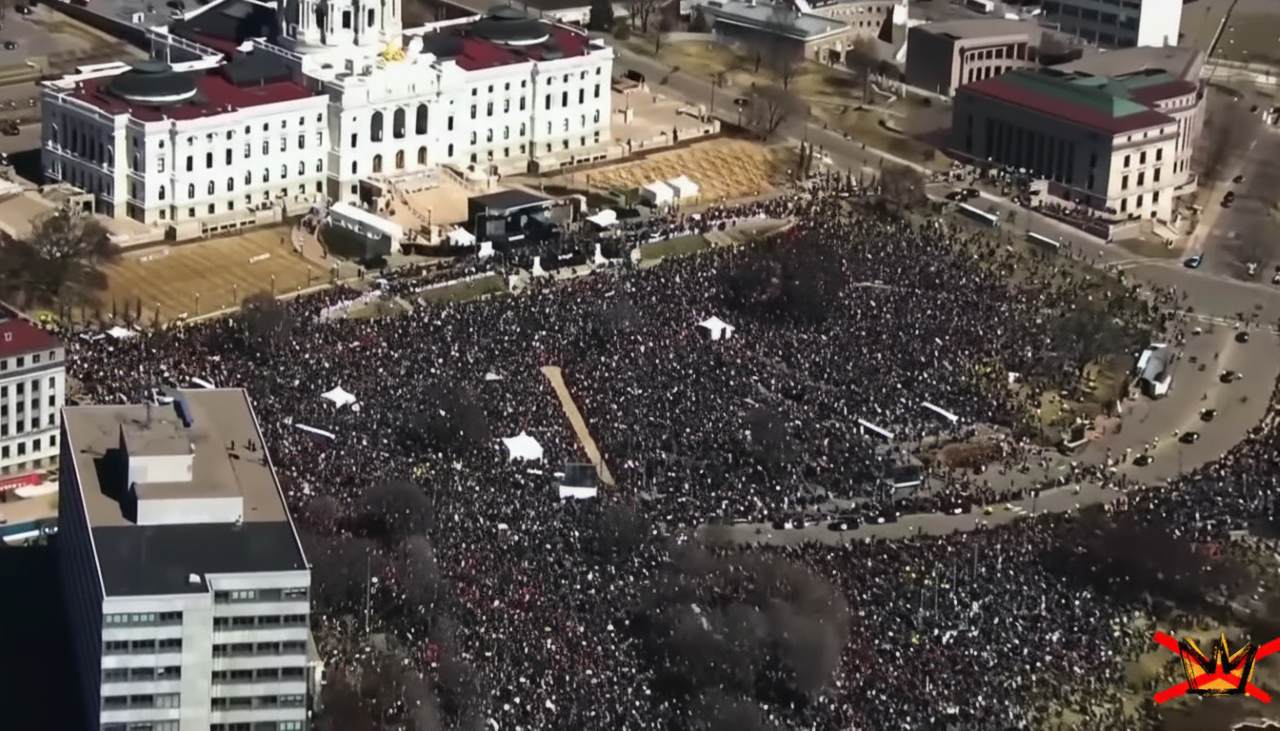
Eight million people. All 50 states. More than 3,300 organized events from Anchorage to Key West. Saturday’s No Kings protests didn’t just break the record for the largest single-day demonstration in American history.
They obliterated it. And yet the most important question about this movement isn’t how many people showed up. It’s what they do on Monday.
The numbers alone are staggering. New York City drew an estimated 350,000. Chicago brought 200,000. The flagship rally in St. Paul, Minnesota, where Bruce Springsteen performed and Governor Tim Walz, Senator Bernie Sanders, Jane Fonda, and Joan Baez took the stage, pulled a crowd the state Department of Public Safety put at 100,000. San Diego County alone saw 94,000 across 21 separate events. Pittsburgh turned out 20,000. These are not fringe gatherings. This is a mass mobilization on a scale the country has never seen in a single day.
What Drove Millions Into The Streets
The No Kings movement, now in its third major mobilization since Trump began his second term in January 2025, has become the primary outlet for Americans who believe the country is sliding toward authoritarianism. Saturday’s protests were fueled by a convergence of grievances: the ongoing U.S. war in Iran, now entering its second month with no diplomatic offramp in sight; aggressive ICE enforcement operations that have terrorized immigrant communities; the continued suppression of the Epstein files; and a broader sense that democratic norms are being dismantled faster than institutions can defend them.
What’s notable about this round of protests is their geographic reach. Previous No Kings events concentrated in major metropolitan areas. Saturday’s marches penetrated deep into red America. Oklahoma City saw thousands in its downtown. Tucson held a significant rally. Kentucky, Louisiana, and Mississippi all hosted events that drew larger crowds than organizers expected. This is no longer a coastal phenomenon. The anger is everywhere.
The Scale Puts Every Previous American Protest In Perspective
To understand what 8 million people in the streets actually means, consider the benchmarks. The 2017 Women’s March, previously considered the largest single-day protest in U.S. history, drew an estimated 3.3 to 4.6 million. The Vietnam War moratorium of October 1969, the event that defined a generation’s opposition to militarism, brought out roughly 2 million. The March on Washington in 1963, where Martin Luther King Jr. delivered the speech that changed America, drew 250,000. Saturday tripled the Women’s March. It quadrupled the moratorium. The No Kings movement has produced a turnout that, on raw numbers alone, has no precedent in American protest history.
And unlike the Women’s March, which peaked on its first outing and gradually lost momentum, the No Kings protests are growing. The first round drew roughly 3 million. The second drew closer to 5 million. Saturday hit 8 million. Each time, the movement gets bigger, angrier, and more geographically diverse.
The Missing Ingredient: A Unified Political Demand
Here is where optimism meets reality. For all the power of Saturday’s demonstrations, the No Kings movement still lacks the single thing that historically transforms street energy into political outcomes: a clear, actionable demand. The Civil Rights movement had the Civil Rights Act. The suffragettes had the vote. The anti-Vietnam movement had withdrawal. No Kings has a mood, a posture, a critique. It does not yet have a bill, a ballot measure, or a specific political ultimatum.
That’s not a fatal flaw, but it is a structural vulnerability. Protests without demands become rituals. They feel good. They generate solidarity. They produce incredible photographs. But they don’t, on their own, change policy. The Tea Party understood this in 2009 when it converted grassroots anger into primary challenges and legislative leverage within months. The question for No Kings is whether it can make the same pivot, or whether Saturday’s record crowd becomes a high-water mark that slowly recedes.
The Political Landscape Has Changed Since January
What the No Kings movement does have working in its favor is a political environment that has shifted dramatically since Trump’s second inauguration. In January, the opposition was demoralized and fragmented. The Iran war had not yet begun. The DHS shutdown had not yet crippled airports. Gas prices had not yet spiked. Trump’s approval numbers had not yet cratered under the weight of a foreign conflict most Americans did not want.
Now, with TSA officers quitting because they haven’t been paid, with oil prices destabilizing the economy, with allied nations like Spain publicly breaking from U.S. military operations, the protest movement has something it lacked two months ago: mainstream credibility. When 8 million people march, it is no longer possible for anyone, supporter or critic, to dismiss this as a coastal elite tantrum. This is a broad, cross-class, cross-regional expression of democratic discontent.
What The Movement Needs To Do Next
The playbook for converting protest energy into political power is well documented. Step one: identify specific legislative targets. The DHS shutdown, the Iran war authorization, the birthright citizenship executive order all offer concrete fights where public opinion already favors the opposition. Step two: channel resources into the 2026 midterm elections, which are now less than eight months away. Step three: build durable local organizations that persist between marches, the kind of infrastructure that turns a Saturday crowd into a Tuesday voting bloc.
Saturday proved that the appetite for opposition is massive and growing. The question that will define 2026 is whether that appetite translates into power. Eight million people in the streets is a statement. What the No Kings movement does with Monday, and every day after, will determine whether it was also a turning point.