
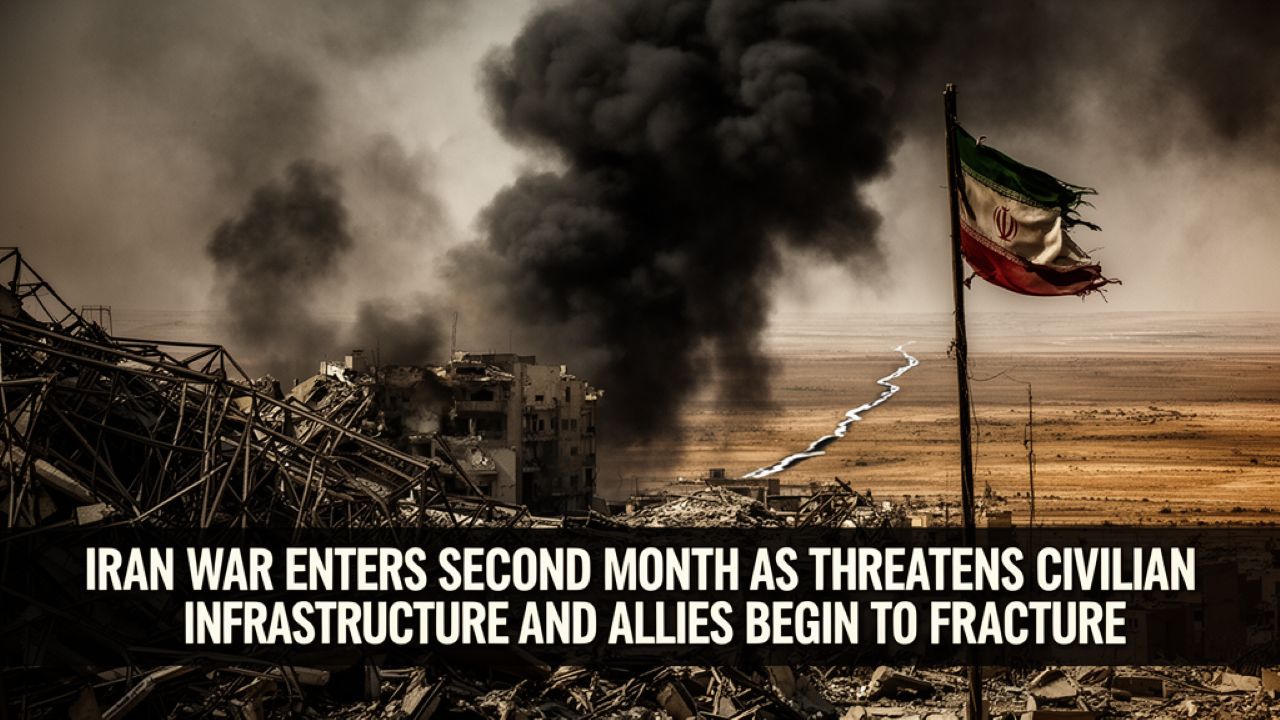
The U.S. war in Iran turned one month old this weekend, and the situation is deteriorating in ways the administration clearly did not anticipate.
Not on the battlefield, where American air power continues to pound Iranian military targets, but in the diplomatic architecture that makes sustained military operations possible. Spain formally closed its airspace to all U.S. military aircraft involved in the conflict on Monday, and the move signals something far more consequential than one country’s objection. The Western alliance that has underwritten American military operations for 80 years is starting to crack.
Spain Goes Further Than Any NATO Ally
Spain’s Defence Minister Margarita Robles did not mince words. “Neither the bases are authorised, nor, of course, is the use of Spanish airspace authorised for any action related to the war in Iran,” she said Monday. Robles described the conflict as “profoundly illegal and unjust,” language that would have been unthinkable from a NATO ally during any previous American military operation in the post-Cold War era.
The airspace ban goes well beyond Spain’s earlier decision to block access to two jointly operated military bases on its soil. It prevents U.S. military aircraft from overflying Spanish territory entirely, including planes originating from bases in the United Kingdom or France. The practical impact is significant: American military logistics in the Mediterranean must now route around the Iberian Peninsula, adding complexity and cost to every sortie connected to the Iranian theater. The symbolic impact is arguably greater. When a NATO ally closes its skies to you, it is not a policy disagreement. It is a rupture.
Trump’s Rhetoric Escalates Toward Civilian Targets
Against this backdrop of allied fracture, President Trump chose escalation. In a series of statements over the weekend and into Monday, Trump warned that the United States would “completely destroy” Iranian water and energy infrastructure if diplomatic talks do not produce results soon. He told the Financial Times that seizing Iran’s Kharg Island, through which roughly 90% of Iran’s oil exports flow, remains a live option. “We have a lot of options,” Trump said, with the casual tone of someone discussing real estate holdings rather than an act that would constitute a war crime under international humanitarian law.
The threat to destroy civilian infrastructure is not a throwaway line. Targeting water and energy systems that serve civilian populations is prohibited under the Geneva Conventions and the Rome Statute. It is precisely the kind of rhetoric that pushes wavering allies from quiet disapproval to public opposition. When Spain’s defence minister calls a war “profoundly illegal,” she is responding to exactly this: an American president publicly contemplating actions that the international legal framework was specifically designed to prevent.
The Houthis Enter The War And The Region Burns Wider
The conflict’s geographic footprint expanded last week when Yemen’s Iran-backed Houthi rebels began firing missiles at Israel, opening a new front in an already sprawling war. Israel, meanwhile, is expanding its operations in Lebanon. The Iranian parliament speaker responded to the arrival of 2,500 U.S. Marines trained in amphibious landings by threatening that American troops would be “set on fire” if they attempted a ground invasion. Foreign ministers from Pakistan, Saudi Arabia, Turkey, and Egypt convened in Islamabad in a scramble to find a diplomatic path that, at this point, neither Washington nor Tehran seems genuinely interested in walking.
The regional escalation matters because it undermines the administration’s stated rationale for the conflict. This was supposed to be a targeted operation against Iran’s nuclear capabilities. One month in, it involves Houthi missile strikes, an expanded Israeli campaign in Lebanon, potential amphibious operations, and open talk of seizing sovereign oil infrastructure. That is not a limited engagement. That is the early architecture of a broader Middle Eastern war.
Trump’s Own Base Is Cracking At CPAC
Perhaps the most revealing signal of the war’s political fragility came not from Madrid but from a hotel ballroom in Washington. Trump skipped CPAC for the first time in a decade this weekend, avoiding the annual gathering of conservative activists at a moment when his base’s enthusiasm for the Iran conflict is visibly fraying. Matt Gaetz, the former Florida congressman, took the stage and warned bluntly: “A ground invasion of Iran will make our country poorer and less safe. It will mean higher gas prices, higher food prices, and I’m not sure we would end up killing more terrorists than we would create.”
Gaetz is not a never-Trumper. He is one of the most loyal MAGA figures in the conservative movement. When someone with his credentials questions the war publicly, it reflects a broader unease that polling confirms. The Washington Post reported significant rifts among CPAC attendees, with many expressing support for Trump personally but deep reservations about the conflict’s trajectory and cost. Vice President JD Vance, Tucker Carlson, and Megyn Kelly were all notably absent from the lineup.
The Economic Fallout Is Already Here
While the administration focuses on military escalation, the economic consequences are compounding daily. Oil prices have surged as Iran leverages its position in the global energy market. The fragile recovery from post-pandemic inflation is being undermined by rising fuel costs, which ripple through every sector of the economy. Markets are volatile. Consumer confidence is falling. The March jobs report, due Friday, is expected to show continued weakness after February’s loss of 92,000 jobs.
For Trump, the political math is getting worse by the week. Gas prices hit voters where they live. Airport chaos from the ongoing DHS shutdown hits them where they travel. And a war in Iran that most Americans did not want hits them in the place that matters most in a democracy: the sense that their government is acting without their consent. Spain’s airspace closure is a diplomatic problem. The erosion of domestic support is an existential one. One month in, the Iran war is a conflict without a clear objective, without allied consensus, and increasingly, without the support of the public that is paying for it.