
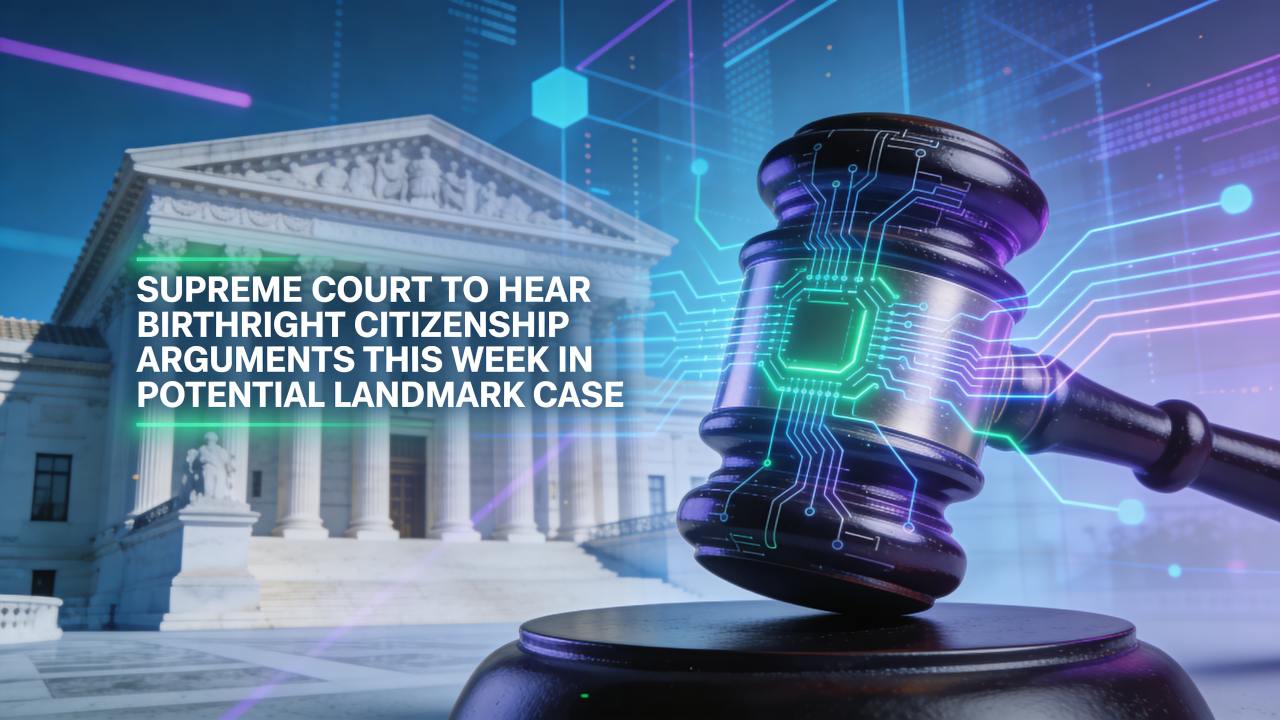
On Tuesday morning, the Supreme Court will hear oral arguments in one of the most consequential cases of the modern era. Trump v. Barbara is, on its surface, a challenge to a single executive order.
In practice, it is a direct assault on a principle that has defined American identity since 1868: if you are born on U.S. soil, you are an American citizen. Period. The administration wants the Court to find an asterisk in that guarantee, and if it succeeds, the ripple effects will touch every hospital, every school district, and every government office that has ever issued a birth certificate without asking about a parent’s immigration status.
How We Got Here: From Executive Order to the Supreme Court
On his first day back in office, January 20, 2025, Trump signed an executive order declaring that babies born in the United States to parents who are either undocumented or on temporary visas would no longer automatically receive citizenship. The order was immediately challenged in federal court. Within weeks, judges in multiple jurisdictions blocked it, calling it a clear violation of the 14th Amendment’s Citizenship Clause: “All persons born or naturalized in the United States, and subject to the jurisdiction thereof, are citizens of the United States.”
Every lower court that has weighed in has reached the same conclusion: the order is unconstitutional. The legal consensus, built over more than 150 years of precedent, has been overwhelming. But the administration appealed, and the Supreme Court agreed to take the case, which alone sent a signal that at least four justices believe the question deserves a fresh look.
The Administration’s Argument Rests on an 1884 Case About a Native American Man
The legal theory behind the executive order hinges on a particular reading of the phrase “subject to the jurisdiction thereof.” For over a century, courts have interpreted this language broadly: essentially everyone on U.S. soil is subject to U.S. jurisdiction, with narrow exceptions for foreign diplomats and hostile occupying forces. The administration argues this reading is wrong.
Their key precedent is Elk v. Wilkins, an 1884 Supreme Court ruling that denied citizenship to John Elk, a Native American man who had voluntarily left his tribal nation and was living among non-Native citizens. The Court ruled that Elk was not “subject to the jurisdiction” of the United States because he had been born into a sovereign tribal nation. The Trump administration contends this logic applies to children of undocumented immigrants: their parents owe allegiance to a foreign sovereign, the argument goes, and therefore their children are not fully “subject to the jurisdiction” of the United States at birth.
Legal scholars across the ideological spectrum have called this argument a stretch. The 14th Amendment was ratified specifically to overturn Dred Scott and guarantee citizenship to formerly enslaved people and their descendants. Its drafters debated the jurisdiction clause extensively and rejected narrower language. The legislative history is not ambiguous. Congress meant what it said: born here means citizen.
What A Ruling For The Government Would Actually Look Like
This is where the case gets genuinely alarming, not as a political argument but as a practical matter. If the Supreme Court rules, even narrowly, that birthright citizenship can be limited based on parental immigration status, it creates an immediate crisis of documentation. Currently, when a baby is born in an American hospital, a birth certificate is issued. Citizenship is assumed. No one checks the parents’ papers.
Under the administration’s framework, that changes. Hospitals or state agencies would need to determine parental immigration status before issuing citizenship documentation. CNN reported that legal experts warn this would create “chaos” in proving newborns’ status. Who makes that determination? What documentation is required? What happens when a parent’s status is in dispute, or when a parent entered legally but overstayed a visa? The bureaucratic apparatus to adjudicate these questions at the point of birth simply does not exist.
The Education And Services Cascade
The downstream effects extend far beyond birth certificates. NPR and WGCU reported that a ruling limiting birthright citizenship could impact education access for millions of children. Under current law, the Supreme Court’s 1982 decision in Plyler v. Doe guarantees that all children, regardless of immigration status, have the right to a public education. But if a new class of children born in the U.S. is suddenly deemed non-citizens, the legal foundation for their access to schools, healthcare, and social services becomes uncertain.
This is not hypothetical. States that have pushed restrictive immigration policies have already tested the boundaries of what services they can deny to non-citizens. A Supreme Court ruling that narrows birthright citizenship would give those states powerful new legal ammunition to exclude children from public institutions. The human cost would fall most heavily on communities of color and immigrant families, but the constitutional principle at stake belongs to everyone.
The “Birth Tourism” Framing Is a Distraction
The administration has leaned heavily on the concept of “birth tourism,” the practice of foreign nationals traveling to the United States specifically to give birth so their children receive citizenship, to frame the case as a matter of fraud prevention. It is a strategically chosen narrative because it sounds reasonable to people who have not examined the numbers.
Experts say the scale of birth tourism is tiny relative to the scope of the executive order. The vast majority of children who would be affected are born to long-term U.S. residents: people who work here, pay taxes here, send their kids to school here, and have built their lives here. Using a fringe phenomenon to justify stripping a constitutional right from millions of children is not fraud prevention. It is constitutional reengineering disguised as common sense.
A Decision Expected By June, With Generational Consequences
The Court is expected to issue its ruling by the end of June. The range of possible outcomes is wide: the justices could uphold the lower courts and leave birthright citizenship intact, they could issue a narrow ruling that chips away at the principle without fully overturning it, or they could fundamentally redefine who gets to be an American at birth. Any outcome short of a full-throated reaffirmation of the 14th Amendment’s plain text would represent a seismic shift in American constitutional law.
What makes Tuesday’s oral arguments worth watching closely is not the legal arguments themselves, which have been exhaustively briefed. It is the questions the justices ask, the hypotheticals they pose, and the lines they seem willing or unwilling to draw. In a Court that has already shown a willingness to overturn long-settled precedent, nothing about the outcome of Trump v. Barbara is guaranteed. The 14th Amendment has survived 158 years of challenges. Whether it survives this one may depend on what happens inside that courtroom on Tuesday morning.