
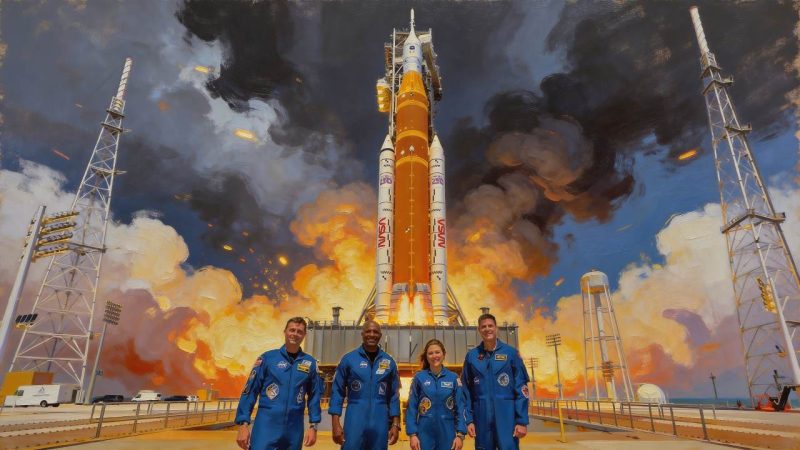
For the first time in more than half a century, human beings have seen the far side of the Moon with their own eyes. And as of this morning, they are on their way back to tell us about it.
NASA’s Artemis II crew, astronauts Reid Wiseman, Victor Glover, Christina Koch, and Canadian Space Agency astronaut Jeremy Hansen, completed a historic lunar flyby on Sunday and are now on a return trajectory toward Earth, with splashdown expected on April 10. Along the way, they broke a record that had stood for 56 years: the farthest distance from Earth ever traveled by human beings, reaching 252,760 miles out and surpassing the mark set by the Apollo 13 crew in April 1970.
What They Saw, And Why It Matters
The flyby was not a sightseeing tour, though the views were spectacular. During a roughly seven-hour observation window, the crew conducted detailed assessments of the lunar surface from their Orion spacecraft, passing approximately 4,000 miles above terrain that no human has studied up close since the Apollo program ended in 1972. They observed geologic features that have been mapped by robotic probes but never examined by trained human eyes at this proximity.
The science matters because Artemis III, the mission that will actually put boots on the lunar surface, depends on what Artemis II reveals. The crew’s observations will help refine landing site selections, validate navigation systems, and test how the Orion spacecraft performs in the deep-space radiation environment that future crews will face for longer durations. Every data point collected during this flyby reduces the risk of the missions that follow.
Perhaps the most visually stunning moment came during a solar eclipse that lasted approximately one hour as Orion, the Moon, and the Sun aligned. The crew watched the Sun disappear behind the Moon’s dark limb and studied the solar corona, the Sun’s outermost atmosphere, as it glowed around the lunar edge. It was the kind of view that no camera can fully capture and no simulation can replicate. You had to be there. And for the first time since 1972, someone was.
Breaking Apollo 13’s Record Was Not The Plan, But It Tells A Story
The distance record is a footnote in mission planning terms. Artemis II’s trajectory was designed around optimal fuel efficiency and observation windows, not record-breaking. But the fact that it happened anyway carries symbolic weight. Apollo 13’s record was set during a crisis, when a catastrophic systems failure turned a moon landing into a desperate survival mission. The crew swung around the far side of the Moon on a free-return trajectory because they had no other choice.
Artemis II broke that record not in desperation but in calm, planned precision. The Orion spacecraft performed flawlessly. The crew executed their observation plan on schedule. At approximately 1:56 p.m. EDT on Sunday, they passed 252,760 miles from home, setting a new benchmark for human spaceflight, and the moment passed with the quiet confidence of a program that, for all its delays and cost overruns, is actually working.
The Long Road To The Moon (And Back To The Moon)
Artemis II launched on April 1, 2026, after years of delays that tested the patience of space enthusiasts and the budgets of congressional appropriators. The Space Launch System rocket, the most powerful ever built by NASA, performed as designed. The Orion capsule, which flew an uncrewed test mission around the Moon as Artemis I in late 2022, proved it could keep humans alive and comfortable in deep space.
The crew itself represents a deliberate statement about who gets to explore. Victor Glover is the first Black astronaut to travel beyond low Earth orbit. Christina Koch holds the record for the longest single spaceflight by a woman and is now the first woman to fly to the Moon’s vicinity. Jeremy Hansen is the first non-American to make the journey, a reflection of the international partnerships that underpin the Artemis program.
Commander Reid Wiseman, a Navy test pilot and veteran of a previous six-month stint on the International Space Station, has led the mission with the understated competence that NASA prizes in its commanders. In a press briefing before the flyby, he described the experience of seeing the Moon grow in Orion’s windows as “the kind of thing that reminds you why you spent 15 years training for this.”
What Comes Next For Artemis
The Orion spacecraft exits the lunar sphere of influence today at approximately 1:25 p.m. ET, at a distance of about 41,000 miles from the Moon. From there, it is a four-day coast back to Earth, culminating in a splashdown in the Pacific Ocean on April 10. Recovery operations will be handled by the USS Portland, which has been stationed in the landing zone for days.
After Artemis II, the focus shifts to Artemis III, the mission that aims to land the first woman and first person of color on the lunar surface, using a SpaceX Starship variant as the landing vehicle. That mission remains targeted for late 2027 or early 2028, depending on the readiness of the Starship lunar lander, which is still undergoing testing.
The gap between flyby and landing reflects both the ambition and the caution of the Artemis program. NASA learned from the space shuttle era that rushing timelines costs lives. Artemis II exists precisely to make Artemis III safer: testing systems, gathering data, proving that the hardware works with humans aboard before asking those humans to descend to the surface of another world.
A Moment Worth Pausing For
In a news cycle dominated by war, political turmoil, and economic anxiety, it is easy to scroll past a space mission. The flyby does not affect your gas prices or your tax bill. It will not resolve any of the crises competing for your attention today.
But four human beings just traveled farther from home than anyone in history, looked down at a world no person has stood on in 54 years, and watched the Sun vanish behind it. They did it not because it was easy, not because it was cheap, but because the capacity to do extraordinary things is still one of the few things this country can agree on. The Moon is still there. And we are going back.
Welcome home, Artemis II. The hardest part is still ahead.