
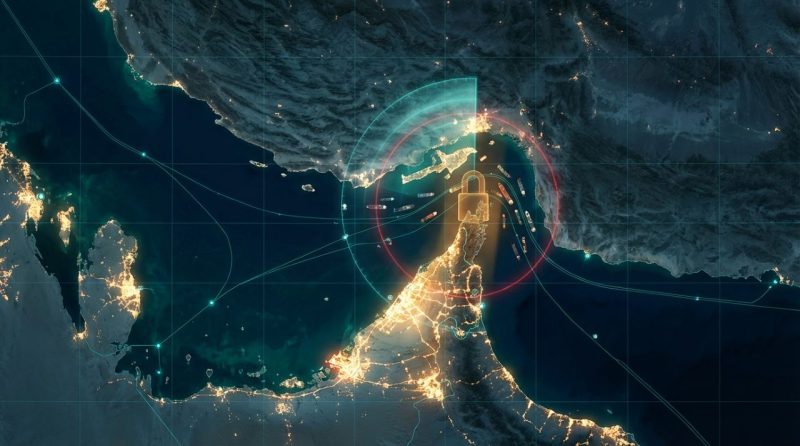
The ceasefire was supposed to change everything. On April 8, after 40 days of relentless US-Israeli airstrikes, a Pakistan-brokered deal between Washington and Tehran seemed to offer a lifeline to global energy markets and a war-weary region. Oil prices dipped below $90 a barrel on the news. Market analysts dusted off their optimism. And then reality set in: the Strait of Hormuz, through which 20 percent of the world’s oil passes, has barely moved.
Two tankers. One Iranian, one other. That is the sum total of vessels that have transited the chokepoint since the ceasefire announcement. The world’s most critical energy bottleneck remains effectively sealed, strangled by confusion, contradictory demands, and the fundamental mistrust that no brief diplomatic reprieve can actually dissolve.
A Deal That Solved Nothing
Let’s be direct: the ceasefire is already showing signs of unraveling, and the Strait of Hormuz is where those fractures are most visible. Pakistani Prime Minister Shehbaz Sharif claimed the agreement included a halt to Israel’s military operations in Lebanon and southern Lebanon. Netanyahu immediately contradicted him. The Israeli leader insisted that the ceasefire does not apply to Israel’s ongoing conflict with Hezbollah or its invasion of southern Lebanon. Iran’s supreme leader viewed this as a dealbreaker, vowing what he called a “new phase” in Hormuz management and demanding war compensation from the United States.
This is not a small detail. It is the entire foundation of the agreement cracking under its own weight within 48 hours.
For shipping companies operating in the region, this ambiguity has translated into paralysis. Executives are blunt: they have no information on how to safely pass through the Strait. No clear protocols. No written assurances. No sense of what comes next. In an industry where margins are razor-thin and insurance premiums spike the moment political risk enters the equation, this vacuum is disqualifying. You do not send a $200 million vessel into a zone where the governing rules are being rewritten in real time by an Iranian government that is actively threatening to withdraw from the deal.
Iran’s New Demands Reshape the Game
Iran’s position has hardened considerably. The government now insists that ships must secure explicit permission before transiting the Strait. More provocatively, Tehran has suggested it possesses the right to impose toll fees on vessels passing through its waters. These are not offhand comments. This is a fundamental recasting of how the Strait would function under Iranian management.
One Iranian tanker did transit. That is not an accident. Domestically owned vessels operating with government sanction face none of the liability exposure that foreign companies do. And paying Iran’s potential toll? A domestic operator has political cover. A foreign shipping company does not.
The Trump administration has accused Iran of failing to live up to the ceasefire terms. This is technically accurate, though the accusation glosses over a more complex reality: Iran views the ceasefire as having already been violated by Israel’s continued military operations in Lebanon. From Tehran’s perspective, the United States brokered a deal it could not enforce. From Washington’s perspective, Iran is manufacturing reasons to renege on commitments made just days ago.
Both are right, which is precisely the problem.
Oil Markets Caught Between Hope and History
The oil market’s whiplash has been severe. A brief window of optimism sent prices plummeting below $90 per barrel, signaling genuine market belief in de-escalation. By Thursday, crude had surged back above $100. Traders are not foolish. They understand that a ceasefire that cannot reopen the world’s most strategically important shipping lane is a ceasefire in name only.
The Strait normally carries 20 percent of global oil supply. Even modest disruptions cascade through global energy systems. A complete closure, which is essentially where we are now, creates supply shocks that ripple across every corner of the economy. This is not theoretical risk. This is the cost of geopolitical uncertainty priced into every barrel.
The Negotiation Theater Continues
Pakistan’s Prime Minister has invited delegations from both the United States and Iran to Islamabad on April 10 for further negotiations. Note the date. We are talking about emergency diplomatic talks just two days after the ceasefire was announced. This is not the behavior of a deal that is holding. This is the behavior of a house built on sand, requiring constant reinforcement to prevent immediate collapse.
The fundamental issue is structural. Iran emerged from 40 days of bombardment weakened militarily but politically empowered domestically. Supreme Leader Khamenei can claim victory to his base. The regime survived. American and Israeli firepower did not topple it. That matters enormously to internal legitimacy in Tehran, regardless of the actual damage inflicted.
But Iran also knows its leverage is temporary. Shipping companies will eventually find workarounds. Insurance costs will be priced in. Routes will be adjusted. The global economy does not grind to a halt indefinitely, even for a 20 percent supply constraint. So Tehran is moving quickly to establish new facts on the ground: permission requirements, toll fees, a “new phase” in Strait management. These are not negotiating positions. They are attempts to lock in gains while the window of maximum leverage is still open.
What Comes Next for Global Energy
The ceasefire has not failed yet, but it is failing in slow motion. Every day that the Strait remains closed, every day that shipping companies have to choose between commercial risk and insurance exposure, every day that oil prices remain elevated, the political incentive structure shifts. For the United States, a resumed blockade becomes politically untenable. For Israel, continued operations in Lebanon become harder to justify if they are destroying the ceasefire that Americans just brokered. For Iran, there is a window to extract maximum value before the pressure mounts.
What we are watching is not peace. It is a pause. And the Strait of Hormuz, where only two tankers have moved in the week since the ceasefire, is the proof.