
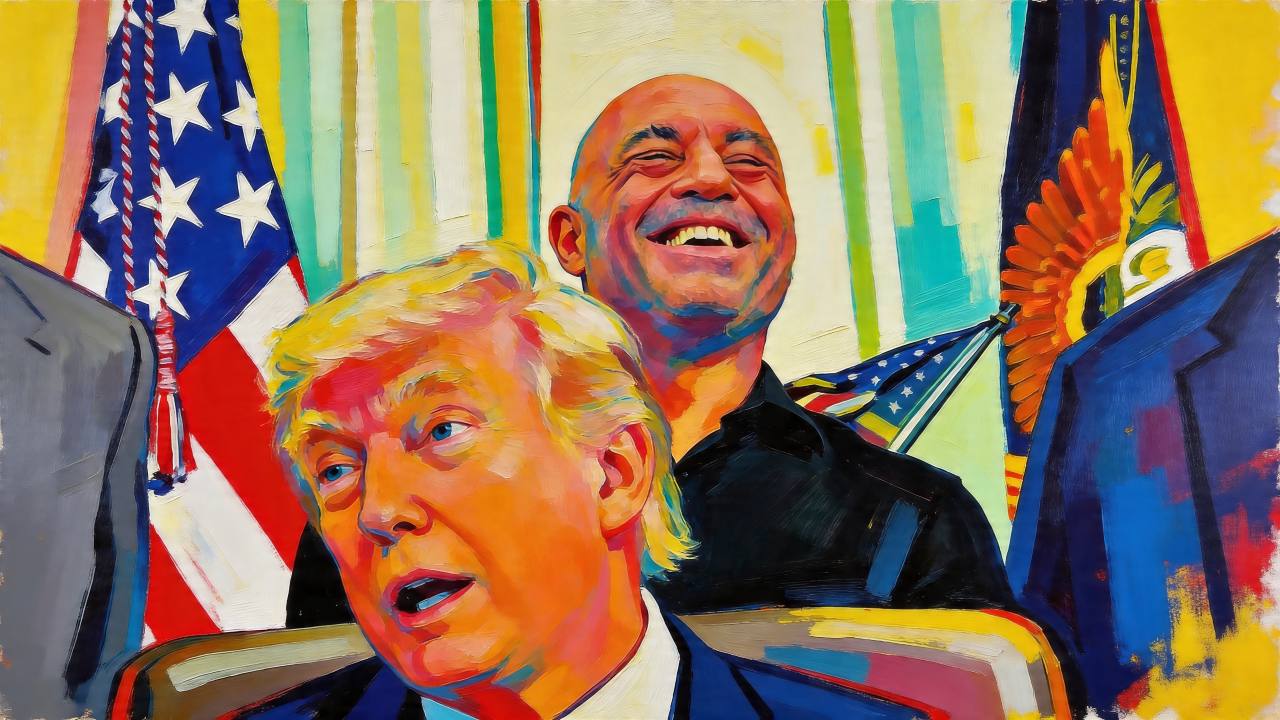
There is a photograph from Friday afternoon that will define a very specific moment in American politics. Joe Rogan, one of the most powerful media figure in the country who holds no office and answers to no editor, stands directly behind the President of the United States in the Oval Office.
Donald Trump is signing an executive order that will reshape federal drug policy. Robert F. Kennedy Jr., the Health and Human Services Secretary, flanks the scene. The document on the Resolute Desk directs the FDA to fast-track clinical trials for psilocybin, MDMA, LSD, and ibogaine.
This is not a stunt. Or rather, it is a stunt, but it is also real policy with real consequences, and that combination is what makes it worth paying attention to.
What The Executive Order Actually Does
The order directs the Food and Drug Administration to support and accelerate clinical trials for psychedelic substances, specifically targeting drugs that researchers have identified as promising treatments for PTSD, treatment-resistant depression, addiction, and other serious mental health conditions. It calls on HHS to allocate at least $50 million to states that have enacted or are developing programs to advance psychedelic drug therapies. It instructs federal agencies to clear regulatory bottlenecks that have kept these substances locked in Schedule I limbo for decades.
This is not a legalization order. Nobody is opening psilocybin dispensaries next week. But it represents the most significant federal action on psychedelic research since the Nixon administration shut it all down in the early 1970s, and the practical effect will be to dramatically shorten the timeline for potential FDA approval of these treatments.
The Rogan Factor
Trump, never one to bury the lede on his own motivations, said the quiet part out loud. “I got a call from a number of people, including the great Joe Rogan,” he told reporters, “and he said, ‘We have to do something about this,’ and I looked into it.” Rogan himself filled in the backstory: he had texted the president information about ibogaine, a psychoactive compound derived from an African shrub that has shown remarkable results in treating opioid addiction. Trump texted back almost immediately. “Sounds great. Do you want FDA approval? Let’s do it.”
Read that exchange again. A podcaster texts the president about a Schedule I substance. The president responds with what amounts to a policy directive. Weeks later, it becomes a signed executive order in the Oval Office with the podcaster standing behind him for the photo op.
This is how policy gets made now. Not through congressional hearings or agency review processes or the slow accumulation of clinical evidence meeting regulatory frameworks. Through a text thread between a comedian-turned-media-mogul and the most powerful person on Earth.
The Science Is Actually Promising
Here is where this gets complicated for anyone who wants to simply dismiss it as a sideshow. The clinical evidence for psychedelic-assisted therapy is genuinely compelling. MDMA-assisted therapy for PTSD has shown response rates that dwarf conventional treatments in multiple Phase 3 trials. Psilocybin has demonstrated sustained remission of treatment-resistant depression in rigorous studies at Johns Hopkins, NYU, and Imperial College London. Ibogaine has produced dramatic results in treating opioid use disorder, with some studies showing significant reductions in withdrawal symptoms and cravings after a single supervised session.
The FDA actually came close to approving MDMA-assisted therapy in 2024 before an advisory committee raised concerns about trial methodology, not the drug’s efficacy. Researchers in the field have been frustrated for years by what they see as regulatory overcaution keeping effective treatments from patients who are running out of options.
So when Kennedy, who stood beside Rogan at the signing, calls this “the most important mental health initiative in a generation,” he is not entirely wrong. The substance of the policy has real support from serious researchers and clinicians.
The Make America Healthy Again Playbook
This executive order fits neatly into the broader “Make America Healthy Again” framework that RFK Jr. has been building since taking over HHS. The strategy is consistent: position the administration as fighting a captured regulatory state on behalf of suffering Americans. The FDA is too slow. The pharmaceutical industry has too much influence. The little guy is getting crushed by bureaucracy while proven treatments gather dust on shelves.
It is an effective populist pitch because it contains grains of truth. The FDA’s drug approval process is genuinely slow. Psychedelic research was genuinely suppressed for political reasons for half a century. Veterans with PTSD are genuinely desperate for treatments that work better than what they currently have access to.
But the MAHA movement also has a persistent problem with conflating legitimate critiques of institutional dysfunction with a blanket skepticism of institutional expertise. Fast-tracking drug approvals sounds great until you remember why we have rigorous approval processes in the first place. The $50 million directed to state programs comes with minimal guidance about what those programs should look like, how they should be supervised, or what safeguards should be in place for vulnerable patients.
Who Was In The Room
The guest list tells you everything about the coalition behind this. Rogan represents the massive podcast-listening audience that has been hearing about psychedelic therapy for years through long-form interviews with researchers and advocates. Kennedy represents the anti-establishment health movement. NIH Director Jay Bhattacharya, also present at the signing, represents the faction of credentialed scientists who have aligned with the administration’s approach to health policy. W. Bryan Hubbard, the CEO of Americans for Ibogaine, was there too, along with former Energy Secretary Rick Perry, who has become an outspoken advocate for ibogaine treatment for veterans.
What you do not see in that room is the traditional drug-policy establishment, the career FDA officials who would normally shepherd something like this, or the congressional committees that would ordinarily have oversight. This is executive action, by design, meant to go around the institutions rather than through them.
What Happens Next
The executive order will face legal challenges. It will face bureaucratic resistance inside the agencies tasked with implementing it. It will face legitimate scientific scrutiny about whether accelerating the approval timeline means cutting corners on safety. All of that is predictable.
What is less predictable is whether this moment represents a genuine inflection point in how America treats mental illness, or whether it becomes another example of policy-by-spectacle, a signing ceremony that generates headlines but changes less than it promises.
The veterans waiting for access to treatments that might actually help them do not care about the optics. They do not care that a podcaster’s text message is what got the ball rolling. They care about whether this translates into real access to real treatment under real medical supervision. That question will not be answered by an executive order. It will be answered by what the FDA, HHS, and state agencies actually do in the months that follow.
The photograph from the Oval Office will be remembered either way. The question is whether it will be remembered as the day something important started, or the day something important was performed.