
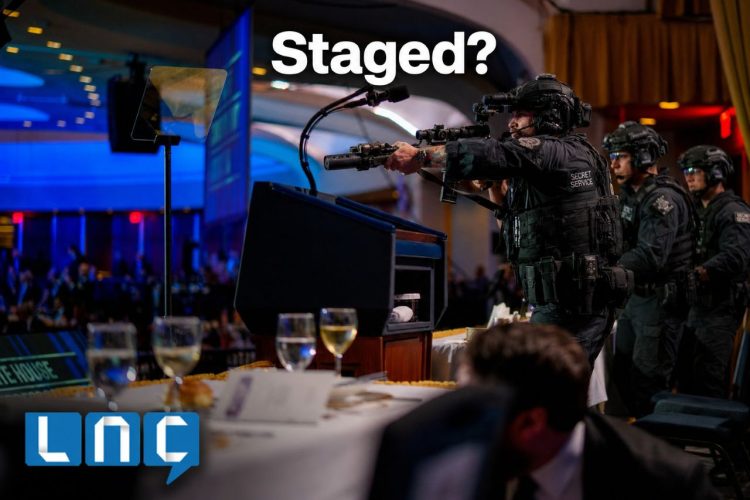
The bullet that hit a Secret Service agent’s vest at the Washington Hilton on Saturday night was real. The agent is real. The shotgun the suspect carried into the lobby is real. The handgun and the multiple knives are real. The 1,000 reporters and dignitaries who hid under their tables are real, and so is the long, strange hour they spent in lockdown waiting for the all-clear.
What is also real, and this is the actual story that broke on Saturday, is that within minutes of the first shot, the word “STAGED” was the top trend on X.
The shooting at the White House Correspondents’ Dinner was not staged. The conspiracy reflex around it absolutely was. And those are two very different stories, only one of which most outlets are going to be brave enough to write.
WHAT WE KNOW, IN THE ORDER WE LEARNED IT
A man identified by federal law enforcement as Cole Tomas Allen, 31, of Torrance, California, charged a Secret Service magnetometer at the Washington Hilton on Saturday, April 25. He was carrying a shotgun, a semiautomatic pistol, and what D.C. Metropolitan Police interim chief Jeff Carroll described as multiple knives. He was not on any watch list. He was a former Caltech mechanical engineering grad with a master’s in computer science from Cal State Dominguez Hills, named “teacher of the month” at a tutoring center in 2024.
He did not get past the magnetometer. He did get a single round into the body armor of a Secret Service agent, who was hospitalized and is reportedly stable. Allen was apprehended in the lobby. President Trump and First Lady Melania Trump were already inside the ballroom on stage. They were never within direct line of fire of the suspect, according to a federal source briefed by the FBI.
The dinner was canceled at law enforcement’s request. Trump went back to the White House and held a press conference at which he praised the Secret Service, praised (for once) the assembled correspondents for their reporting, and pledged the dinner would be rescheduled within 30 days.
That’s the ground truth. Hold onto it, because it gets blurry fast.
THE “STAGED” REFLEX: HOW FAST AND HOW LOUD
By the time Trump reached the briefing room, X had already done its work. “Staged” was trending. A clip of Press Secretary Karoline Leavitt’s pre-event Fox News appearance, in which she joked that there would be “some shots fired tonight in the room,” referring to the speech Trump had been planning, was circulating with millions of views and a single-word caption: “It was staged.”
The mainstream entrants (The Mirror, Irish Star, AOL, MSN) were running aggregations of the discourse within hours. The frame was uniform: a shooting happened, conspiracy theorists immediately declared it fake, here are the screenshots. One X user wrote: “His approval ratings are so bad that he staged another assassination attempt to get out of the White House correspondents’ dinner.” Another, more elaborately: “This is another false flag operation by the deep state, just like what happened in 2024. The question is whether Karoline Leavitt and Trump will blame Iranians or Democrats, because that’s what will help them win votes in the upcoming election.”
That’s not a fringe sentiment buried in a 4chan thread. That was the consensus take across a significant slice of American social media within ninety minutes of a Secret Service agent getting shot.
The interesting question, the only question worth a thousand words, is why.
THE TINDER WAS DRY: FOUR REASONS THE MATCH CAUGHT
The “staged” frame didn’t appear from nowhere. It landed in a context that had been priming for it for months. Four pressures, all of them real, all of them documented, all of them weighing on this White House:
The Iran war is stuck and the public knows it. Trump’s two-week ceasefire with Iran, brokered through Pakistan in early April, has been extended repeatedly with no end state. The U.S. is enforcing a naval blockade of Iranian ports. As of last week, 37 ships have been redirected. On Saturday (the same day as the shooting), Trump abruptly canceled a Witkoff-Kushner trip to Islamabad for the next round of talks. CNN’s polling, and the Reuters-Ipsos and AP-NORC numbers, show approval of his Iran handling sliding fast. There is no obvious off-ramp, and the war is now the macro story dragging on the rest of the agenda.
The Epstein files saga refuses to die. The Justice Department’s Office of the Inspector General announced just last Thursday that it will formally probe whether DOJ complied with the Epstein Files Transparency Act. Trump fired Attorney General Pam Bondi in early April, reportedly over her handling of the files. Acting AG Todd Blanche said the Epstein files “should not be a part of anything going forward,” which, predictably, became part of everything going forward. Melania Trump made a public statement denying connections to Epstein that left both friendly and hostile press asking “why now?” Survivors are still angry. Lawmakers are still alleging redactions protected powerful figures. The story has lost none of its half-life.
The ballroom is in litigation and looks bad. Trump’s $400 million White House ballroom, the project he demolished the East Wing for last October, is currently halted above-ground by an injunction from federal Judge Richard J. Leon, who wrote that “the President of the United States is the steward of the White House for future generations of First Families. He is not, however, the owner!” The National Trust for Historic Preservation is suing. A National Capital Planning Commission packed with Trump appointees voted to approve the project anyway. It is, even by the standards of this administration, an ugly, expensive, contested fight, and Trump’s repeated insistence at his Saturday night briefing that the rescheduled WHCD will be held in the new ballroom (“we’ll make it safer,” he said) handed the conspiracy economy a gift it would have invented if the president hadn’t said it himself.
Butler is still in the bloodstream. The single most-cited reference in the “staged” tweets is not about Saturday at all. It’s the assassination attempt at Butler, Pennsylvania, on July 13, 2024, the day a bullet grazed Trump’s ear, killed a rallygoer named Corey Comperatore, and produced the iconic raised-fist photograph that powered the closing weeks of his campaign. Official investigations confirmed the gunman, the shots, the wound, the death. None of that has stopped a persistent, durable online conviction that Butler was theater, a conviction now resurrected, almost word-for-word, in the WHCD response. Multiple X users explicitly framed Saturday as “Butler 2.0.” Whatever you think of the Butler theories on the merits, they have proven impossible to extinguish, and they are now load-bearing structure in how a chunk of America processes any dramatic event involving this president.
Stack those four pressures and you don’t need a conspiracy to explain the reflex. You just need a population that no longer assumes anything happened the way it appears.
THIS IS NOT A “BOTH SIDES” STORY. IT’S A TRUST STORY.
Here is where the temptation, particularly for a Google News property, is to bothsides this: to write that “some say staged, others say real, the truth is somewhere in the middle.” The truth is not in the middle. A Secret Service agent took a round to the chest at close range. The shooter is in custody. The factual record on what happened Saturday is going to be very boring and very establishable. Anyone who tells you otherwise is selling something: engagement, ad impressions, or a political narrative.
What is genuinely contested, and worth contesting, is the information environment that produced “STAGED” as the top trend within minutes. That environment is the actual product of years of bipartisan choices: a federal communications apparatus that has lied repeatedly to the public on matters big and small, a social platform now optimized for outrage velocity, a White House that broadcasts on Truth Social and bypasses traditional gatekeepers, a press that earned much of its credibility deficit honestly, and a political opposition that has spent a decade swinging between insisting Trump is uniquely dangerous and insisting nothing he does is real.
Add in unresolved priors (Epstein, the ballroom, the Iran war’s frozen middle), and what you get is not a conspiracy theory. You get a conspiracy posture: a default reading frame that interprets any dramatic event involving the administration as choreography. The posture is durable, contagious, and increasingly politically consequential. It does not require evidence. It requires only the prior assumption that nothing is what it seems, which is an assumption a non-trivial share of the country now holds as a starting condition.
That’s the story. And it cuts in every direction. Plenty of people convinced Butler was staged in 2024 to help Trump are now also convinced Saturday was staged to help Trump. Plenty of people convinced Saturday’s shooting was a deep-state operation will be convinced of the next opposite thing next month. The frame is the constant; the target rotates.
WHAT TO ACTUALLY WATCH FOR THIS WEEK
A few things will tell us a great deal about where this lands:
The first is whether Allen’s motive becomes clear and whether it cleanly maps onto a known political identity. If it does, expect the “staged” frame to soften but not disappear. If it doesn’t, if he turns out to be a “lone wolf” with no coherent ideology (the now-standard outcome of these incidents), expect the frame to harden, because ambiguity is the conspiracy economy’s preferred fuel.
The second is whether the wounded Secret Service agent gets named, and whether his recovery is documented. Naming the wounded humanizes the night and corrodes the staging frame more than any official statement can. Expect a real internal fight inside Secret Service public affairs over how much to release.
The third is whether Trump uses the rescheduled dinner (almost certainly in his ballroom) as a campaign-style victory moment. He will. The question is how much it eats his Iran problem, his Epstein problem, his approval problem. The bet inside the White House is that it eats all three, at least for a news cycle. The bet on the other side is that it accelerates the staged frame into a permanent feature of his coverage.
The fourth, and the one that matters most for the next decade, is whether any institution (press, platform, or government) figures out how to respond to a country that processes major events through conspiracy posture in real time. Saturday suggests none of them have, yet.
THE CONSPIRACY WAS NOT THE SHOOTING. THE CONSPIRACY WAS THAT IT NEEDED TO BE A CONSPIRACY.
A man with a shotgun charged a security checkpoint at a press dinner. A Secret Service agent’s body armor saved his life. The President of the United States was evacuated. Those are the facts, and they would have been the entire story in 1995 or even in 2015.
In 2026, the facts barely lasted ninety minutes before they had to share the stage with their own counter-narrative. That is not because the country is stupid. It is because the country has been given excellent reason, by every institution that used to mediate reality on its behalf, to treat reality as one story among several. When you pair that with a stalled war, an unresolved sex-trafficking scandal, an East Wing that no longer exists, and an ear that is still, four years later, being relitigated on the timeline, the surprise isn’t that “STAGED” trended on Saturday night.
The surprise would have been if it hadn’t.
Reporting from AP, NBC News, CBS News, NewsNation, Axios, CNN, NPR, Al Jazeera, Salon, Reuters/Mirror, MSN, AOL, Wikipedia (Epstein Files Transparency Act, White House State Ballroom, 2026 Iran war ceasefire), and The Mirror US’s aggregation of X discourse. Federal law enforcement identifications via AP. Quotes from Judge Richard J. Leon’s March 31, 2026 ruling and April 16, 2026 amended order.