
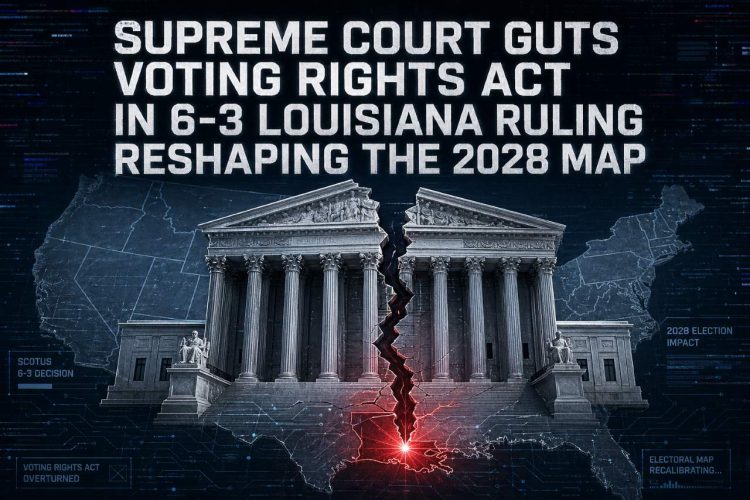
The Supreme Court has spent more than a decade chipping away at the Voting Rights Act, the 1965 law widely considered the most consequential civil rights statute in American history. On Wednesday, the court did not so much chip as crack the foundation. In a 6-3 ruling in Louisiana v. Callais, the conservative majority hollowed out Section 2, the provision that for four decades has policed how states draw their voting maps and protected the ability of Black and Hispanic voters to elect candidates of their choosing.
Justice Samuel Alito, writing for the majority, framed the decision in the language of constitutional restraint. The Constitution, he argued, “almost never permits” the government to sort citizens by race, and Section 2 of the Voting Rights Act cannot justify what he called race-based redistricting. From now on, plaintiffs must show that lawmakers acted with intentional discrimination, not just that the resulting maps diluted minority voting power. Effect alone is no longer enough.
Effect alone has been the entire ballgame for forty years.
That is what Justice Elena Kagan made clear in a dissent joined by Justices Sonia Sotomayor and Ketanji Brown Jackson. The ruling, she wrote, renders Section 2 “all but a dead letter.” Then she went further, with a sentence destined to be quoted for years: “Today, the majority straight-facedly holds that the Voting Rights Act must be brought low to make the world safe for partisan gerrymanders.” Translation: the court has decided that the price of preventing race from being a “predominant factor” in mapmaking is allowing politicians to dismantle minority districts in the name of party advantage.
WHAT THE COURT ACTUALLY DID
The case began in Louisiana, where after the 2020 census the state initially drew a congressional map with one majority-Black district out of six. Black residents make up roughly a third of the state’s population. A federal court ordered a second majority-Black district. The Republican-controlled legislature complied, then watched non-Black voters challenge the new map as a racial gerrymander. The challenge succeeded.
The court did not strike down Section 2 on its face. It did something more clever and more lasting. It rewrote the standard. Under the new test, a state violates the Voting Rights Act only when “evidence supports a strong inference that the State intentionally drew its districts to afford minority voters less opportunity because of their race.” That is a far higher bar than the totality-of-circumstances analysis that has guided redistricting cases since the 1980s, and it puts the burden on plaintiffs to prove what is almost never written down.
In effect, the court swapped a results-based test for an intent-based test. And intent is the kind of thing legislators learn very quickly to never put in an email. You can read the full opinion at the Supreme Court’s official site.
WHO LOSES, AND WHERE
The political consequences are not subtle. Civil rights groups and election analysts have been bracing for this outcome for the better part of a year. According to advocacy groups tracking redistricting risk, as many as 19 congressional districts with primarily Black or Hispanic populations could be redrawn before the 2028 cycle. That carries potential effects on roughly a quarter of the Congressional Black Caucus and a tenth of the Congressional Hispanic Caucus.
The geography is predictable. Louisiana, Alabama, South Carolina, Texas, Georgia, and Florida all have maps now exposed to redrawing. Most of those legislatures are controlled by Republicans, who have an obvious incentive to consolidate friendly districts. The party math in the U.S. House is currently tight enough that even a handful of new Republican-leaning seats could shift control after the 2028 election.
WHY THIS WAS THE LOGICAL ENDPOINT
If you have followed the Roberts Court on voting rights, none of this is a surprise. In 2013, Shelby County v. Holder pulled the teeth from Section 5, which had required states with histories of discrimination to get federal preclearance before changing their election laws. In 2021, Brnovich v. Democratic National Committee narrowed Section 2 challenges to voting procedures. The Allen v. Milligan decision in 2023 looked, for a moment, like a pause. It was not. It was a holding pattern.
Callais is the logical endpoint of an argument the conservative legal movement has been building for thirty years. The argument is that any consideration of race in mapmaking, even race used to remedy past discrimination, runs afoul of the Equal Protection Clause. The argument has finally captured a majority. The Voting Rights Act remains on the books. It just no longer does most of what it was passed to do.
THE CORPORATE AND DEMOCRATIC IMPLICATIONS
The political class will spend the next month dissecting which seats flip. The deeper question is what this does to American democracy as an actual functioning system. Voting rights have always been the load-bearing wall of representative government. When a minority population is consistently denied the ability to elect representatives that reflect its political preferences, the legitimacy of the resulting legislature becomes a serious problem, and not just for civil rights lawyers.
There is also a corporate dimension that gets less attention. Major employers in the South, particularly in Atlanta, Houston, and Charlotte, have spent the last decade making public commitments to diverse representation in civic and political life. Those commitments are now in tension with the legal landscape they operate in. Expect the corporate response to be quiet, careful, and largely focused on shareholder optics rather than public statements. The era of CEOs writing op-eds about voting rights ended somewhere around 2022, and this ruling will not bring it back.
WHAT HAPPENS NEXT
Congress can rewrite the Voting Rights Act. It will not. The John Lewis Voting Rights Advancement Act has sat dormant for years because the votes have never been there, and the votes are even less there now. That leaves litigation, state-level ballot initiatives, and turnout. Civil rights groups including the NAACP Legal Defense Fund and the Brennan Center have already signaled that they will pivot to state constitutional claims and Section 1 challenges, which are slower, narrower, and a fraction as effective. The Brennan Center has tracked the steady erosion of the Voting Rights Act for years, and its analysts are already mapping the next phase of state-level litigation.
For voters in affected states, the next decade will be a test of how much representation can be salvaged through organizing alone, in a system where the legal scaffolding has been kicked away.
The Voting Rights Act survives in name. The court has made sure of that. What it can no longer do is the question every state legislature in the South is now answering, district by district, with a sharpie.