
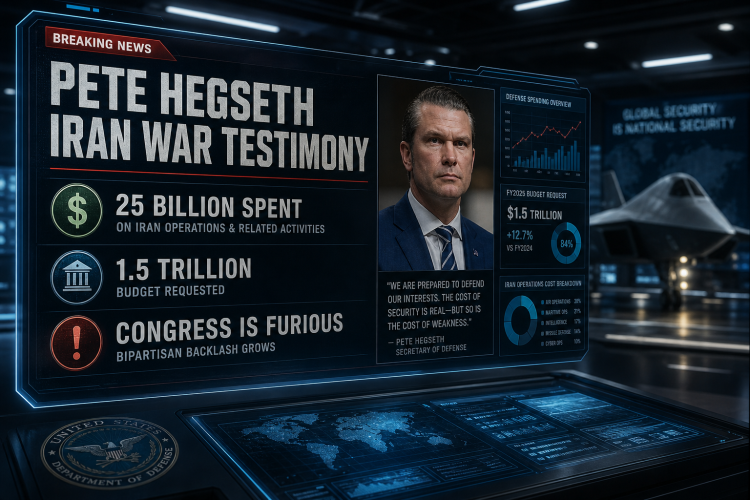
The first real accounting of what the Iran war is costing the American taxpayer arrived on Capitol Hill this week, and the numbers landed like a concussion grenade in a room already thick with partisan rage. Defense Secretary Pete Hegseth and Joint Chiefs Chairman Dan Caine sat before House lawmakers on Tuesday for their first public testimony since the United States and Israel launched strikes against Iran on February 28, and what emerged was less a policy hearing than a political brawl over the price of a war that, two months in, has no visible endgame.
The headline number: $25 billion. That is what the Pentagon says the Iran campaign has cost so far, with the acting comptroller noting that “most of that” went to munitions and the cost of surging assets to the Middle East. For context, that is roughly double what the U.S. spent in the first two months of the Iraq invasion in 2003, adjusted for inflation. And unlike Iraq, the Strait of Hormuz remains effectively closed, meaning the economic blowback from this war is hitting every American at the gas pump every single day.
A Historic Budget Request With Wartime Urgency
Hegseth used the testimony to defend the White House’s request for a $1.5 trillion defense budget, a figure that would represent the largest military spending package in American history. The number signals something the administration has not explicitly said out loud: this war is not ending soon, and Washington is preparing for a sustained campaign that could stretch well into 2027 or beyond.
The budget request includes significant increases for naval power projection (unsurprising, given that three aircraft carrier strike groups are now deployed to the Middle East simultaneously for the first time since 2003), hypersonic missile production, and what Hegseth vaguely described as “next-generation strike capabilities.” Translation: the Pentagon wants to buy a lot more of the things it is currently running low on.
Democrats Call the War “A Strategic Blunder”
The partisan divide was immediate and brutal. Rep. John Garamendi of California set the tone for Democrats when he accused Hegseth of misleading Americans about the reasons for the conflict, calling the war “a geopolitical calamity,” “a strategic blunder,” and “a self-inflicted wound to America.” Others pointed to the Strait of Hormuz closure, which has sent oil past $126 a barrel and gasoline to $4.30 nationally (and above $8 in parts of Los Angeles), as proof that the war’s economic consequences were either not anticipated or deliberately ignored.
Hegseth’s response was combative in a way that would have been unthinkable from a Defense Secretary even five years ago. “Two months in, on an existential fight for the safety of the American people, Iran cannot have a nuclear bomb, we are proud of this undertaking,” he said. Then he went further: “The biggest challenge, the biggest adversary, we face at this point are the reckless, feckless and defeatist words of congressional Democrats and some Republicans.”
That framing, casting domestic political opponents as a bigger threat than the actual enemy, is not new in wartime rhetoric. But hearing it from the Secretary of Defense in sworn testimony before Congress represents a crossing of a line that previous administrations, even in the most heated moments of Iraq and Afghanistan, generally avoided.
What $25 Billion Actually Bought
The Pentagon’s breakdown of war costs reveals the sheer scale of kinetic operations. The majority of spending went to precision-guided munitions, cruise missiles, and the logistical cost of rotating carrier strike groups through the theater. The USS Gerald R. Ford, which just completed a record 311-day deployment, burned through flight hours, spare parts, and crew endurance at rates that have Navy leadership privately concerned about long-term readiness.
Equipment losses were acknowledged but not detailed. What is publicly known: at least two MQ-9 Reaper drones have been shot down over Iranian airspace, and Iranian ballistic missile strikes on U.S. positions in the Gulf have resulted in damage to forward-deployed assets that the Pentagon has been reluctant to specify. The human cost, while officially described as “minimal” in Hegseth’s testimony, remains partially classified.
The 60-Day War Powers Clock
Hanging over the entire hearing was a legal deadline the administration would clearly prefer to ignore. The War Powers Resolution requires the president to withdraw forces from hostilities within 60 days unless Congress explicitly authorizes the use of military force. That clock started on February 28. It expired on April 29, the day of Hegseth’s testimony.
Democrats raised this point repeatedly. The administration’s position, articulated by Hegseth, is that the existing 2001 Authorization for Use of Military Force provides sufficient legal cover because Iran has provided material support to terrorist organizations. Legal scholars across the political spectrum have called this argument a stretch at best and legally baseless at worst.
No vote on a new AUMF is currently scheduled, and Speaker Johnson has shown no interest in bringing one to the floor. This means the Iran war continues in a constitutional gray zone that, whatever one’s position on the merits of the conflict, should concern anyone who believes in the principle that Congress authorizes wars.
Where This Goes Next
The Senate Armed Services Committee gets its turn with Hegseth and Caine next, and that hearing promises to be even more contentious. Several Republican senators, including those from oil-producing states who initially supported the war, are now facing constituent backlash over gas prices and are publicly asking harder questions about the exit strategy.
The $1.5 trillion budget request will move through the appropriations process over the summer, and it will become a proxy fight over the war itself. Every line item will be a referendum on whether this conflict is worth its cost, in dollars, in diplomatic isolation, and in the economic pain being felt by Americans every time they fill up their tanks.
What Hegseth’s testimony made clear, perhaps unintentionally, is that the administration has no timeline for concluding this war and no metric for what “winning” looks like beyond the negative goal of preventing an Iranian nuclear weapon. That is not a strategy. That is an open-ended commitment with a $25 billion price tag that grows every day the Strait of Hormuz stays closed.