
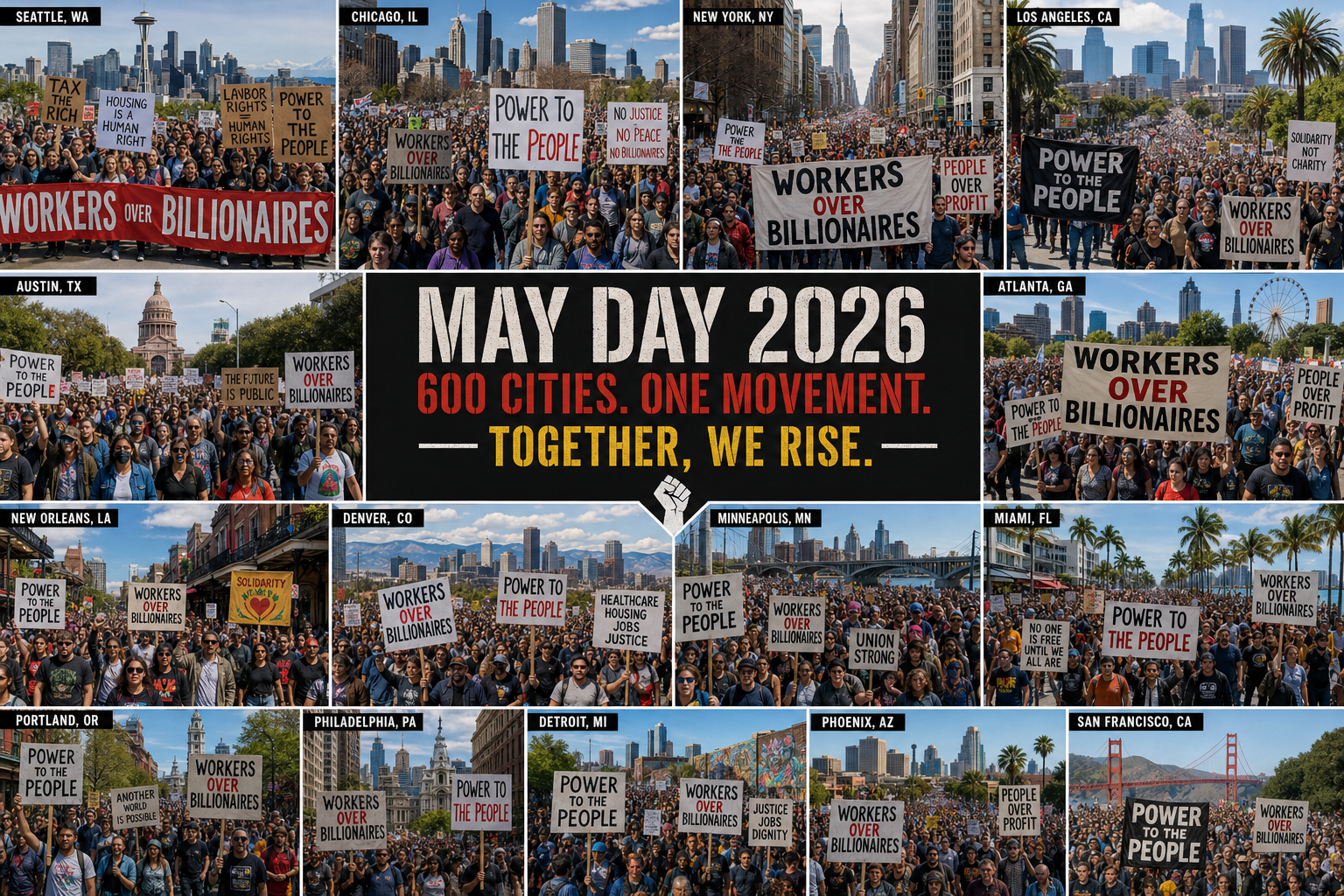
May 1, 2026 will not be remembered as another quiet labor holiday. By dawn, organizers had locked in more than 3,000 events across roughly 600 American cities, with sister rallies firing off from Sydney and Seoul to Paris and Manila.
The coalition behind it, May Day Strong, pulled together 500 unions, immigrant-rights groups, climate organizations, and student networks under one blunt slogan: “Workers Over Billionaires.”
This was not a vibe protest. It was a logistics operation. The Sunrise Movement told reporters that more than 100,000 students were expected to walk out, framing the day as a strike rather than a field trip. In Chicago, CPS teachers and students marched from Union Park into downtown. In Minneapolis, tens of thousands flooded the streets after a string of ICE operations and the police shooting of Renee Nicole Good, turning a national protest day into a local accountability moment. As the Washington Post reported, activists worldwide gathered for May Day rallies and street protests, calling for peace, higher wages, and better working conditions as workers grappled with rising energy costs tied to the Iran war.
A Three-Front Grievance List
Treat this like a campaign and the messaging gets clearer. Organizers stitched three pressure points together: the Trump administration’s deportation push, the cost-of-living squeeze from the U.S.-Israeli war with Iran, and what protesters call billionaire capture of the federal government.
The economic argument is the spine of the day. Energy prices have stayed elevated since the Iran conflict opened, food and rent are still grinding household budgets, and wage growth has trailed sticky core inflation for most of the past year. NPR’s coverage of the boycott of work, school, and shopping framed the day as a voluntary economic strike, not a parade. Whether the boycott actually moved retail data is the kind of thing the Bureau of Labor Statistics will sort out later, but the political message was unmistakable: workers want their share back.
The immigration plank is hotter. ICE raids have been the single most visible domestic story of 2026, and the coalition’s call for abolishing the agency is the kind of position that would have been fringe in 2020 and is now the entrance fee to any labor-immigrant alliance. Whatever you think of the policy, the politics are interesting. Service unions, who have spent two decades organizing immigrant workforces, were never going to sit this one out.
The Foreign Policy Wildcard
Iran is the variable nobody in Washington wants to talk about on a labor holiday, and that is exactly why protesters dragged it onto the stage. In Manila, marchers held banners reading “no troops, no bases, no war games, resist U.S.-led wars,” and clashed with police near the U.S. Embassy. In Paris, French unions rallied under the slogan “bread, peace and freedom,” explicitly tying domestic concerns to the wars in the Middle East and Ukraine. In Istanbul, Turkish police detained roughly 15 protesters trying to reach Taksim Square in defiance of a standing government ban.
Those scenes matter for one reason: they collapse the wall between foreign policy and kitchen-table economics. When gas costs more because of a war the public never voted on, every labor rally becomes a foreign policy rally, whether the AFL-CIO wanted it that way or not. That kind of merger tends to follow long, expensive military engagements. It happened in 1968. It happened in the early 2000s. It is happening now.
The Money And Coordination Question
An investigation by Fox News flagged that the roughly 600 organizations behind the protests collectively pull in around $2 billion in revenue, framed as a “red-blue alliance” of mainline labor, climate, and progressive groups. Read past the framing and the number is unsurprising. The SEIU alone reports hundreds of millions in annual dues. The NEA is one of the largest unions in the country. The Sunrise Movement has been a fixture in climate organizing since 2017.
What is actually interesting is the coordination. Three thousand events in 600 cities is not a spontaneous uprising. It is a project that has been quietly built over the past 18 months, and it explains why turnout cleared the bar that the earlier No Kings protests against the Trump administration set as a benchmark when they drew millions across the country earlier this year.
What Workers Are Actually Demanding
Strip the slogans down and the demand list reads like a 2024 Senate Democratic platform with sharper edges. Higher taxes on the wealthiest Americans. Full funding for public schools, healthcare, and housing. Protection of Medicaid and Social Security from cuts. Abolition of ICE. An end to the Iran war. Expansion of voting rights, with corporate political spending pushed back.
None of those positions are new. What is new is the willingness of mainstream unions to put their bodies behind the more contested ones, particularly the immigration and foreign policy planks. Twenty years ago, the AFL-CIO would have hedged on ICE. Today, several major affiliates are co-sponsoring marches that explicitly call for its abolition. That is a structural shift, not a press release.
What To Watch Next
Three things to watch in the next two weeks.
First, union density. May Day rhetoric is cheap. NLRB filings are the receipt. If organizers convert the energy of May 1 into actual recognition petitions, you will see it in regional NLRB data within 30 days.
Second, corporate response. Several Fortune 500 employers had to navigate walkouts on Friday. Watch which CEOs issue statements, which stay quiet, and which quietly tighten attendance policies. The 2020 racial justice playbook of “stand with our people” memos is already being tested for fatigue.
Third, the White House. President Trump has so far declined to engage directly with May Day Strong, but his administration’s response to the immigration plank in particular will shape the next round of midterm messaging. ICE expansions, new executive orders, or escalations against organizers would hand the coalition a sharper frame than they could draw themselves.
The honest read on May Day 2026 is this: it was the largest single-day labor and progressive mobilization on U.S. soil in years, and unlike most of its predecessors, it was tightly fused to a foreign policy crisis, an active deportation regime, and a sustained economic squeeze on working households. That is a different kind of protest. It is harder to absorb, harder to dismiss, and harder to forecast.
Whether Friday becomes the high-water mark or the warm-up depends on whether the 500 organizations behind the banner can do the boring part: turn one good day into a year of sustained pressure.