
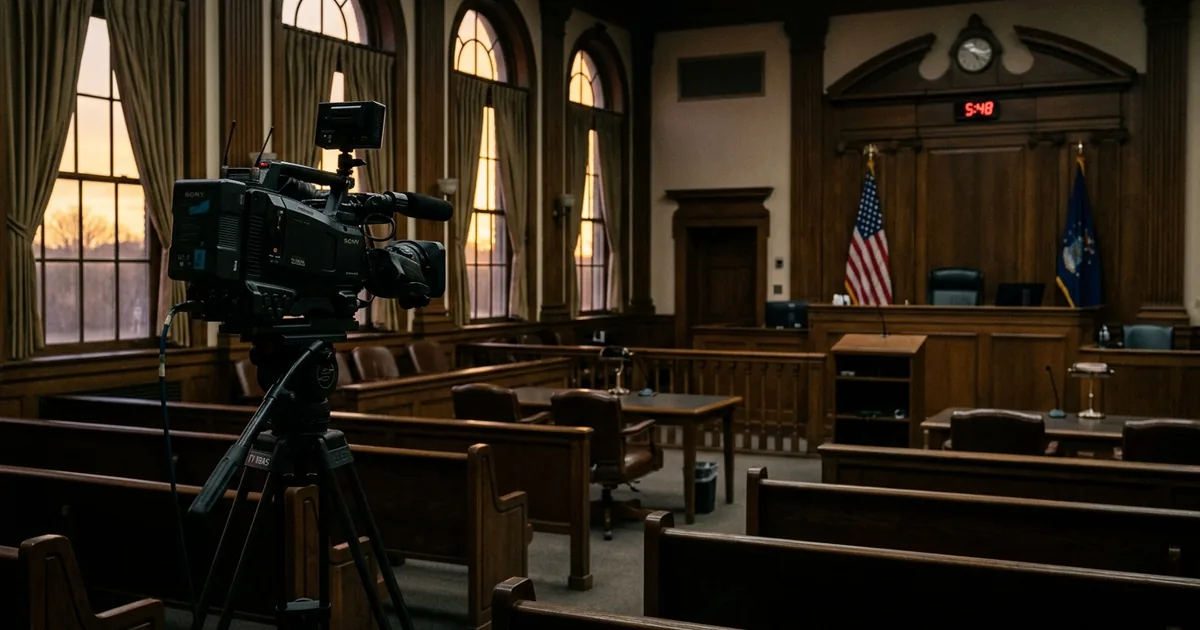
Utah 4th District Court Judge Tony Graf ruled Friday, May 8, 2026, that cameras will remain in the courtroom for the murder trial of Tyler Robinson, the 23-year-old charged with assassinating conservative activist Charlie Kirk on the campus of Utah Valley University in September 2025.
The ruling rejects a defense motion to ban media coverage and keeps one of the most heavily watched trials of the year in public view, but the judge’s reasoning reads less like a celebration of press freedom than a sigh of compromise.
What Graf Ruled and What He Did Not
Graf declined to ban cameras outright. He kept the longstanding Utah default of allowing electronic media coverage during pretrial proceedings, requested by news outlets on a case-by-case basis. He explicitly cited the access principle, writing in his order that “Electronic media coverage provides a means to facilitate the public’s right of access to court proceedings for those who cannot physically occupy the limited space available in a courtroom,” per the Deseret News writeup of Friday’s hearing.
What he did not do is call the existing media coverage a model of restraint. Graf acknowledged in the same order that “the commentary from established news media does not provide a neutral summary of court proceedings,” noting that some outlets have used courtroom footage as a springboard to discuss out-of-court statements by public officials, opine on evidence not yet presented, and “generally vilify the defendant.” That sentence is the one the defense will quote back to the appellate court if a guilty verdict ever lands and the question of pretrial publicity comes up.
The judge also pushed Robinson’s preliminary hearing from May 18 to a five-day window of July 6 through 10. He approved the defense motion for a delay and described the request, citing the volume of discovery in the case, as “neither unexpected nor unreasonable.”
The Compromise: Tighter Pool Rules After a Shackles Incident
Graf’s accommodation to Robinson’s defense team is procedural, not philosophical. The order tightens how the press operates inside the courtroom in ways that read directly off a list of recent grievances.
Cameras now sit at the back of the courtroom, behind the defendant. Pool members are prohibited from photographing Robinson’s shackles, his family members in the gallery, or him entering and exiting the room. Reporters seeking coverage on a given day must file a request 14 days in advance, with prosecution and defense each given 10 days to object.
Those rules were not invented in a vacuum. Members of the media pool covering an earlier hearing violated an existing courtroom order by capturing footage of Robinson’s shackles and shooting close-ups of him conferring privately with his attorneys, as KSAT reported in its preview of Friday’s hearing. The shackles question is not minor. Photos of a defendant in restraints prejudice juries, and the protection against jurors seeing a defendant in chains is one of the older fair-trial doctrines in American courtrooms. A camera angle that captures shackles, even by accident, is a real fair-trial problem.
Read in that light, Graf’s ruling is doing two things at once. He is keeping the public’s access to a politically fraught trial intact. He is also putting the press on probation. Coverage will continue, but the rules of how that coverage is gathered have hardened in ways that will frustrate every video editor working on a daily deadline.
What the Defense Asked for and Why
Robinson’s lead defense attorney, Kathryn Nester, argued that livestreaming and pool video had created a media ecosystem in which Robinson’s neutral-faced courtroom appearances were being framed as evidence of remorselessness. The argument is not novel. It is the standard fair-trial argument, applied here to a defendant facing seven counts that include aggravated murder, obstruction of justice, and witness tampering, with the Utah County Attorney’s Office seeking the death penalty.
Robinson has not yet entered a plea. The case is still in its pretrial phase. The decision Graf made Friday is meaningful precisely because the discovery and pretrial-publicity record built over the next six months becomes the backbone of any appellate challenge later. If the prosecution wins a conviction on aggravated murder and the death-penalty phase proceeds, the appellate question of whether the trial was tainted by pretrial coverage will be evaluated on this record. Allowing cameras while restricting their angle and timing is a way for the trial court to lock in a defensible position on both sides of that future appeal.
For LNC readers tracking the broader case, our coverage of Tyler Robinson’s path from quiet student to alleged shooter lays out the personal and political backdrop that Friday’s ruling now operates against.
Why This Matters Beyond the Kirk Case
Utah is one of the more open states for courtroom cameras, but it is not the most open. Federal courts still ban most cameras during trial. State practices vary widely. The Robinson case is, in practical terms, a national stress test for the case-by-case framework that Utah uses, with a defendant who is the country’s most-discussed criminal defendant on the right and a victim who was one of the most influential conservative voices of his generation.
If Graf’s tighter pool rules become a model that holds up through trial without producing a successful pretrial-publicity appeal, expect other states to look at this order when they next confront a high-profile defendant with constitutional fair-trial concerns. If the rules fail to prevent prejudicial coverage and an appeal lands on those grounds, the precedent runs the other way and the next high-profile state court will hesitate before allowing cameras at all.
What Comes Next
The preliminary hearing is now July 6 through 10. That is when prosecutors will be required to put on enough evidence to bind Robinson over for trial. The hearing is expected to be the first major public airing of the prosecution’s case. Whether and how cameras cover it, under the new pool rules, will be the next live test of Graf’s compromise.
Graf framed the delay in a single sentence that reads as a concession to both sides. The new July date, he wrote, “balances the constitutional rights of Mr. Robinson and Mrs. Kirk.”
That balance is now on the clock.