
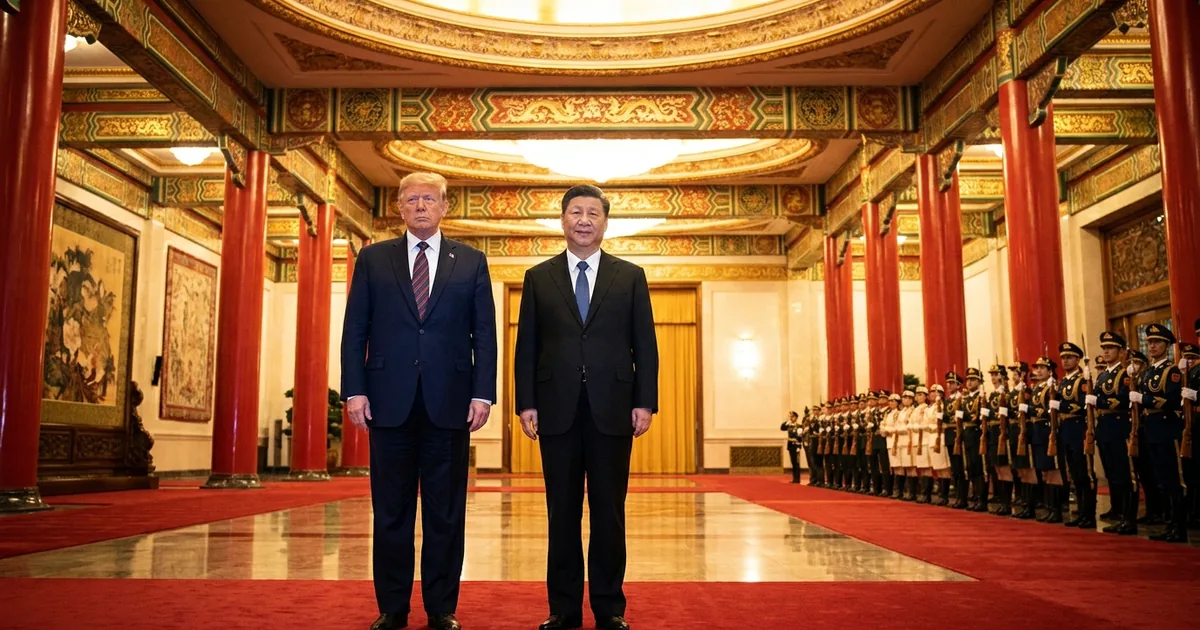
President Donald Trump landed in Beijing on Thursday convinced he was winning, the first sitting U.S. president to make a state visit to China since 2017.
By the time the cameras pulled back from the Great Hall of the People, Xi Jinping had quietly reframed the entire summit around Taiwan, rare earths, and a pointed question about whether the world’s two largest economies can avoid war.
A Smaller Welcome Than 2017
Start with the staging, because the staging carries the message. When Trump visited China in 2017, Xi staged what analysts called a “state visit-plus”: a private dinner inside the Forbidden City, a procession through Tiananmen Square, and a Great Hall ceremony built around $250 billion in announced business deals. This week the welcome was an honor guard and schoolchildren waving paper flags. Writing before the summit, the Council on Foreign Relations’ Rush Doshi, who directs the think tank’s China Strategy Initiative, predicted the meeting would fall well short of that earlier trip, and the opening ceremony bore him out.
The downgrade is not sentiment. It is arithmetic. Xi has spent years telling Communist Party cadres that “the East is rising and the West is declining,” and he walked into this summit holding the receipts. Twice in 2025, when Xi threatened to choke off exports of rare earth minerals and magnets, Trump backed down rather than escalate. Those materials sit inside almost every smartphone, fighter jet, and precision missile the United States builds, and China processes the overwhelming majority of the world’s supply. Tariffs were supposed to be Trump’s decisive instrument. The summit turned on China’s instead.
The Thucydides Trap, Said Out Loud
In opening remarks carried on Chinese state television, Xi posed a question that would have been unimaginable as summit choreography a decade ago. Could the United States and China avoid the “Thucydides Trap,” the historical pattern in which a rising power and an established one slide into war? Trump, for his part, offered that the relationship “is going to be better than ever before.”
The gap between those two statements is the whole story. One leader is describing the structural risk of great-power conflict. The other is describing a mood. As CNBC reported from Beijing, Xi paired the question with a call for “strategic stability,” language that sounds reassuring until you notice it commits Beijing to nothing it was not already doing.
Taiwan Was Xi’s Agenda, Not Trump’s
Here is the tell. Across the half-dozen Trump-Xi exchanges since January 2025, the American readouts have centered on trade while the Chinese readouts have increasingly centered on Taiwan. Thursday followed the pattern. Xi called Taiwan “the most important issue” between the two countries and warned, in remarks NPR reported from the summit, that mishandling it would push the relationship toward “clashes and even conflicts.” He told Trump the island’s independence and cross-Strait peace were “as irreconcilable as fire and water.”
That warning landed on receptive ground, and that is the worrying part. Trump has publicly questioned whether the United States should defend Taiwan, has accused the island of taking the American semiconductor industry, and has reportedly delayed an $11 billion arms package the State Department approved in December. A democratically governed island of 23 million people is being treated, in summit terms, as a concession to be priced. A senior Taiwanese official told Bloomberg last month that what Taipei feared most was ending up “on the menu” of a Trump-Xi meeting. On Thursday, Taiwan was the main course.
What Trump Actually Brought Home
Set against that, look at what the American side can show for the trip. The likely deliverables, sketched in working-level talks, are Chinese purchases of Boeing aircraft and American soybeans, an extension of the existing tariff truce, and the launch of a “Board of Trade” and a parallel “Board of Investment.” Analysts describe the farm and aircraft orders as a price Beijing can comfortably absorb to keep Trump satisfied. None of it touches the structural complaints, the subsidies, the state-directed industrial policy, the technology-transfer demands, that successive U.S. administrations have raised for two decades.
Artificial intelligence was on the agenda too, with both governments reportedly weighing an AI safety dialogue. Beijing has wanted that channel for years, and the reason is not safety. China treats these talks mainly as a route to U.S. technology and a way to close the roughly eight-month lead American labs still hold. A dialogue that Washington enters without first widening that gap is a concession dressed as cooperation.
History suggests even the headline numbers deserve skepticism. The $83.7 billion West Virginia investment memorandum announced during Trump’s 2017 visit was larger than the entire state’s economy. It never materialized. The Iran war has also quietly knocked the energy card out of Trump’s hand. With the U.S. Navy blockading the Strait of Hormuz, Washington needs Beijing’s help reopening the waterway more than Beijing needs what Washington is selling. Even the dozen executives Trump brought with him, Elon Musk, Tim Cook, and Jensen Huang among them, read less as a show of force than as a delegation assembled to give the host something to point at.
The Real Outcome
No one expected a grand bargain in Beijing, and no one got one. What the summit produced instead was a clean snapshot of where the power now sits. Xi set the agenda, delivered the warning, controlled the staging, and gave up soybeans. Trump got the photographs and the language of friendship. The pattern was visible well before Air Force One landed, running straight through the days when Trump was still calling Iran’s ceasefire proposal “garbage” on his way to the meeting. Doshi’s pre-summit read was that Beijing would use this summit, and the string of meetings to come, to “manage” Washington: to coax the United States into deferring hard competitive choices for the sake of a stability that mostly serves China.
The question worth watching is not what gets signed in Beijing. It is whether the Taiwan arms package stays frozen once Trump is home, and whether anyone in the administration is willing to say out loud that a trade truce built on a democratic ally’s security is not a win.