
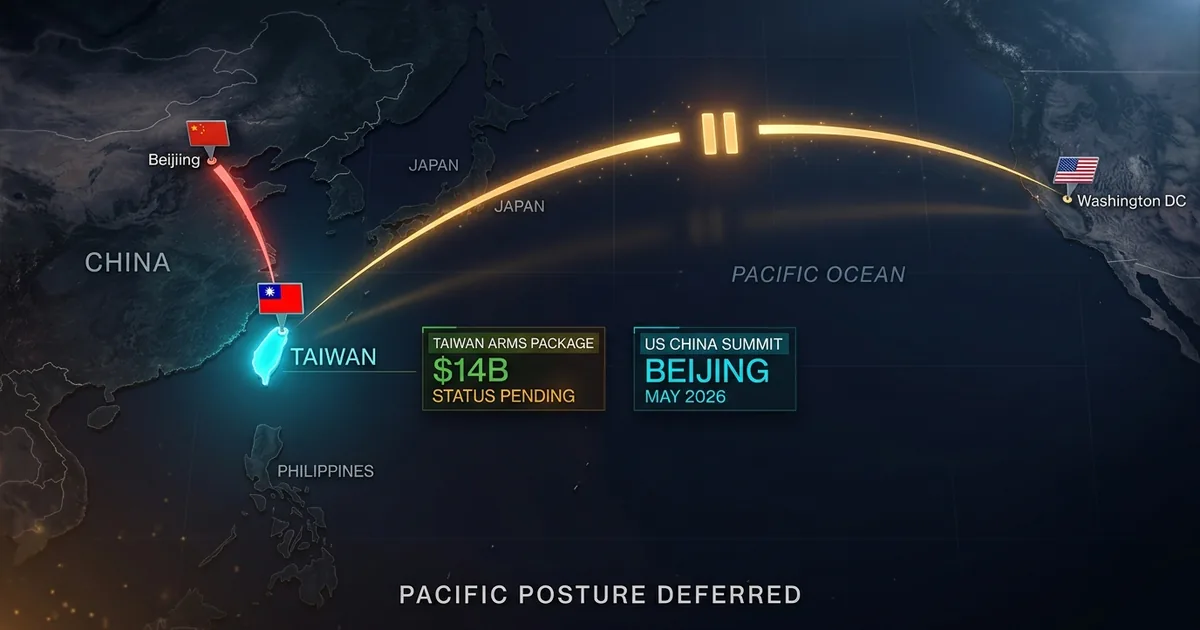
Trump returned from his Beijing summit with Xi Jinping refusing to commit to a $14 billion arms package for Taiwan, telling reporters in a Fox News interview that he “has not approved it yet” and openly questioning the value of “a war that’s 9,500 miles away.”
That is not strategic ambiguity. That is a US president treating an ally’s defense like a chip he can fold or play depending on how trade talks land.
The Package Beijing Wants Killed
The pending arrangement is not abstract. It covers missiles and air defense interceptors that have sat in administration limbo for months, and as Axios reported on May 15, the Taiwanese parliament cleared the funding earlier this month to pull down both this tranche and a separate $11 billion package already in the pipeline. From Taipei’s vantage point, the political risk has already been absorbed at home. The only signature left to collect is the one in Washington.
That is the signature Xi spent two days pushing Trump not to provide. Foreign Policy noted that Xi raised potential conflicts over Taiwan as the central irritant in the relationship, and according to the Axios account, Xi had already used a February phone call with Trump to warn against further deliveries after an earlier weapons clearance. Beijing’s read is correct on the politics: every package the United States approves moves Taiwan a little further out of the gravitational well China spent the last decade building, and a Trump who is openly indifferent to that is a Trump worth lobbying.
Trump’s Words, and What Taipei Heard
The president’s actual answers, lifted directly from his post-summit Fox appearance, are the story. “I’ll be making decisions,” he said, framing the issue around personal latitude rather than US treaty obligation. Asked about the 1982 Six Assurances, he was looser still: “What am I going to do, say I don’t want to talk to you about it because I have an agreement wrote in 1982? No, we discussed arms sales.” Then the line that put Taipei into a small panic: “The last thing we need right now is a war that’s 9,500 miles away.”
This is the rhetorical move worth pausing on. “We discussed arms sales” reduces a formal alliance commitment to a bargaining item on a list. “Wrote in 1982” implies the document has expired with the people who signed it. And the 9,500-mile framing imports the same isolationist logic Trump used on Ukraine into a region where the credibility of US security guarantees is the entire deterrent. A senior Taiwanese defense official quoted by Bloomberg ahead of the summit called the package the test the world is watching. It is, and the world is watching Trump fail to take the test.
A Bargaining Chip Strategy With a Deterrence Cost
The administration’s defenders will call this a bargaining strategy: hold the arms sale to extract concessions on rare earths, on TikTok, on the tariff posture China kept dialed up through 2025. That is consistent with the Trump operating system. It is also a category error.
A signed arms package is a deterrence asset. It tells Beijing that an invasion timeline runs into hardware Taiwan does not yet have but will. The moment Washington starts trading that asset, two things happen at once. First, the deterrence value collapses, because Xi now knows the package is negotiable. Second, the precedent travels: Japan, the Philippines, South Korea, and Australia all start running the same math on whatever the United States has promised them. That is the dynamic this site flagged when Trump warned Taipei from Beijing earlier this week. You cannot use an ally’s survival as a chip without paying for it in the credibility of every other commitment you have made.
What Happens If the Deal Slips Further
Three concrete things follow if Trump lets the package keep slipping past summer.
One, Taipei’s defense planning has to budget for a US that may not deliver. That is not theoretical; it pushes the cabinet toward domestic procurement and toward closer hardware ties with Japan and the EU, both of which have been quietly building the option. Two, the deterrence calendar tightens. The Pentagon’s working assumption is a 2027 window for Beijing to attempt something kinetic, and every month the interceptors are not on Taiwanese soil is a month inside that window. Three, the political fallout in Washington stops being containable. Senate Republicans publicly pushed Trump on this exact package before the summit, per Bloomberg, and a slow walk now will hand China hawks in his own party a clean line of attack.
The 2027 Window
The trap in covering this story is to treat each Trump comment as a one-off impulse. The Taiwan file is not impulse. It is the place where his trade instincts, his isolationist reflex, and his transactional relationship with Xi all collide. He keeps saying he has not decided. The pattern around Ukraine suggests “not decided” is the decision: delay until the political cost of moving forward outweighs the political cost of letting the file rot.
What would push him off that path is exactly what Beijing is trying to prevent. Public commitments from Senate Republicans. A unified statement from the Quad. A clear public ask from Taipei that forces the administration to either approve or visibly walk away. Trump responds to the optics of strength and the optics of being played. Right now the world is watching him be played, on camera, by Xi. That is the part Taipei cannot say out loud, but everyone in the room understood it.
The decision will come. The question is whether it arrives in time to matter.