
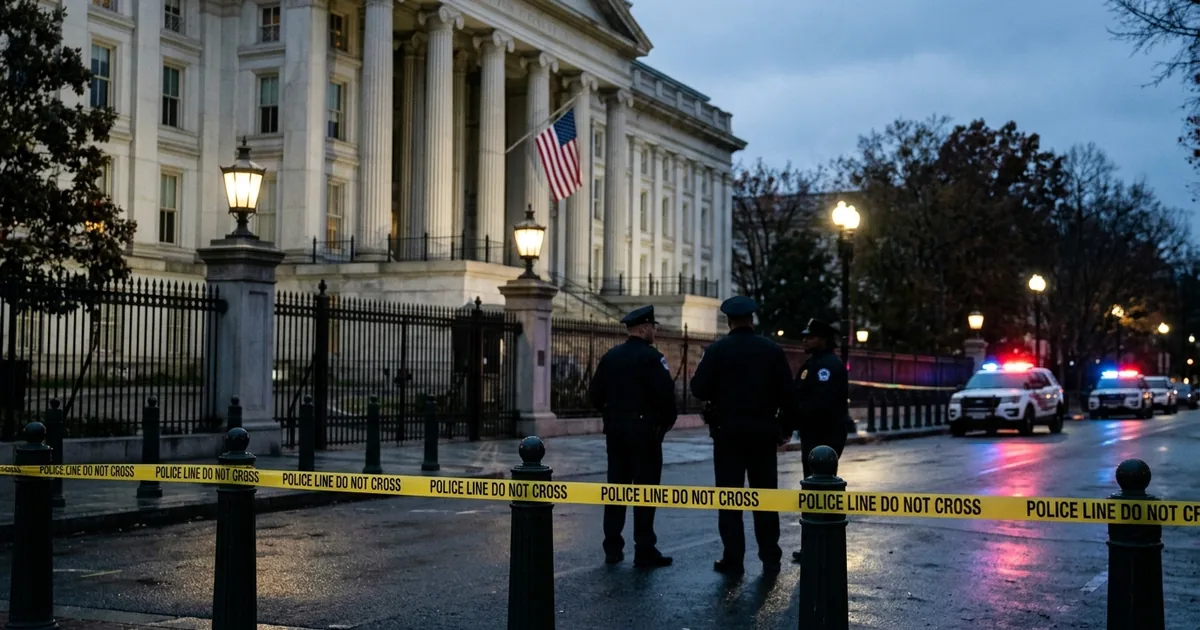
A 21-year-old man pulled a weapon from his bag at a White House security checkpoint on Saturday evening, opened fire on Secret Service officers, and was killed when they shot back, leaving a bystander in critical condition.
It was the third time in a month that gunfire has erupted near President Donald Trump, and the pattern is starting to look less like a run of bad luck than a standing question about how the country protects a president, and everyone who happens to be standing near him.
What Happened at 17th and Pennsylvania
Shortly after 6 p.m., the man approached a checkpoint at the intersection of 17th Street and Pennsylvania Avenue, drew a firearm, and began shooting at officers, according to CNN’s account of the Secret Service response. Officers returned fire and struck him. He later died at a hospital. The Secret Service said none of its officers were hurt, and that Trump, who was at the White House at the time, was not affected.
Authorities identified the man as Nasire Best, 21, who NPR reported was known to the Secret Service and had a documented history of mental-health conditions. That detail matters, and not as an excuse. It points at a system that knew this person existed and still ended up in an exchange of gunfire with him at one of the most heavily secured intersections in the country.
A Bystander in Critical Condition
The most important person in this story is not the shooter or the president. It is the bystander who was struck and remains in critical condition, and whom officials could not immediately say was hit by the gunman’s fire or by the rounds officers fired back. That ambiguity is the whole problem with a shootout at a crowded urban checkpoint. There is no clean version of bullets flying near a sidewalk full of tourists, and the people most exposed are the ones who simply chose the wrong block to walk down on a Saturday night.
The Third Time in a Month
This did not happen in a vacuum. It is the third gunfire incident in the president’s vicinity in roughly a month, coming after prosecutors brought an assassination charge in a separate case earlier this spring. Three incidents in four weeks is no longer a coincidence to be managed one press conference at a time. It is a trend line, and trend lines around political violence have a way of becoming the new normal if nobody names them as a crisis.
The uncomfortable truth is that a country awash in firearms, running hot with political rhetoric, and short on mental-health infrastructure produces exactly this kind of recurring danger. None of those conditions were created on Saturday, and none of them get solved by tightening a single checkpoint.
What This Says About Access and Care
Best’s documented mental-health history sitting alongside his apparent access to a firearm is its own indictment. We have built a system that is efficient at flagging people as risks and almost useless at intervening before the risk becomes a body on a sidewalk. The Secret Service will review its posture, as it should. But the agency cannot legislate who gets a gun, fund a mental-health system, or lower the political temperature, and those are the levers that actually move the number of these incidents.
What Comes Next
The investigation will fill in the timeline, the motive, and the question of whose round hit the bystander. The harder accounting is the one the country keeps deferring. When gunfire near the president stops being a shock and starts being a monthly occurrence, the story is no longer about a single gunman. It is about whether we are willing to treat the pattern as the emergency it has become.