
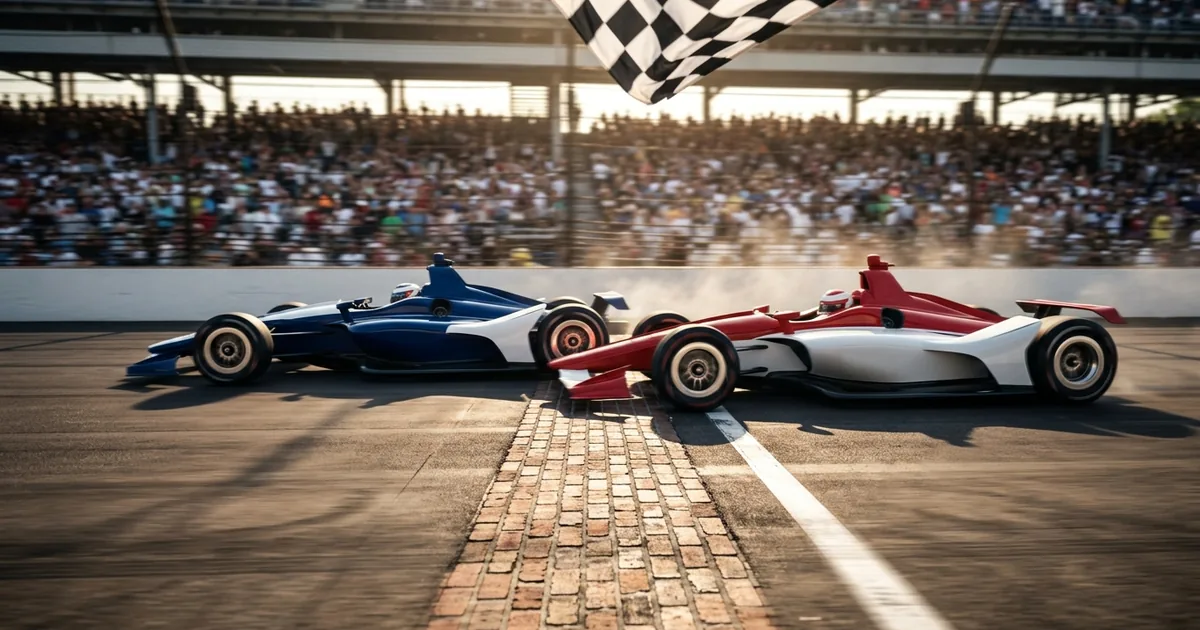
Felix Rosenqvist slingshotted around David Malukas in the final yards of the 110th Indianapolis 500 on Sunday and beat him to the Yard of Bricks by 0.0233 seconds, the closest finish in the race’s history. On a Memorial Day weekend that produced a record 70 lead changes and a rain-shadowed final sprint, the 500 reminded a fragmenting sports audience exactly why this spectacle still commands a holiday afternoon.
The Pass That Decided It
The finish came together in the span of a single lap. As Lap 200 began with rain closing in, Marcus Armstrong led with Malukas and Rosenqvist stacked behind him coming to the white flag. Malukas pulled out of line to make his move, and Rosenqvist went with him, then carried the run all the way around the outside in the closing yards. Rosenqvist edged Malukas by 0.0233 seconds, the closest margin Indy has ever recorded, crossing the line by roughly half a car length.
An outside pass at over 220 miles per hour, on the final lap, for the Indianapolis 500, with rain about to freeze the running order, is the kind of sequence drivers spend entire careers never getting a chance to attempt. Rosenqvist attempted it and made it stick.
A Record-Setting Day
The margin was historic, and so was the chaos that produced it. IndyCar’s own account called it a final lap for the ages, capping a race that saw 70 lead changes, an all-time Indianapolis 500 record. That number is the real headline behind the headline. Seventy lead changes means the race was never settled, never a parade, never the processional that critics like to say open-wheel racing has become.
Spare a thought for David Malukas, who led the field to the white flag and did everything right except hold off a driver with nothing to lose. The runner-up margin, less than a quarter of a tenth of a second, eclipses the 0.043-second gap Al Unser Jr. held over Scott Goodyear in 1992, long the gold standard for an Indianapolis photo finish. Malukas now owns the other half of the closest finish the race has ever produced, which is its own cruel kind of history.
Rosenqvist and the Swedish Line
Rosenqvist, 34, won for Meyer Shank Racing and became the third Swede to take the 500, joining Kenny Brack in 1999 and Marcus Ericsson in 2022. For a midfield-budget operation to win the biggest race in American open-wheel racing is its own story, the rare outcome in modern motorsport where money does not simply buy the trophy. It is the kind of result that sends a sport’s casual fans looking up a name they did not know that morning.
Why a 0.02-Second Finish Matters Beyond Racing
Here is the part that travels past the grandstand. Live sport is the last reliable appointment viewing left, the one thing a splintered audience still watches together, in real time, unwilling to risk the spoiler. A photo finish at the Indy 500 on Memorial Day weekend is precisely the product the entire attention economy is now built to chase, and almost nothing else delivers it on demand.
The 500 has always been a traffic magnet on a holiday weekend that opens the same spring sports calendar that began with the Kentucky Derby. A finish this close does the one thing no marketing budget can manufacture. It gives people who were not watching a reason to wish they had been, and a clip they will pass to everyone they know.
What Comes Next
Rosenqvist kissed the bricks as the closest Indy 500 winner ever, and IndyCar got the thing it needs most, a moment that escapes the motorsport bubble and lands in the general conversation. The challenge now is the one every sport faces after a perfect day. A 0.0233-second finish is a gift. Turning a once-a-century finish into durable attention is the harder race, and it starts the morning after.