
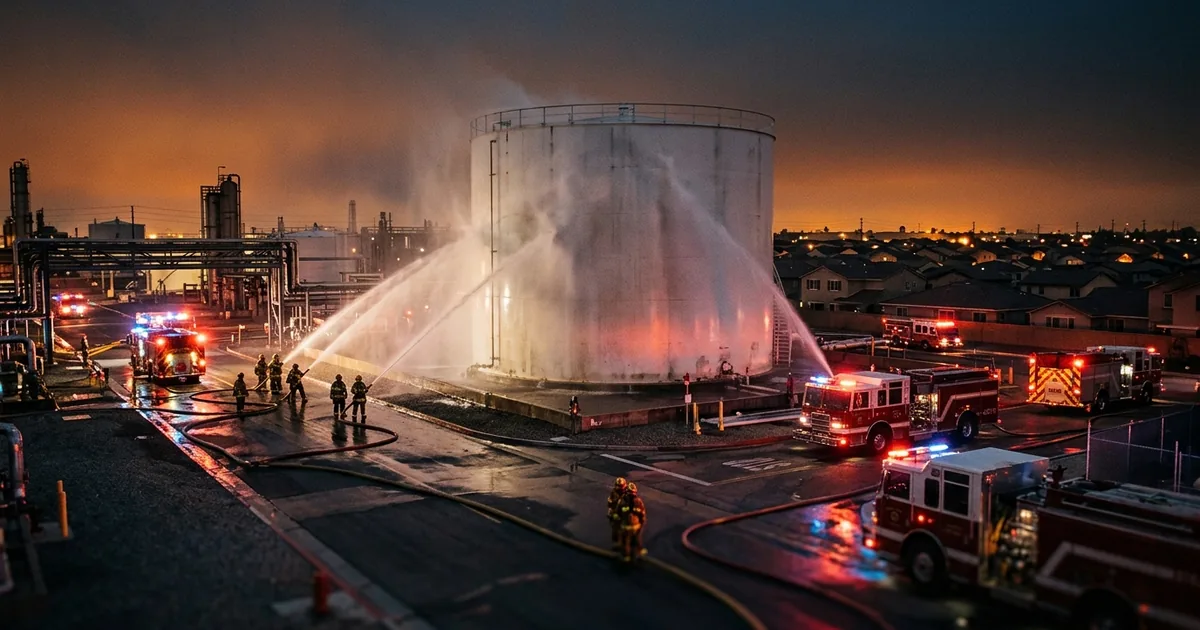
A 34,000-gallon tank of volatile plastics chemical began overheating at a Garden Grove aerospace plant on May 21, and three days later roughly 50,000 Orange County residents remain locked out of their homes while crews fight to keep it from exploding.
The slow-motion emergency is a reminder that the gravest threat to a dense Southern California suburb is not always the wildfire or the earthquake we plan for, but the industrial tank no one outside the plant had been watching.
What Is Actually Happening Inside the Tank
The chemical is methyl methacrylate, a clear liquid used to make plastic, and roughly 7,000 gallons of it sat inside a tank at the GKN Aerospace facility when it started to overheat and off-gas vapor. Methyl methacrylate is highly volatile, and when it reacts it releases energy. Trap that reaction inside a sealed container and the pressure climbs until the container itself becomes the bomb. That is the scenario the Orange County Fire Authority has spent days trying to prevent, hosing the tank with water to pull its temperature down, in a response NPR detailed as the tank began to fail.
There was a break in the standoff over the weekend. Crews late Saturday found a pressure-relieving crack in the tank, and OCFA Interim Chief TJ McGovern said the discovery had put the response on a “new trajectory.” A crack that vents pressure is better than a tank that holds it until it ruptures. It is not the same as safe, and officials have pointedly declined to say when anyone gets to go home.
A State of Emergency and a Map of the Blast Zone
Governor Gavin Newsom declared a state of emergency in Orange County, freeing state resources for an evacuation whose footprint keeps testing the limits of a suburban grid never designed to empty out on short notice. The hazard got concrete fast: local station KTLA published a map of the potential blast zones should the tank let go, the kind of graphic that turns an abstract risk into a property-by-property reckoning for the people who live there.
Fifty thousand people is not a number you move quietly. It means shelters, traffic control, medical logistics, and days of limbo for families who packed a bag expecting to be gone for an afternoon. Every hour the tank holds is an hour those residents spend somewhere that is not their home, on a holiday weekend, waiting on temperature readings they cannot see.
The Question Nobody at the Plant Wants to Answer
Here is the part that should outlast the immediate scare. A tank capable of leveling a residential-adjacent neighborhood was sitting in one, and the public learned of its existence only when it started to fail. California’s emergency-management system, already stretched by fire seasons and even an FBI warning this spring about a possible offshore drone threat, is now running a multi-day evacuation over a single piece of industrial equipment.
Industrial chemical storage is governed by a patchwork. The EPA’s Risk Management Program, Cal/OSHA process-safety rules, and local fire-code inspections each assume the others are catching what they miss. When a tank ends up off-gassing in the middle of a populated county, the honest question is not only what failed mechanically, but how many similar tanks sit near homes, schools, and freeways without anyone outside the facility able to name them. The workers inside these plants live closest to the risk and hold the least power to force a shutdown.
What Comes Next
The crack buys time. It does not hand anyone the all-clear, and the reentry decision will hinge on temperature readings, vapor levels, and whether the relief holds. The larger reckoning will outlast the evacuation order.
Garden Grove is now a test of whether a near-miss produces real change in how California inventories and inspects the chemicals it allows to be stored where people sleep, or whether the tank gets patched, the residents come home, and the next community learns the name of its most dangerous neighbor the same way this one just did.