
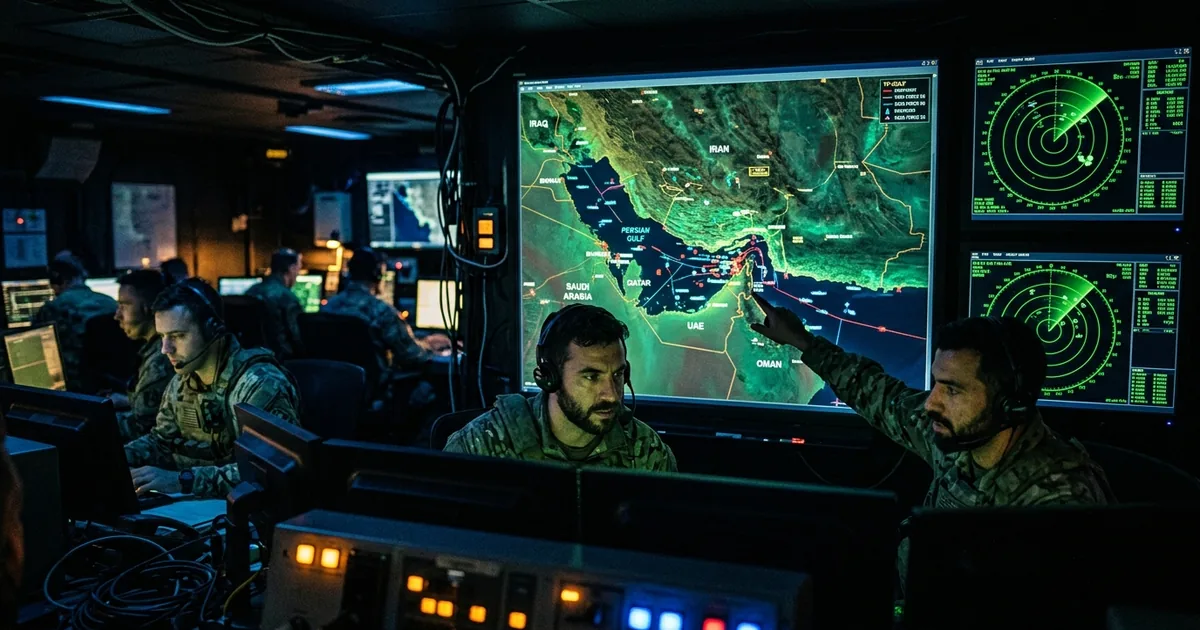
The United States military destroyed Iranian radar stations and drone command sites on Goruk and Qeshm Islands over the weekend, marking the latest escalation in an already volatile corridor where American and Iranian forces have been trading fire for weeks.
What CENTCOM Hit and Why It Matters
U.S. Central Command confirmed on Sunday that fighter aircraft targeted air defense systems, a ground control station, and two one-way attack drones that the Pentagon said posed “clear threats to ships transiting regional waters.” The strikes came in direct response to Iran’s shootdown of an American MQ-1 surveillance drone that was operating over international waters, a provocation the U.S. framed as an unacceptable escalation against routine maritime monitoring.
What makes this round different is the hardware that was sitting on those islands. Among the primary targets on Goruk were Chinese-supplied military systems, including the JY-27A long-range surveillance radar and the HQ-9 surface-to-air missile battery, according to NPR’s national security reporting. Destroying Chinese-made air defense equipment on Iranian soil sends a message that extends well beyond Tehran. It tells Beijing that its defense exports are not shielded from American targeting when they are used against U.S. assets.
Iran Fires Back, Kuwait Scrambles
The Islamic Revolutionary Guard Corps responded with what it called a retaliatory strike on an undisclosed air base that it claimed had supported the American mission, as NBC News reported. The details remain murky, and the Pentagon has not confirmed any damage from the Iranian counterstrike.
The regional ripple effects were immediate. Kuwait activated air-defense systems after detecting incoming drones and projectiles in its airspace, and Kuwaiti authorities implemented precautionary flight diversions as a security measure. For Gulf states that have spent years trying to thread the needle between Washington and Tehran, the weekend was a stark reminder that geography does not grant neutrality when the shooting starts.
The Diplomatic Track Is Not Dead, but It Is on Life Support
The strikes landed against a backdrop of stalled nuclear negotiations. The Trump administration insists that diplomatic channels remain open, with CBS News reporting that the president told reporters talks are “continuing” even as the military escalation deepens. That framing tracks with the administration’s established pattern of coupling maximum pressure with intermittent outreach, a strategy that critics argue sends contradictory signals to Tehran’s hardliners.
Meanwhile, Israel’s seizure of the medieval Beaufort Castle in southern Lebanon, its deepest incursion in 26 years, is adding another pressure point to an already overloaded regional chessboard. The convergence of U.S. strikes on Iranian soil, IRGC counter-fire, Israeli advances in Lebanon, and Gulf state scrambles paints a picture of a Middle East corridor that is one miscalculation away from a much wider conflagration.
What Comes Next
The destruction of Chinese-supplied air defenses inside Iran introduces a new variable into an already complex equation. Beijing has been conspicuously quiet about its military hardware being turned into scrap metal on Iranian islands, but the diplomatic silence will not last forever. For the Pentagon, the operational message is straightforward: if it tracks American aircraft, it gets hit. For the rest of the region, the message is grimmer. The 72-hour cycle of strikes, counterstrikes, and nervous scrambles by neighboring states is starting to look less like crisis management and more like a new normal.