
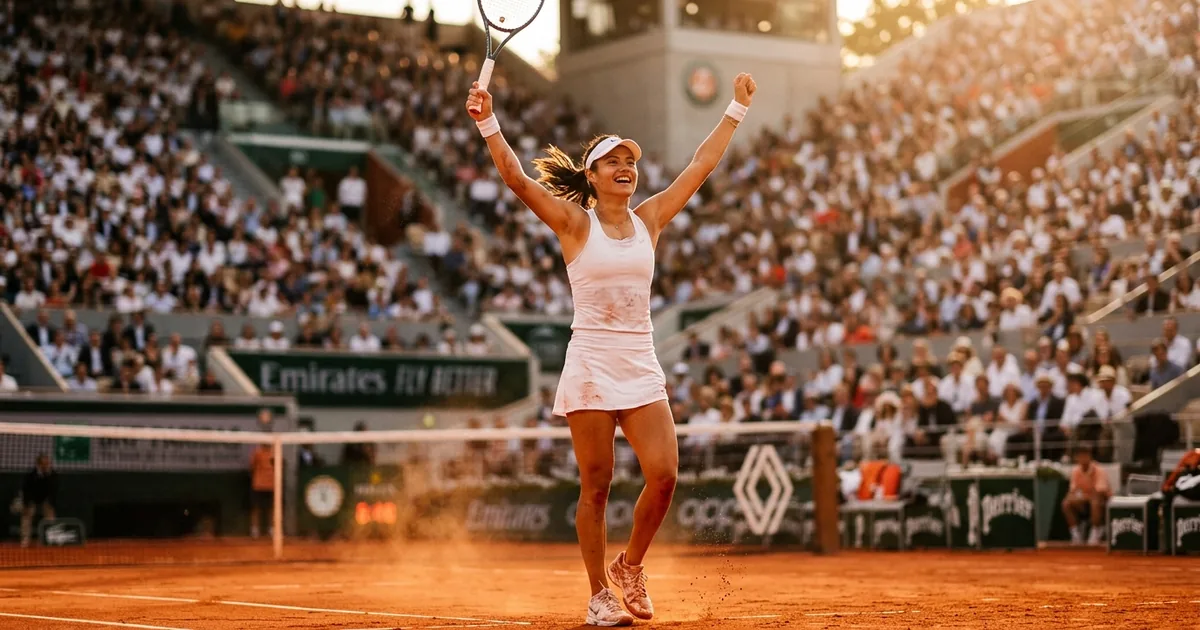
A 22-year-old Polish qualifier ranked 114th in the world has become the most compelling story at the 2026 French Open, and she is doing it with the kind of fearless, full-throttle tennis that makes you wonder why anyone bothers seeding a draw at all.
Maja Chwalinska stepped onto the Paris clay as a qualifier and has refused to leave, stringing together seven consecutive wins to reach the quarterfinals and earning comparisons to Emma Raducanu’s legendary 2021 U.S. Open run.
Seven Wins and Counting
The numbers barely do justice to what Chwalinska has accomplished over the past two weeks. She fought through three rounds of qualifying just to earn a spot in the main draw, then proceeded to beat 23rd seed Elise Mertens, former top-10 player Maria Sakkari, home crowd favorite Diane Parry, and, most remarkably, Olympic gold medalist Zheng Qinwen in a lopsided 6-4, 6-0 demolition that represented Zheng’s earliest Roland Garros exit.
Chwalinska became the first qualifier to reach the French Open quarterfinals since 2020, a stat that only scratches the surface of how improbable this run has been. Coming into the tournament, she had won just two Tour-level matches on clay in her entire career. Her only other main Tour event in 2026 was in Cluj-Napoca, where she also came through qualifying to reach the quarters. The pattern is striking: give Chwalinska a qualifying gauntlet and she will run through it.
Her quarterfinal opponent on Wednesday is Anna Kalinskaya, who booked her spot with a grueling three-set win over Anastasia Potapova. On the other side of the draw, top seed Aryna Sabalenka, who dismantled Naomi Osaka in straight sets, faces Diana Shnaider. If Chwalinska can get past Kalinskaya, a semifinal against one of those two heavyweights would be the kind of matchup that stops a sporting world in its tracks.
The Raducanu Comparisons Are Not Lazy
When Yahoo Sports drew the parallel to Raducanu’s 2021 U.S. Open, it was not just headline bait. The structural similarities are real. Raducanu was a qualifier ranked 150th who won 10 consecutive matches without dropping a set to win the title. Chwalinska is a qualifier ranked 114th who has now won seven straight, and her straight-sets destruction of Zheng Qinwen echoes Raducanu’s habit of making top-ranked opponents look ordinary.
The difference is surface. Raducanu’s run happened on hard courts at Flushing Meadows. Chwalinska is doing this on the clay of Roland Garros, historically the Grand Slam surface most resistant to underdog runs because of how physically demanding best-of-three sets on slow clay can be over a two-week tournament. Qualifiers burn through their reserves early, and the deep runs in Grand Slam history typically belong to players who conserve energy with first-round byes and favorable early draws.
Chwalinska has had none of those advantages and it has not mattered.
What Makes Her Game So Effective on Clay
Watch Chwalinska play and you immediately understand why clay suits her better than her ranking suggests. She has a heavy topspin forehand that kicks high off the slow surface, forcing opponents into uncomfortable contact points above their shoulders. Her movement is exceptional, covering the court laterally with the kind of sliding footwork that takes years to develop on clay.
But the real weapon is her mentality. In every match of this run, including the qualifying rounds, Chwalinska has played with a freedom that comes from having nothing to lose and everything to prove. When Zheng Qinwen jumped out to an early lead in their fourth-round match, Chwalinska did not tighten up or play conservatively. She accelerated, swinging bigger and moving forward more aggressively, and the Olympic champion had no answer.
That mental approach is what separates fairytale runs from first-round upsets. Any player on Tour can produce one great match. Producing seven in a row against progressively tougher opponents requires a psychological gear that rankings cannot measure.
Paris Has a New Favorite
The Roland Garros crowd, which famously adopted local hero Parry earlier in the tournament, has pivoted hard to Chwalinska. The Polish qualifier has earned the kind of organic crowd support that tournament organizers cannot manufacture, the underdog energy that turns a tennis match into a communal experience.
If she beats Kalinskaya on Wednesday, the semifinal will draw an audience well beyond the usual tennis viewership. And if she somehow runs the table? The story of a world No. 114 who came through qualifying to win the French Open would be one of the greatest achievements in the history of professional sports, full stop.
We are not there yet. But the fact that the sentence does not sound absurd anymore tells you everything about what Chwalinska has already accomplished.