
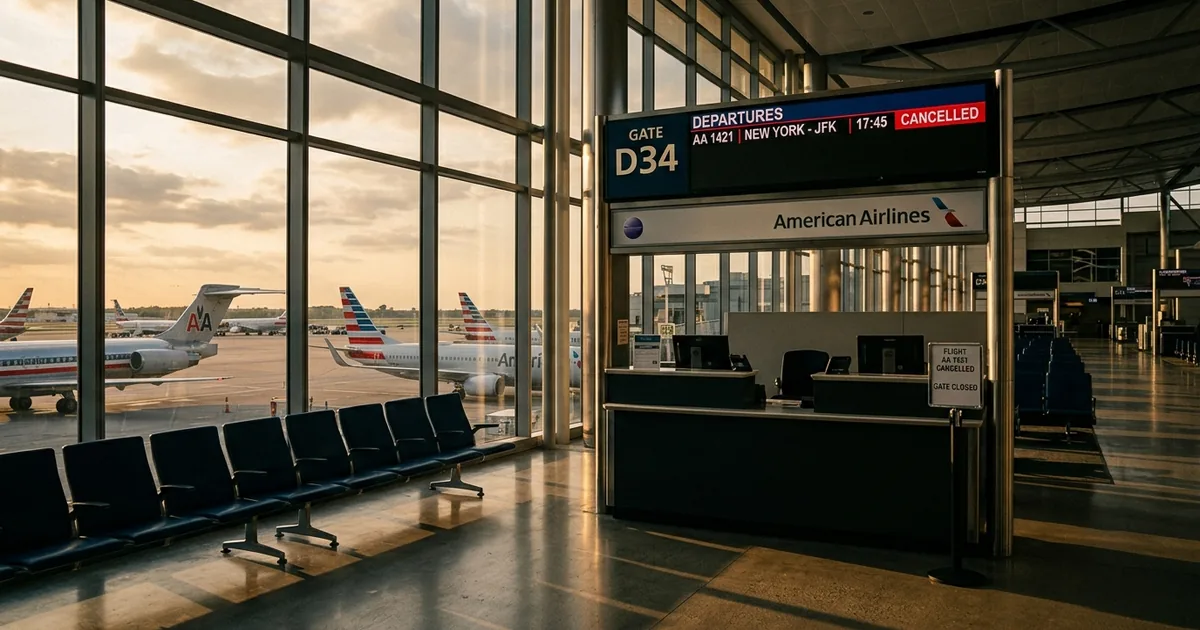
American Airlines just became the first major U.S. carrier to publicly flinch at the fuel-price shock that has been grinding the airline industry since the Strait of Hormuz effectively closed in late February.
The airline confirmed on Tuesday that it will temporarily suspend six domestic routes between August 5 and October 5, blaming jet fuel costs at Los Angeles International Airport that have surged roughly 50 percent to around $15 per gallon.
The Routes That Disappeared
Four of the six suspended flights originate from LAX, the airline’s busiest West Coast hub: nonstop service to Cleveland, Columbus, Pittsburgh, and Washington Dulles. Two Charlotte routes, to Ontario, California, and Sacramento, round out the cuts. Collectively, as CBS News first reported, the suspensions affect an estimated 1.4 million passengers who use those connections annually, a real blow to business travelers and families who depend on affordable cross-country nonstops.
An American Airlines spokesperson stressed that none of the routes are being permanently retired. “American is not suspending any routes indefinitely as part of this adjustment,” the airline said. Translation: they will come back when the economics work again, which is a diplomatic way of saying when fuel stops costing more than a decent bottle of wine per gallon.
Why This Is Happening Now
The math is brutal. Since the Iran crisis escalated and the Strait of Hormuz choked, global crude benchmarks have climbed steadily, and refined jet fuel has outpaced even those gains. American’s own projections, according to FTN News, peg the quarterly fuel-cost increase at more than $4 billion. That is not a rounding error. That is an existential line item that forces operational triage.
LAX is feeling the worst of it because West Coast refineries are already capacity-constrained. When you layer a geopolitical supply shock on top of structural refining bottlenecks, you get $15-a-gallon jet fuel, and airlines start asking hard questions about which routes still make money.
What Travelers Should Know
If you hold a ticket on one of the six affected routes during the suspension window, American says it will rebook passengers on alternative itineraries, likely with connections. That is cold comfort for anyone who booked a nonstop precisely to avoid the layover grind.
The bigger question is whether American is the first domino. United and Delta have not announced similar cuts, but they are exposed to the same fuel economics. Southwest, which hedges fuel more aggressively than its legacy rivals, may have a temporary buffer, but hedges expire. Industry analysts widely expect at least one more major carrier to trim marginal routes before the end of summer if crude stays above $100 per barrel.
The Consumer Squeeze Keeps Tightening
This is not just an airline story. It is a leading indicator of how geopolitical instability transmits through supply chains to hit everyday Americans in the wallet. The same fuel-cost dynamics pushing American to shelve routes are also driving up shipping costs, pushing diesel prices past $6 in some states, and quietly raising the price of everything that moves by truck.
For travelers, the practical advice is straightforward: book early, build in flexibility, and do not assume that a route available today will still be on the schedule in August. American’s “temporary” framing is optimistic by design. The Iran situation shows no signs of resolving quickly, and the market knows it.