
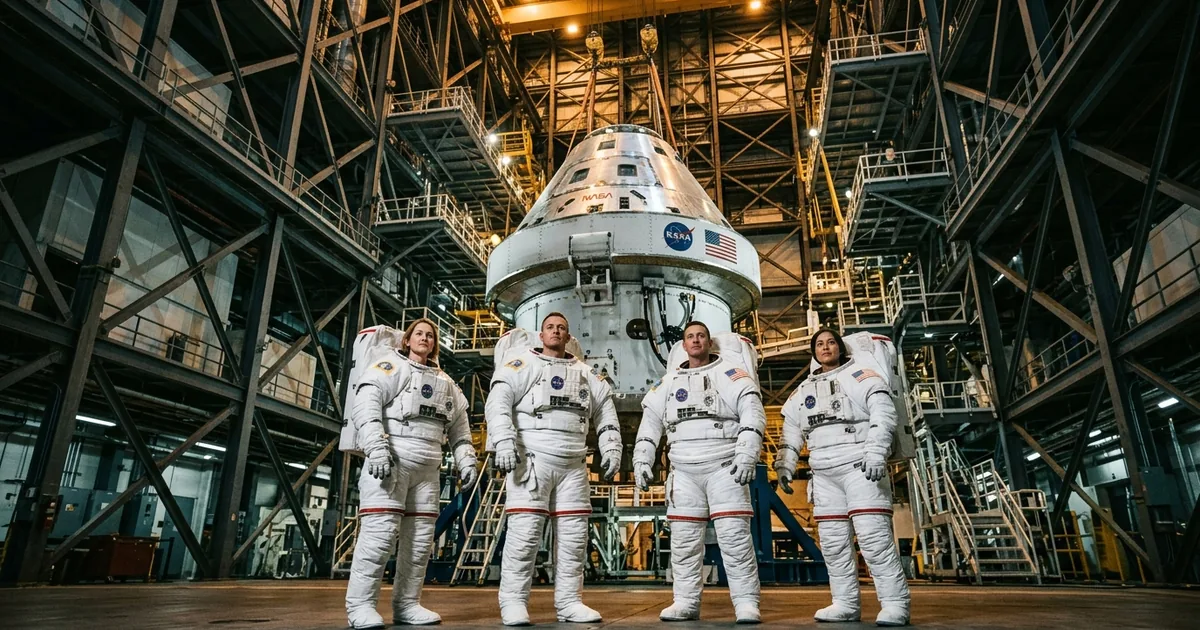
NASA announced the crew for Artemis III on Monday, putting names and faces on a mission that will serve as the critical dress rehearsal before humans return to the lunar surface.
Commander Randy Bresnik, pilot Luca Parmitano, and mission specialists Andre Douglas and Frank Rubio will fly the mission in late 2027, with NASA confirming the crew at a Kennedy Space Center event attended by all four astronauts and NASA Administrator Bill Nelson.
Who They Are and What They Bring
The crew is a mix of deep spaceflight experience and historic firsts that reflects both the mission’s complexity and NASA’s international ambitions. Bresnik, a Marine Corps test pilot, commanded the International Space Station during Expedition 53 and has logged over 150 days in space across two missions. He will lead Artemis III from the Orion spacecraft and be responsible for the most technically demanding phase: docking with a commercial lander in low Earth orbit.
Parmitano, an Italian Air Force pilot and European Space Agency astronaut, becomes the first ESA astronaut assigned to an Artemis mission, a milestone that underscores the program’s coalition structure. He has two ISS stints under his belt, including a memorable 2013 spacewalk that was cut short when water leaked into his helmet, an incident that became a case study in astronaut composure under life-threatening conditions.
Douglas, a Coast Guard officer turned NASA astronaut selected in the 2021 class, represents the program’s newer generation. Rubio brings the crew’s most extreme endurance credential: he spent 371 consecutive days aboard the ISS in 2023, setting the record for the longest single spaceflight by an American. That endurance background matters for a mission that will test crew performance during extended orbital operations.
Bob Hines, who flew to the ISS in 2022, was named the backup crew member.
What Artemis III Actually Does
Despite the Artemis name’s association with the Moon, Artemis III will not land on the lunar surface. The mission tests the architecture that makes a landing possible, and every piece of that architecture needs to work before NASA commits astronauts to a descent.
After launching aboard NASA’s Space Launch System rocket, Orion will enter low Earth orbit and attempt something the spacecraft has never done: rendezvous and dock with the commercial human landing systems being developed by SpaceX and Blue Origin. SpaceX’s Starship HLS variant and Blue Origin’s Blue Moon lander are both still in active testing, and Artemis III will evaluate one or both of them in orbit.
CNN reported that NASA framed the mission as “complex” during the announcement event, a word choice that acknowledges the real engineering risk involved. The docking test is the entire point. Artemis IV, currently planned for 2028, is the mission designed to put astronauts on the lunar South Pole for the first time. But NASA cannot green-light that landing until it proves the Orion-to-lander handoff works under real orbital conditions. Artemis III is the proof-of-concept, and the agency is treating it with the corresponding level of caution.
The Bigger Picture for the Artemis Program
The Artemis program has weathered repeated delays since its inception. The uncrewed Artemis I mission flew in late 2022 and was considered a success. Artemis II, which will carry astronauts around the Moon without landing, has been pushed from its original target to later dates. Now Artemis III slots into 2027 as the bridge mission that must succeed before any surface activity can proceed.
What makes this crew announcement significant beyond the names is the signal it sends about program health. Naming a crew means NASA believes the hardware timeline is firm enough to begin mission-specific training, a process that typically runs 18 to 24 months. It also means the agency is confident that at least one of the two commercial landers will be ready for an orbital test by late 2027.
For space watchers who followed the FAA’s grounding of SpaceX’s Starship after the Flight 12 booster failure earlier this year, the inclusion of SpaceX’s lander in Artemis III’s test plan adds genuine urgency to the company’s return-to-flight timeline. SpaceX needs to demonstrate reliable Starship operations well before the mission window opens.
What Comes Next
Bresnik, Parmitano, Douglas, and Rubio begin integrated training at Johnson Space Center immediately. The crew will practice Orion operations, docking procedures, and emergency scenarios while the landing system hardware continues development in parallel at contractor facilities in Texas and Florida. If Artemis III succeeds, the path to boots on the Moon in 2028 becomes real, the first crewed lunar landing since Apollo 17 in 1972. If it does not, the timeline stretches again, and the political will to fund a multi-decade lunar program gets tested at a moment when federal spending priorities are already under intense pressure.
Either way, four astronauts now have names next to the mission. The countdown clock is running.