
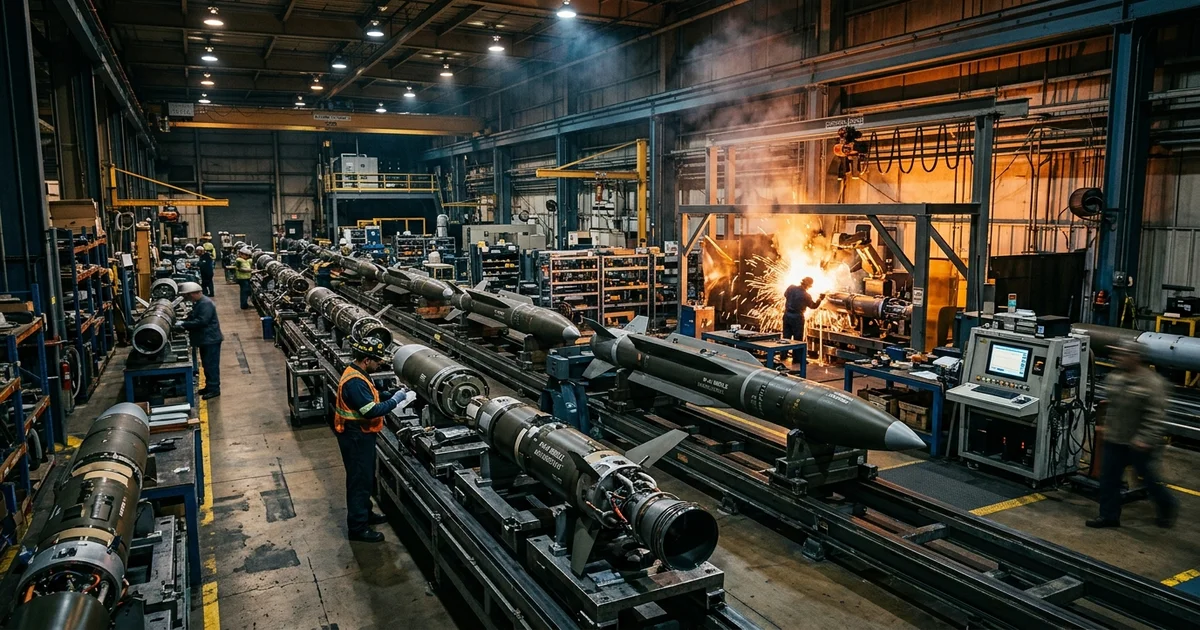
President Trump signed a memorandum invoking the Defense Production Act of 1950 to accelerate munitions production and shore up strained military supply chains, the White House disclosed Tuesday.
The move comes as the ongoing conflict with Iran has exposed deep vulnerabilities in America’s ability to manufacture weapons at the pace a modern war demands.
A Cold War Tool for a Modern Problem
The Defense Production Act grants the president sweeping authority to prioritize government contracts, allocate materials, and compel private industry to produce goods deemed essential to national defense. It was last invoked at scale during the COVID-19 pandemic to boost ventilator and vaccine production. Now the same statute is being pointed at a very different kind of supply chain bottleneck: the components that go inside missiles.
According to the presidential memo, dated June 11 and made public by the White House on Tuesday, the order delegates authority to Defense Secretary Pete Hegseth to form “voluntary agreements and plans of action” with defense manufacturers. Solid rocket motors, igniters, and guidance systems are identified as the most capacity-constrained subsystems needed for both legacy weapons and future modernization programs.
The language in the memo is blunt: “I hereby find that conditions exist which may pose a direct threat to the national defense or its preparedness programs.”
The Iran Conflict Has Burned Through Stockpiles
An April analysis by the Center for Strategic and International Studies found that the United States may have expended more than half its inventory of four critical munitions during the campaign against Iran, including Tomahawk cruise missiles. That finding alarmed defense policy analysts who had already been warning for years that America’s defense industrial base was not built for sustained high-intensity conflict.
The numbers paint a stark picture. The U.S. has been drawing down weapons reserves at a rate not seen since the early stages of the Iraq War, and the current production infrastructure simply cannot replace what is being consumed on the battlefield fast enough. It is the kind of mismatch between consumption and manufacturing capacity that defense planners have been gaming out in war college simulations for decades, only now it is happening in real time.
Hegseth, for his part, has pushed back on characterizations of the stockpile situation as a “crisis,” even while acknowledging in congressional testimony that replenishment could take “months to years.” That tension between the public messaging and the operational reality is itself revealing.
What the DPA Can and Cannot Fix
The Defense Production Act is powerful but it is not magic. It lets the government cut through procurement red tape and jump to the front of the manufacturing queue, but it cannot conjure factory capacity overnight. Building new production lines for precision-guided munitions takes years, not months, and the specialized workforce required to operate them does not materialize on command.
What the DPA can do effectively is break down the antitrust barriers that normally prevent defense companies from coordinating on supply chain issues. The order specifically notes that industrial base policy chief Michael Cadenazzi will oversee consultations with defense firms under DPA authority, enabling coordination that would otherwise run afoul of competition law.
This is where the real short-term impact is likely to land. The bottleneck in munitions production is not primarily a problem of factory floor capacity. It is a problem of sub-tier suppliers, the small and mid-sized companies that make the niche components going into guidance packages and propulsion systems. Many of these firms serve both defense and commercial markets, and without a clear signal from the government that defense orders take priority, they have little incentive to retool.
The Broader Pattern
The DPA invocation is the latest in a series of moves by the Trump administration to put the defense industrial base on a wartime footing as the Iran conflict drags on. Earlier this year, the president convened the heads of the largest American defense manufacturers at the White House and told them to “quadruple production” of what he called “exquisite class” weapons.
Whether this invocation will actually accelerate production timelines or simply create another layer of bureaucratic coordination remains to be seen. The DPA is a tool, not a solution. And the underlying problem, an industrial base that was optimized for peacetime efficiency rather than wartime surge, is going to take more than a presidential memo to fix.