
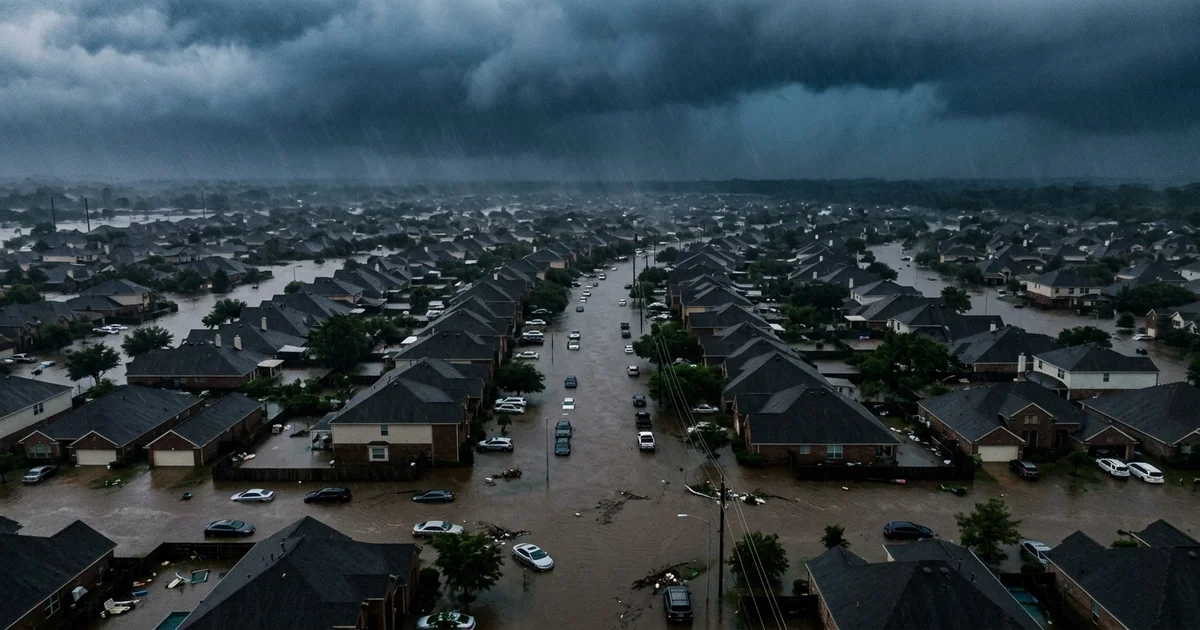
Governor Greg Abbott issued a disaster declaration Monday covering 101 Texas counties as severe storms continue to pound the state with flash flooding, destructive winds, large hail, and tornado threats.
Houston and the surrounding metro area are bracing for days of additional rainfall, with a tropical disturbance in the Gulf of Mexico carrying a 50 percent chance of cyclone development and threatening to make an already dangerous situation significantly worse.
The Scope of the Disaster
The declaration, which Abbott issued through an official proclamation, covers Harris, Fort Bend, Galveston, Montgomery, and dozens of other counties across eastern and central Texas. The move gives local officials access to state emergency resources, activates the State Operations Center for round-the-clock coordination, and signals the severity of a weather event that began on June 14 and shows no signs of easing.
One hundred and one counties is an extraordinary number. For context, Texas has 254 counties total. Nearly 40 percent of the state is now under an active disaster proclamation for a single weather event, and the worst of it may still be coming.
Houston Is the Epicenter
The Houston metro area, home to roughly 7 million people, is bearing the brunt of the storm system. Heavy rain triggered flash flooding northwest of Houston on Monday, submerging streets, stranding vehicles, and forcing school closures across multiple districts. Houston Public Media reported that forecasters expect an average of 3 to 6 inches of additional rain through Thursday morning, with isolated areas potentially receiving more.
Houston’s relationship with flooding is long, painful, and deeply personal. Hurricane Harvey dumped more than 60 inches of rain on parts of the metro in 2017, causing $125 billion in damage and killing more than 80 people. Every major flood event since then has been measured against that benchmark, and every one serves as a reminder that the city’s flood infrastructure, despite billions in post-Harvey investment, remains inadequate for the kind of extreme precipitation events that are becoming more frequent.
The Gulf Tropical Disturbance
The variable that has weather officials most concerned is a tropical low sitting in the western Gulf of Mexico. The National Hurricane Center gives it a 50 percent chance of developing into a tropical cyclone, and regardless of whether it formally organizes, it is already pumping moisture into the storm systems hitting Texas.
If the disturbance tracks northward toward the Texas coast, as some models suggest, it could dump additional inches of rain on areas already saturated by days of storms. Flash flood watches are in effect across a wide swath of southeast Texas through at least Thursday, and the National Weather Service has been issuing flash flood warnings in rapid succession as individual cells move across the region.
The Pattern Keeps Repeating
Texas has experienced catastrophic flooding with increasing regularity over the past decade. Harvey in 2017. Imelda in 2019. The Guadalupe River disaster. And now this, a multi-day onslaught that has already drawn comparisons to previous catastrophic flood events in the state.
The infrastructure conversation around Houston flooding tends to follow a predictable arc: disaster, outrage, promises, partial funding, and then the gradual erosion of urgency as the waters recede and other priorities take over. The Harris County Flood Control District has invested more than $2.5 billion in drainage improvements since Harvey, but the scale of what needs to be built to protect a sprawling, flat, concrete-heavy metro from extreme rainfall events is measured in tens of billions, not single digits.
What is different about this event, for now, is the duration. This is not a single hurricane making landfall. It is a persistent pattern of severe storms feeding off Gulf moisture, hitting the same geography repeatedly over the course of a week. That kind of sustained flooding is in some ways harder to manage than a single catastrophic event because it exhausts emergency resources, overwhelms drainage systems already at capacity, and wears down the communities trying to cope with it.
The next 48 to 72 hours will determine whether this remains a severe but manageable flood event or escalates into something worse. The tropical disturbance is the wildcard. If it develops and pushes ashore, the 101-county disaster declaration may need to grow.